
The Indian Canvas #112: One Land, Two Harvests
Two Union ministers shared a stage in Delhi this week, and the pairing was the point. On one side, the agriculture minister, Shivraj Singh Chouhan, telling the room that India's farmers must remain Annadatas - givers of food. On the other, the new and renewable energy minister, Pralhad Joshi, offering them a second title: Urjadatas, givers of energy. The occasion was the AgriVoltaics World Conference 2026, inaugurated on 21 October, and the announcement was Joshi's: "one of the world's most ambitious agrivoltaic programmes" will be launched under the next phase of PM-KUSUM, the farmer-solar scheme. The idea, in his ministry's phrase, is "one land, two harvests" - solar panels raised above the crop, electricity and food from the same field. Hold the size of that promise for a moment, because the fine print matters: as of today there is no PM-KUSUM 2.0 notification. What exists is a conference-stage commitment, plus press reporting that the target is 5 GW of dual-use capacity over three years with a 25% cost-premium subsidy (Mint, 21 October), to be folded into a wider PM-KUSUM 2.0 once the agrivoltaics component is finalised (Moneycontrol, 21 October). Nothing here is settled policy yet - it is a direction, announced out loud.
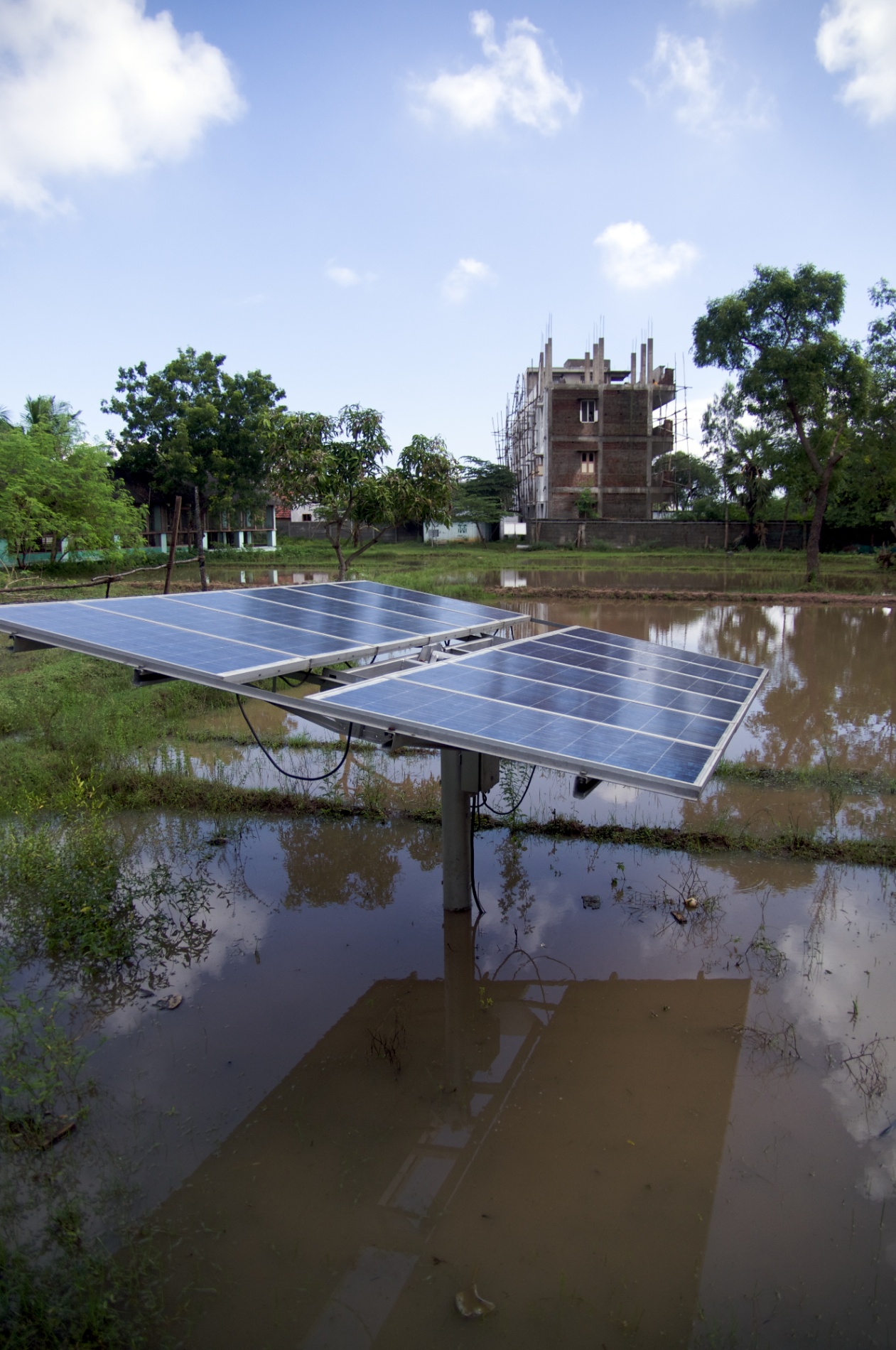
India already puts panels on farms - here a solar pump array stands over a waterlogged field. PM-KUSUM's next phase wants the panels and the crop to share the land properly. Photo: PWRDF / Wikimedia Commons, CC BY 2.0.
Why the land is the argument
India's solar programme has always had a land problem: utility-scale parks want the same flat, sunny acres that farmers farm. The numbers on the farmers' side make the competition unfair - an average holding of 0.96 hectares, with small and marginal farmers over 85% of the community (Chouhan, in the same PIB release). Agrivoltaics is the proposal to stop competing: raise the panels high enough for tractors to pass and crops to grow underneath, and the land produces both. How much both? The estimate being quoted in Delhi comes from a TERI study - and it is TERI's estimate, not a government figure - that 47.5 million hectares, about 30% of India's 160 million hectares of cropland, are technically suitable; a deployment scenario over 16 million hectares yields 12,775 TWh a year, against projected national demand of 5,250-10,020 TWh in 2050. Joshi quoted exactly these numbers on stage and, to his credit, quoted the caveat too: technical estimates, with actual deployment dependent on local conditions. His line that agrivoltaics on 10% of suitable land could meet 2050 demand (The Hindu, 21 October) is a minister's rendering of that scenario - worth reporting as his claim, not as a forecast.
The credibility test the new promise has to pass
PM-KUSUM's first phase is the reason to read phase two carefully. The scheme, launched in 2019 and scaled up in January 2024, targeted 34.8 GW of solar capacity with Rs 34,422 crore of support by March 2026. By 31 March 2026, 13.11 GW had been installed - about 38% - and projects with power purchase agreements signed by end-2025 get until March 2027 (Lok Sabha USQ 676, 22 July 2026). The split inside that number is the instructive part. The pump components did the heavy lifting: 28,38,970 irrigation pumps solarised under Components B and C by July 2026 (Lok Sabha SQ 348, 12 August 2026). But Component A - the decentralised plants of up to 2 MW on or near farmland, structurally the closest thing phase one had to agrivoltaics - limped: 10,000 MW allocated, 9,871 MW of PPAs signed, and just 1,726.92 MW actually installed by 30 June 2026. Paper agreements are not panels. If phase two is to be different, it has to solve whatever kept 83% of Component A on paper - land records, DISCOM cooperation, financing for 2-MW plants owned by people with 1-hectare fields.
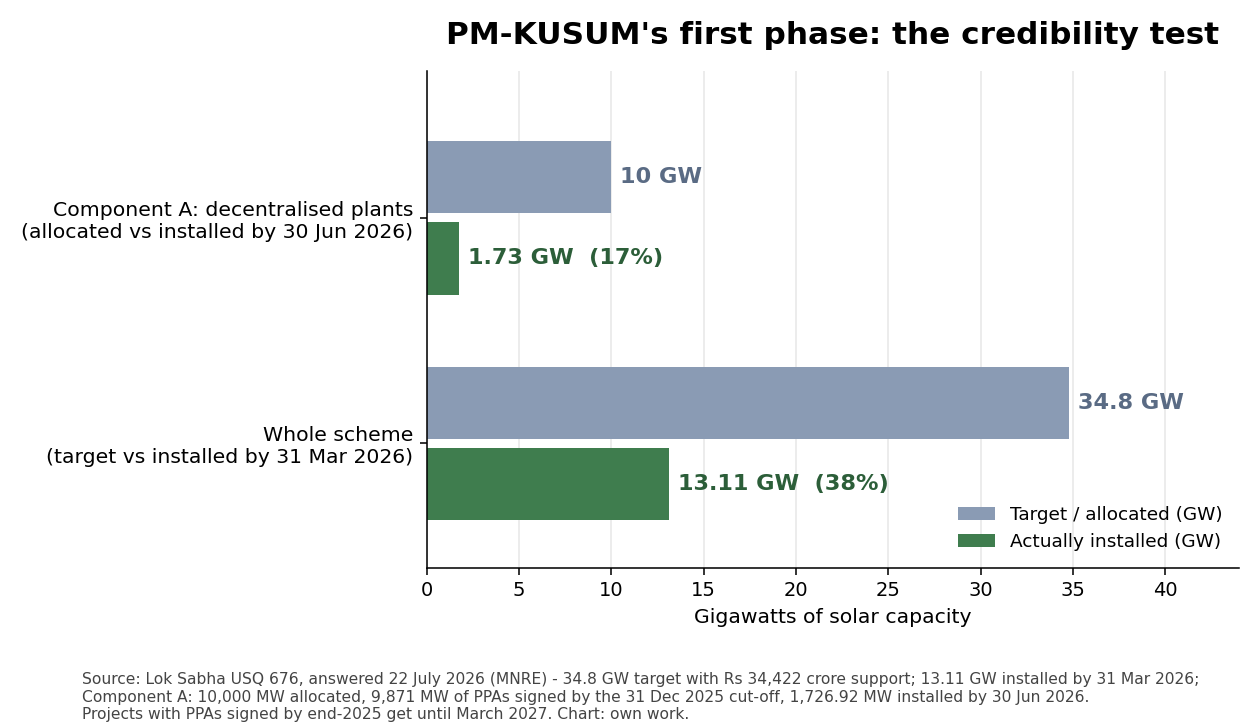
The pump components delivered; the decentralised-plant component - the closest thing to agrivoltaics - is at 17%. Chart: own work, from Lok Sabha USQ 676 (22 July 2026).
What the rest of the world actually did
The concept is not new, and its global record is more modest than the conference stage suggested - which is useful information, not discouragement. Germany invented it: Adolf Goetzberger and Armin Zastrow proposed "potatoes under the collector" in 1981, and Fraunhofer ISE built the modern reference pilot at Heggelbach farm in 2016, publishing multi-year results from crops under raised panels (Fraunhofer ISE, APV-RESOLA results). Germany also wrote the first technical standard, DIN SPEC 91434 in 2021, and now links support to continued agricultural use and minimum crop yields - but honest accounting says Germany's deployment is still pilots and tender rounds, not a countryside transformed. Japan took the small-systems road: "solar sharing" has existed since 2004, and the farm ministry permits panels on farmland only as removable structures with farming continued below - the permit count reached 4,349 by FY2021, with vegetables the most common crop underneath (Environment Ministry summary of MAFF data; MAFF's permit regime). Thousands of small systems, not gigawatts - real, but modest. France chose law: the March 2023 acceleration law made it the first country to define agrivoltaism in statute, with criteria requiring the installation to serve the parcel and remain reversible - a framework barely two years old. Joshi's own summary to the conference - an 18.4 GW global market in 2025, Italy's EUR 1.7 billion programme, Japan opening all farmland categories - is the bullish version; the owning documents show a field that is promising, young, and still mostly small.
The economics, with the hedges attached
The minister was unusually candid about the cost problem: elevated and tilted structures make agrivoltaic plants 25-30% more expensive than ordinary ground-mounted solar, and the government's intent is to bridge that gap with support for capacity creation. Against that, some agrivoltaic assessments put potential generation cost at Rs 3.20-3.30 per unit "under specific assumptions", against an average cost of electricity supply around Rs 7 in 2025-26 (both from the PIB release). The crop side of the ledger needs the most care: Joshi quoted field studies indicating yield improvements of 10-20% for certain crops and water savings around 30% "under suitable systems". Those are study results under specific systems and geographies - shade helps some crops in some climates and hurts others, and results from Japanese or German fields do not transfer to Indian heat and cropping patterns without local trials, which is precisely what Indian pilots like the CAZRI Jodhpur site exist to produce. Employment estimates - 1.10 to 3.32 lakh full-time jobs, per CSTEP's AgriPV Manual as quoted in the release - are projections on the same footing. None of this is a reason not to proceed; all of it is a reason to fund pilots and publish their data before scaling targets.
One distinction is worth a sentence, because the scheme names rhyme: this is not PM Surya Ghar, the rooftop programme that the government says crossed 63 lakh household beneficiaries by this week - there the payer is the household and the asset is the roof; here the payer is the farmer and the DISCOM feeder, and the asset is the land itself. India now runs both experiments at once, which is probably right. The farm-gate version is the harder one - it asks a ministry of energy and a ministry of agriculture to share a file, a subsidy and a definition of success. This week, at least, they shared a stage.
Sources
PIB, 21 October 2026 - AgriVoltaics World Conference 2026: Chouhan and Joshi's addresses; "one land, two harvests"; 0.96 ha average holding; TERI estimate quoted with caveats; 25-30% cost premium; Rs 3.20-3.30 vs Rs 7 per unit; yield/water study figures; global summary (18.4 GW market, Italy, Japan, Germany); CSTEP jobs estimate; PM Surya Ghar crossing 63 lakh beneficiaries; next-phase PM-KUSUM announcement language.
Mint, 21 October 2026 - 5 GW dual-use target over three years; 25% cost-neutralisation subsidy (press-reported).
Moneycontrol, 21 October 2026 - PM-KUSUM 2.0 announcement once agrivoltaics component finalised (press-reported).
The Hindu, 21 October 2026 - Joshi's "10% of suitable land" line (minister's claim).
Lok Sabha USQ 676, 22 July 2026 - PM-KUSUM: 34.8 GW target, 13.11 GW installed by 31.03.2026; extension to March 2027; Component A: 10,000 MW allocated, 9,871 MW PPAs, 1,726.92 MW installed by 30.06.2026.
Lok Sabha SQ 348, 12 August 2026 - 28,38,970 pumps solarised under Components B+C by 31.7.2026; PM Surya Ghar 51,27,843 households by 10.08.2026.
Fraunhofer ISE, 2016 and 2019 - Heggelbach pilot and APV-RESOLA results; 1981 Goetzberger-Zastrow origin per the APV Guideline. DIN SPEC 91434 (2021).
Japan Environment Ministry (citing MAFF), September 2024 - 4,349 farmland-conversion permits for solar sharing by FY2021; crop mix under panels. MAFF permit regime.
France, LOI n° 2023-175 du 10 mars 2023 and Ministry of Agriculture explainer - the statutory agrivoltaism definition and criteria.
Cover photograph: Heggelbach agrivoltaics pilot, Tobi Kellner / Wikimedia Commons, CC BY-SA 4.0. In-body: solar pump array on a farm in India, PWRDF / Wikimedia Commons, CC BY 2.0.
Responses
No responses yet - yours could be the first.
Get the notes
Occasional emails about what I'm building, what worked, and what broke.