
The Indian Canvas #121: Holding Its Breath
No submarine is part of the Hazira milestone. On 24 October, inside Larsen & Toubro's AM Naik Heavy Engineering Complex on the Gujarat coast, the Defence Secretary logged in virtually and inaugurated something called Setting to Work Phase-2 of the Energy Module of India's indigenous Air Independent Propulsion system - a fuel-cell power pack for submarines, built by the Naval Materials Research Laboratory, DRDO, sitting on a shop floor, not yet inside any boat. No submarine moved that day. And yet the ceremony matters, because of what that module promises the moment it works: a submarine that needs to breathe far less often.
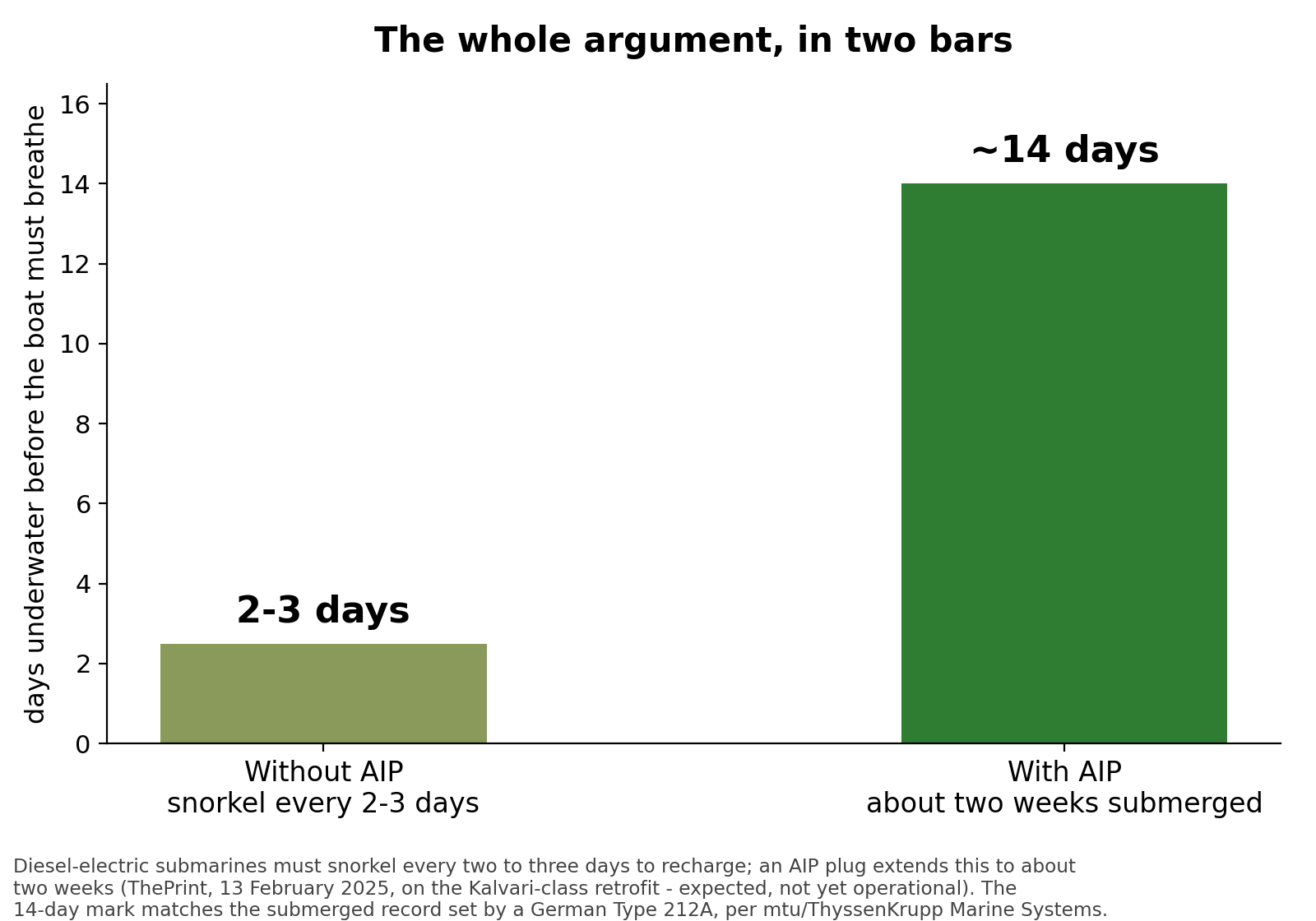
Here is the problem it solves. A conventional diesel-electric submarine is, in propulsion terms, a battery with a snorkel. Its diesels need air, so every few days - the interval depends on the design and how the boat is being used - it must come near the surface, raise a mast and run its generators - and those minutes are when it is loudest and most findable. Air Independent Propulsion breaks that rhythm: the boat can recharge without coming up, and a few days can stretch into a few weeks, depending on the design and how hard the boat is driven. That is the entire tactical argument, and it fits in a chart with two bars.
The club, named
Countries that field this technology are a small, named club, and it is worth naming them rather than gesturing at them. Sweden got there first: the Gotland class, built by Kockums - now part of Saab - was commissioned in 1996 as the world's first operational AIP submarines, using Stirling engines, per the US Naval Institute. Germany took the fuel-cell route: the Type 212A, which holds a fourteen-day submerged record according to engine-builder mtu and ThyssenKrupp Marine Systems. Japan runs license-built Kockums Stirling engines on its Soryu class, per the US Indo-Pacific Command. China has produced fifteen Stirling-powered Type 039A Yuan-class boats, per Naval Post. South Korea operates fuel-cell Type 214s and its newer KSS-III, per the Nuclear Threat Initiative's fleet accounting. Spain, the prospective member: Navantia passed factory acceptance tests for its bioethanol fuel-cell system in 2023 and is installing it first on the third S-80 boat. And then there is the member that sharpens the Indian story: Pakistan. Its third Agosta-90B, PNS Hamza, was commissioned in September 2008 with a French MESMA system - the first AIP submarine built in South Asia - and the other two boats of the class were retrofitted in 2011, per NTI. India's neighbour has held this card for eighteen years.
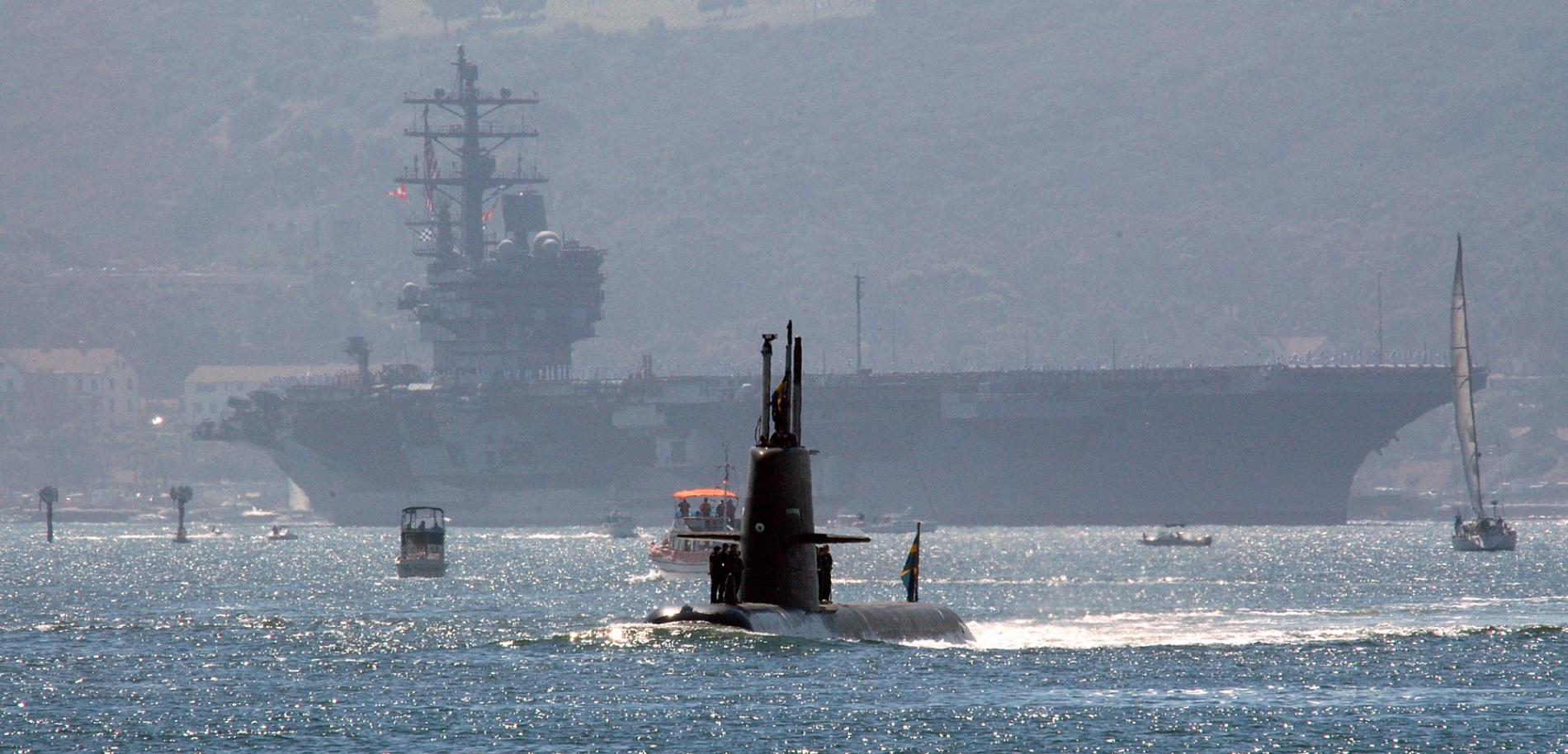
One more Swedish detail belongs here, told as reported rather than as legend. In a 2005 war game, naval press accounts say, the little Gotland ran multiple simulated attacks against the carrier USS Ronald Reagan and was never detected; the US Navy's response was to lease the Gotland and her Swedish crew for two years, 2005 to 2007, and base them in San Diego as the opposing force in anti-submarine training. A forty-year-old technology from a country of ten million embarrassed the world's most expensive warship, in simulation, because it did not have to come up for air.
The lab-to-yard route
India's way into the club is not a purchase and not a licence. It is a relay. The technology - a fuel-cell Energy Module that generates its hydrogen on demand instead of carrying it aboard, the single biggest safety hazard in such systems - was developed over more than a decade at DRDO's Naval Materials Research Laboratory. The transfer of technology was handed to L&T at Aero India 2021; in June 2023 L&T signed the contract to realise two modules, as prime industry partner, with manufacturing and factory acceptance trials at Hazira; and in December 2024 the Defence Ministry signed a Rs 1,990 crore contract with Mazagon Dock Shipbuilders, builder of the six Kalvari-class boats, to construct the AIP plug and integrate it into the class. The architecture the Indians chose - hydrogen made on board from a fuel, not stored - is the same third-generation philosophy as Spain's bioethanol system. Even the by-product is polite: water clean enough to release into the sea.
Where the programme actually is
Precision matters more than excitement here, so: no Kalvari-class submarine is at sea with this system, and none has been retrofitted yet. The remaining steps are real. The module inaugurated on 24 October will now be energised for power production and tested rigorously to the Navy's protocols; the government's release says it is then to be handed to Mazagon Dock for integration on a Kalvari-class submarine in early 2027 - that is the plan, not a fact. Integration itself is surgery: the submarine is cut open and an additional compartment, the AIP plug, is inserted during a normal refit, which is why the first candidate is likely to be the second boat of the class rather than INS Kalvari itself, whose 2025 refit went ahead without the system. ThePrint, which has tracked the delay closely, reported in February 2025 that the original plan was to fit the fifth and sixth boats on the slipway; the delay meant all six were commissioned without AIP. Then come harbour trials, sea trials, and only then a capability. The honest date for an operational Indian AIP submarine is: not yet, and not soon by naval standards.
There is also a live argument about whether fuel cells are even the final word. Japan, the US Indo-Pacific Command reports, is shifting its newest conventional submarines to lithium-ion batteries instead of AIP, judging the added speed and energy density worth more than the AIP's slow, patient endurance. India's programme is a specific bet - third-generation fuel cell, indigenous chemistry, lab-to-yard manufacturing - placed while the technology itself is still being argued over. That is not a reason the bet is wrong. It is a reason to call it a bet.
What the shop floor proves
Everything above is documented. This last part is my argument, marked as one.
The thing worth watching in this programme is not the fuel cell; it is the template. A DRDO laboratory holds the chemistry, a private heavy-engineering yard holds the manufacturing, a public shipyard holds the boat, and the Navy tests at every stage - four institutions, one relay baton, and the baton has now visibly reached the shop floor. If this module passes its Navy protocols, India has more than a quieter submarine: it has a demonstrated way to move frontier technology out of a lab and into series production without buying it abroad. L&T's own statement looks further - the remaining five Kalvari boats, and possibly other navies that operate Scorpene-class submarines. The white space in Indian defence has never been invention; it has been industrialisation. Hazira is what industrialisation looks like when it finally gets a date on the calendar.
Sometime in the next phase, engineers at Hazira will energise the module and watch the gauges. There will be no ceremony then, and no sea - those tests happen on land, in the factory. The sea comes later - first a protocol, then a plug, then a refit, then a trial. But when a Kalvari-class boat finally slips under and, if the module performs as designed, stays down for weeks where days were the limit, the day it became possible will have been this one: a Saturday in October, in a factory, with the Defence Secretary on a video link and the sea still waiting.
Sources
Press Information Bureau, 24 October 2026: Indigenous AIP system achieves STW-2 milestone at L&T Hazira (next phase: energising, Navy-protocol tests, handover to MDL planned early 2027)
Larsen & Toubro, 22 June 2023: DRDO-L&T contract for two AIP modules (on-demand hydrogen; ToT at Aero India 2021; five remaining boats; export possibility)
ThePrint, 13 February 2025: INS Kalvari refit without AIP (Rs 1,990 crore MDL plug contract; cut-and-insert integration; second boat the likely first candidate)
USNI Proceedings, October 2023: Sweden's Gotland class, AIP pioneers (first operational AIP class, 1996; US Navy lease 2005-2007)
Naval Post, 14 September 2021: how Gotland hunted a US carrier in a 2005 war game (simulated attacks, reported account) and USNI (the lease that followed)
mtu / ThyssenKrupp Marine Systems: underwater propulsion (Type 212A fuel cells; 14-day submerged record; snorkel cycle)
US Indo-Pacific Command: Japan's switch from AIP to lithium-ion (Soryu-class Stirling AIP license-built by Kawasaki)
Navantia, 15 September 2023: S-80 AIP BEST passes factory acceptance tests (bioethanol fuel cell; three weeks submerged; S-83 first)
NTI: South Korea submarine capabilities (Type 214 and KSS-III fuel-cell AIP) and NTI: Pakistan submarine capabilities (PNS Hamza, 2008, first AIP submarine built in South Asia; 2011 retrofits)
Responses
No responses yet - yours could be the first.
Get the notes
Occasional emails about what I'm building, what worked, and what broke.