
The Indian Canvas #103: The 218 Million Tonne Question
On a January morning in 2025, a cargo vessel named MV Trishul nosed into Pandu, the river port of Guwahati, with two dumb barges - Ajay and Dikhu - in tow. Between them they carried 1,500 tonnes of cement from Kolkata. Nothing about the cargo was unusual. The route was: to reach Assam, the vessel had left the Hooghly, crossed into Bangladesh, travelled up that country's rivers under a bilateral transit protocol, and re-entered India on the Brahmaputra. It was the first sailing completed under a fixed-day scheduled freight service the government had flagged off three weeks earlier, and it was meant to prove a point - that an Indian river could be a timetable, not a gamble.
That point got a much bigger headline this month. On 16 October, the Press Information Bureau announced that cargo moved on India's National Waterways had risen from 29 million tonnes in 2014-15 to 218 million tonnes in 2025-26 - a compound growth rate of 20.13%, and enough to cross, roughly four years early, the 200-million-tonne target that Maritime India Vision 2030 had set for the end of the decade.
Two hundred and eighteen million tonnes. When I read the release, my first reaction was disbelief - that is more bulk cargo than the Rhine barges lift out of Rotterdam, Europe's busiest port. My second was a question: where exactly is all of it moving? The answer to that question turns out to be the whole story.
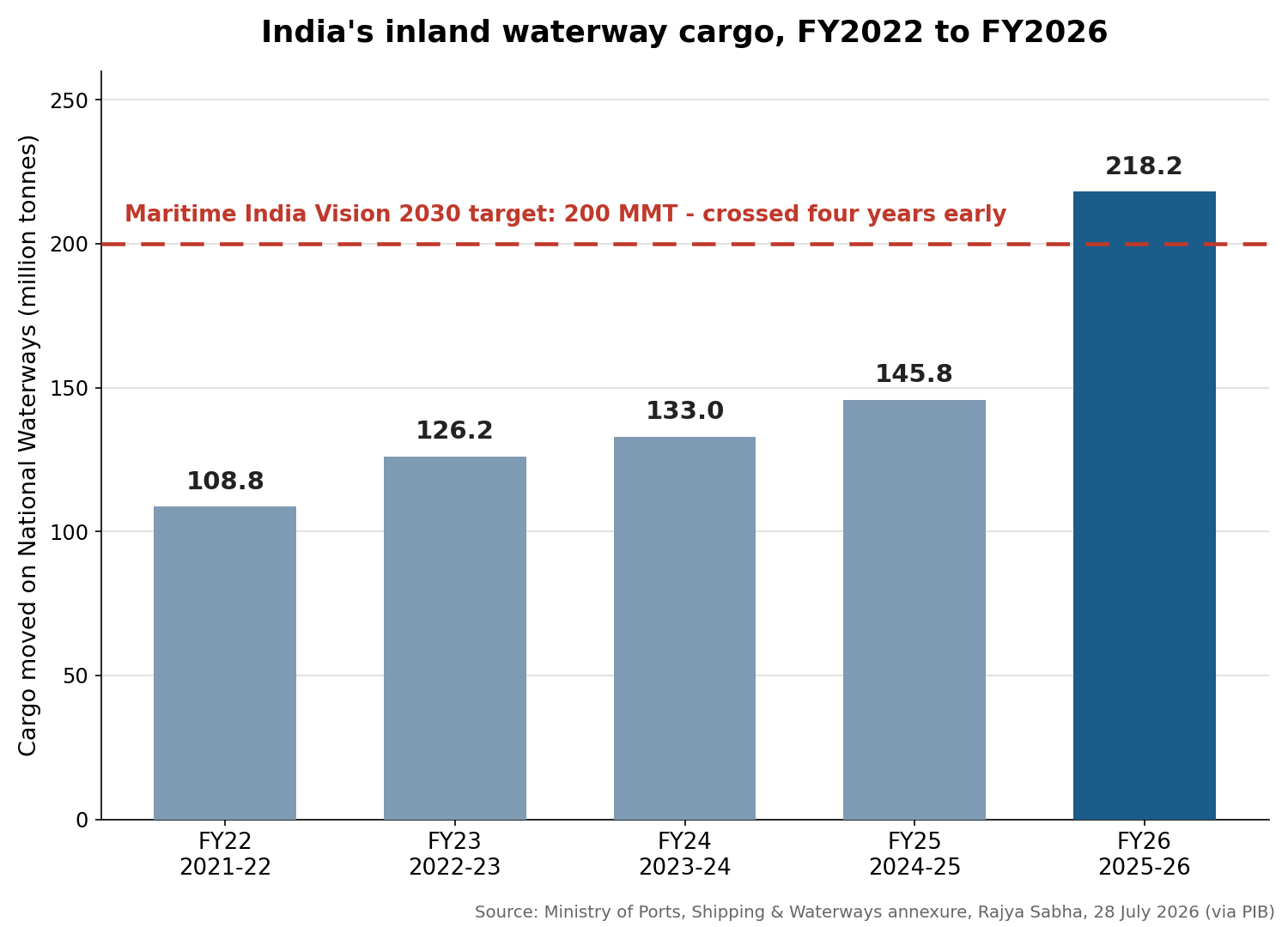
National Waterways cargo, FY2022 to FY2026, against the Maritime India Vision 2030 target of 200 MMT. Source: Ministry of Ports, Shipping & Waterways annexure, Rajya Sabha, 28 July 2026 (via PIB).
Reading the number closely
The ministry's own detailed table, placed before the Rajya Sabha on 28 July 2026 (PIB, annexure), breaks the 218.24 million tonnes down by waterway, and the shape is striking. Four waterways - the Ganga system (NW-1, 84.78 MMT), the Tapi (NW-100, 34.75 MMT), the Shastri-Jaigad creek system (NW-91, 34.41 MMT) and the Amba river (NW-10, 31.07 MMT) - carried, by my calculation from the annexure, about 85% of everything. The three western rivers are short, tidal, deep enough year-round, and lined with industry: coal, ore and aggregates shuttling between plants and the ports at the rivers' mouths. They work for the least glamorous reason in logistics - the factory already sits on the bank.
The Ganga's figure is the eye-catcher: 84.78 million tonnes in 2025-26, a five-fold jump in a single year from 16.38 MMT the year before, making it India's busiest waterway on paper. I want to be careful here, because the official table records the jump but no government release I could find breaks down what drove it - which commodities, which stretches, how much of it is the tidal lower river near Haldia versus the long dredged channel up to Varanasi. Until that breakdown exists, the honest thing is to hold both facts at once: the jump is in the government's own annexure, and its composition is not publicly explained. (The IWAI cargo dashboard shows the new level persisting - 96.57 MMT across all waterways in just the first five months of 2026-27.)
What vessels carry, nationally, is clearer: government cargo-composition data reported for 2024-25 had coal at about 27%, iron ore fines 18%, iron ore 9%, sand 8% and fly ash 6% - heavy, slow, cheap bulk that does not mind a river's pace. That is the natural cargo of waterways everywhere.
The other number: 1,057 tonnes
Now hold that against a second number. The multimodal terminal at Ramnagar, Varanasi - the flagship of the Jal Marg Vikas Project on NW-1, inaugurated in November 2018 with a rated capacity of 1.26 million tonnes a year, per the Inland Waterways Authority of India - was projected in its own detailed project report to handle 3.55 million tonnes a year by 2020 and 3.82 million tonnes by 2025. An RTI response in early 2020 revealed it had handled 282 tonnes in its first fourteen months (Indian Express). And an analysis of IWAI's own cargo portal by the research group Manthan Adhyayan Kendra, reported by Mongabay-India in April 2026, found that between November 2018 and December 2025 the terminal moved about 1,057 tonnes in total - with just two shipments flagged off in all of 2024-25.
One thousand and fifty-seven tonnes, over seven years, from the terminal built to anchor a river highway. A single day's flow on the Tapi moves more.
The reasons are not mysterious; the government has listed them itself. Answering Parliament in December 2025, the ports minister named the obstacles on NW-1: seasonal flow variation, barrages without navigation locks, no cargo for the return journey, low industrialisation along the waterway, first- and last-mile connectivity costs, and low private participation. In the Rajya Sabha in 2022, the same ministry said the Varanasi-Prayagraj stretch is navigable for only six months a year. A river is not a road: its channel shifts, splits around sandbars and shallows, so the IWAI runs continuous thalweg surveys - mapping the deepest navigable line, now across 22 waterways - and dredges perpetually. It has spent Rs 767.52 crore dredging NW-1 alone, and a parliamentary standing committee has warned that maintenance funding, at Rs 267 crore, looks insufficient, with some dredging tenders cancelled because bids overshot estimates. The 16 October PIB release is candid that keeping a fairway means measuring the river forever.
What the Rhine does differently
For a sense of what mature river freight looks like, I went back to the Central Commission for Navigation on the Rhine's market observation. In 2024, 91,356 inland vessels called at the Port of Rotterdam, moving 141.9 million tonnes by barge. In 2023, inland shipping carried 35.7% of everything the port handled - behind only pipelines, and nearly double road's share - including 30.5% of the containers moving to and from the hinterland. Antwerp's barge share of port throughput hit 51% in 2024, its highest since 2019.
The Rhine's advantage is not technology. It is that two centuries of river training made its depth boringly predictable, and Europe's heavy industry - the Ruhr's steel, the chemical complexes at Ludwigshafen - grew up directly on the bank, so the barge is the default and the truck is the exception. Nobody had to subsidise a steel mill into noticing the river outside its gate.
That is exactly the pattern inside India's own data, and this is my reading, not an official finding: the waterways that carry real tonnage - Tapi, Shastri-Jaigad, Amba, the tidal lower Ganga - are the ones where industry already touches navigable water. Cargo appears where a plant gate meets a jetty. It does not appear because a terminal exists at the end of a dredged channel, however well built. Varanasi's terminal is a fine piece of engineering waiting for an industrial reason to exist.
Paying to prove the river
Which is what makes the government's newest lever interesting, because it is aimed at the demand side, not the concrete. The Jalvahak scheme, launched in December 2024, reimburses cargo owners up to 35% of their operating expenditure for moving freight more than 300 km on the Ganga, Brahmaputra and Barak waterways, explicitly encouraging them to hire private vessels rather than state-owned ones. Alongside it runs the fixed-day scheduled service MV Trishul inaugurated: Kolkata to Patna in seven days, Patna to Varanasi in five, Kolkata to Pandu in eighteen. The budget is modest - Rs 95.4 crore to shift 800 million tonne-kilometres by 2027, about 17% of the network's current 4,700 million tonne-kilometres - but the design is honest about the chicken-and-egg problem: shippers will not commit without a reliable service, and operators will not run one without cargo. So the state pays for both, briefly, and publishes the timetable.
Around it, the enabling stack keeps filling in: a new navigation lock at Farakka inaugurated in October 2023; 53 community jetties operational under the Arth Ganga initiative by November 2025; India's first riverine lighthouses announced for the Brahmaputra in March 2026; 312 solar-powered buoys already lighting Kerala's NW-3 for round-the-clock navigation. And the cargo is getting more interesting than coal: containers of PepsiCo products reached Varanasi back in November 2018; in February 2026 a 189-tonne over-dimensional consignment for Tata's semiconductor facility in Assam moved up the protocol route, and a month later Tata Steel shipped 1,500 tonnes of slag and TMT bars to Pandu for L&T - reported movements that show the one road cargo rivers genuinely beat: the oversized kind.
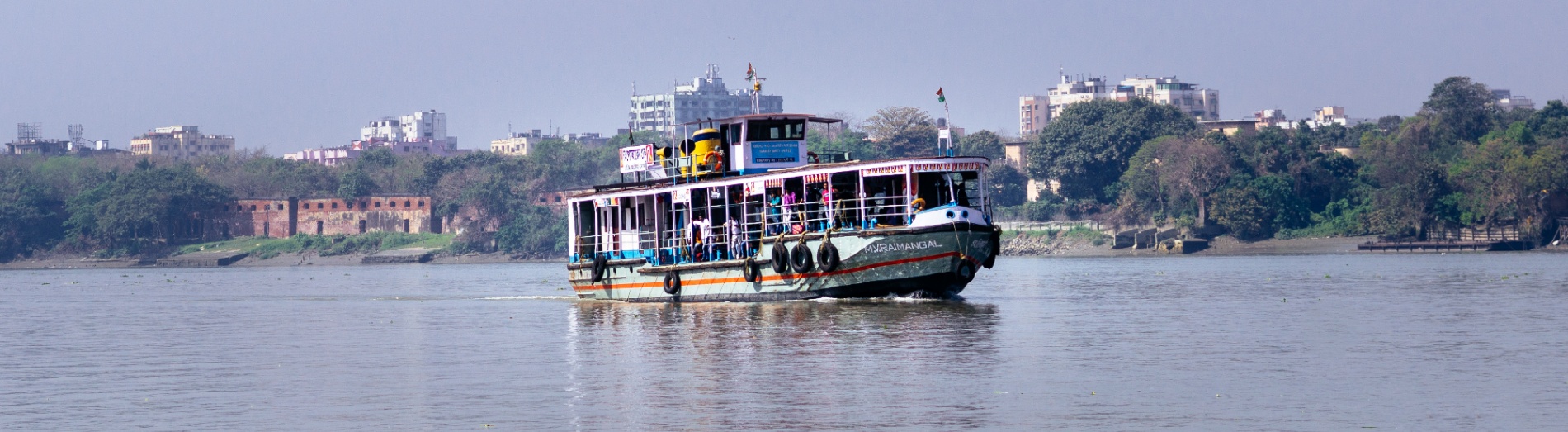
The river as daily infrastructure: a passenger ferry on the Hooghly in Kolkata. NW-1 carried 4.91 crore passengers in 2025-26, most of them on ferries like this one. Photo: Subhrajyoti07, CC BY-SA 4.0, via Wikimedia Commons.
The conversion still to come
Here is the thing that stays with me. The Rajya Sabha annexure records that NW-1 carried 4.91 crore passengers in 2025-26 - more than the populations of most countries, crossing the Ganga system on ferries every day. Assam's Brahmaputra waterway carried another 88.7 lakh. People never abandoned these rivers; the ferry never stopped being how the delta moves. It is freight that has to be won back, and freight is unsentimental: it goes where the arithmetic is cheapest once reliability is proven.
So the 218 million tonnes is real, and so are the 1,057 tonnes at Varanasi. One number says India has built serious waterborne capacity where geography already favoured it. The other says the flagship river highway is still a bet - on dredging holding, on return cargo appearing, on a subsidised timetable becoming an unsubsidised habit before the scheme's three years run out in 2027. Maritime Amrit Kaal Vision 2047 wants waterways carrying 5% of India's freight, up from about 2% today, and 500 million tonnes a year. Whether that happens will be decided less by how many waterways are declared - 111 and counting, of which 32 are operational - than by how many factories, over the next decade, decide to build their gates on the bank.
On the evidence so far, the cement for Assam is more likely to keep sailing than the terminal at Ramnagar is to fill up. But I would not have bet on a five-fold jump on the Ganga in a single year either. The river is full of surprises; that is precisely the problem, and the promise.
Sources
Press Information Bureau, "Navigating India's Waterways: Building a Safer, Smarter Network", 16 October 2026 - 218 MMT in 2025-26 vs 29 MMT in 2014-15, 20.13% CAGR, MIV-2030 target crossed; 111 NWs / 20,187 km / 32 operational; thalweg surveys; Brahmaputra lighthouses; Kerala buoy network; LAD explainer; freight cost comparisons.
PIB, Rajya Sabha answer with NW-wise annexure, July 2026 and the annexure PDF (28 July 2026) - waterway-wise cargo FY22-FY26 (NW-1 84.78 MMT etc.), funding, passenger traffic, 32 operational NWs / 5,155 km.
PIB, Jalvahak cargo promotion scheme launch, 15 December 2024 - 35% OpEx reimbursement, >300 km, NW-1/2/16; Rs 95.4 crore; 800 million tonne-km target; fixed-day scheduled service timings; launch vessels and cargoes.
Mongabay-India, "Hopes for inland waterways transport fall short as operational challenges rise", 13 April 2026 - Varanasi MMT throughput Nov 2018-Dec 2025 (Manthan Adhyayan Kendra analysis of IWAI portal), minister's December 2025 Lok Sabha answer on challenges, dredging spend, standing committee findings, RS 2022 answer on the Varanasi-Prayagraj stretch.
The Indian Express, "Varanasi port lags in cargo handling, finds RTI", 3 March 2020 - 282 tonnes in the terminal's first fourteen months; DPR targets.
CCNR / European Commission, Inland Navigation Market Observation, chapter 5 (2025 edition) - Rotterdam, Antwerp and North Sea Port barge volumes and modal splits.
IWAI, NW-1 JMVP terminals - Varanasi terminal Phase-I capacity 1.26 MMTPA.
Chapter1 Magazine, "India's rivers are becoming freight highways again", 1 September 2026 - reported cargo composition for 2024-25, Tata over-dimensional consignment (Feb 2026), Tata Steel slag/TMT movement (Mar 2026), Farakka lock, Arth Ganga jetties, Economic Survey 2025-26 references. Secondary source; used with attribution.
PIB, "India's Record Cargo Movement on Inland Waterways Achieves 145.5 million tonnes in FY 2024-25", 24 April 2025 - modal share ambition from 2% to 5%.
IWAI cargo dashboard (Car-D) - 96.57 MMT moved in FY 2026-27 till August.
Responses
No responses yet - yours could be the first.
Get the notes
Occasional emails about what I'm building, what worked, and what broke.