
The Indian Canvas #116: Very Close, Very Far
On 8 October, at Bharat Mandapam in New Delhi, the Union Health Minister stood before a new volunteer army - more than 58,000 young people being enrolled into Joint Squad for Health teams, drawn from My Bharat and the NCC - and declared that India is "very close" to eliminating tuberculosis, needing only "a last push." Here is what very close means in numbers. India's own National Strategic Plan, adopted in March 2017, defined the 2025 elimination target as 44 TB cases per lakh of population. The actual figure, as the minister himself told the Rajya Sabha in August, citing WHO's Global TB Report 2025, is 187 per lakh - and the World Health Organization's technical definition of elimination, the one the United States adopted when it set its own goal, is fewer than 0.1 cases per lakh: one case per million people. Elimination is a defined term, not a vibe. On the definition India set for itself, it ended 2025 four times over target. On the definition the science uses, the distance is longer still.
The deadline that moved
India's promise was genuinely ambitious - 2025 was five years ahead of the WHO's own End TB timeline - and its missing was genuinely quiet. As IndiaSpend documented on World TB Day this March, the country recorded about 2.7 million TB cases in 2025, an incidence of roughly 185 per lakh, and the programme's latest progress update simply reverted to the global 2030 target. No announcement marked the retreat; the goalposts moved inside a document. Yet flatten this into a government-failure story and you lose the truth, because the delivery record over the same decade is real and independently verified. Between 2015 and 2024, India's TB incidence fell 21% - from 237 to 187 per lakh - against a global decline of 12%. Mortality fell from 28 to 21 per lakh. Treatment coverage rose from 53% to 92%, well above the global 78%. Case notifications, the programme's eyes, have climbed to record levels: 25.52 lakh in 2023, 26.18 lakh in 2024, 26.37 lakh in 2025.
The programme India built to get here is substantial. Since December 2024, the TB Mukt Bharat Abhiyaan has screened over 20 crore vulnerable people and diagnosed more than 28 lakh patients. Drug-resistant cases now get the six-month BPaLM regimen instead of years of toxic injections. Handheld X-ray machines with AI readouts tour high-risk communities; every presumptive case is meant to get a molecular NAAT test. Patients receive Rs 1,000 a month in nutritional support. And the panchayat-by-panchayat certification drive has declared 67,933 gram panchayats TB-free. Even the programme's worst years show institutional muscle: when Covid collapsed TB notification by 25% in 2020 - 1.81 million cases notified against 2.4 million the year before, with monthly notifications down 39% at the peak, as WHO's India office recorded - the system improvised doorstep drug delivery and bidirectional screening, and was back at pre-Covid notification levels within a year.
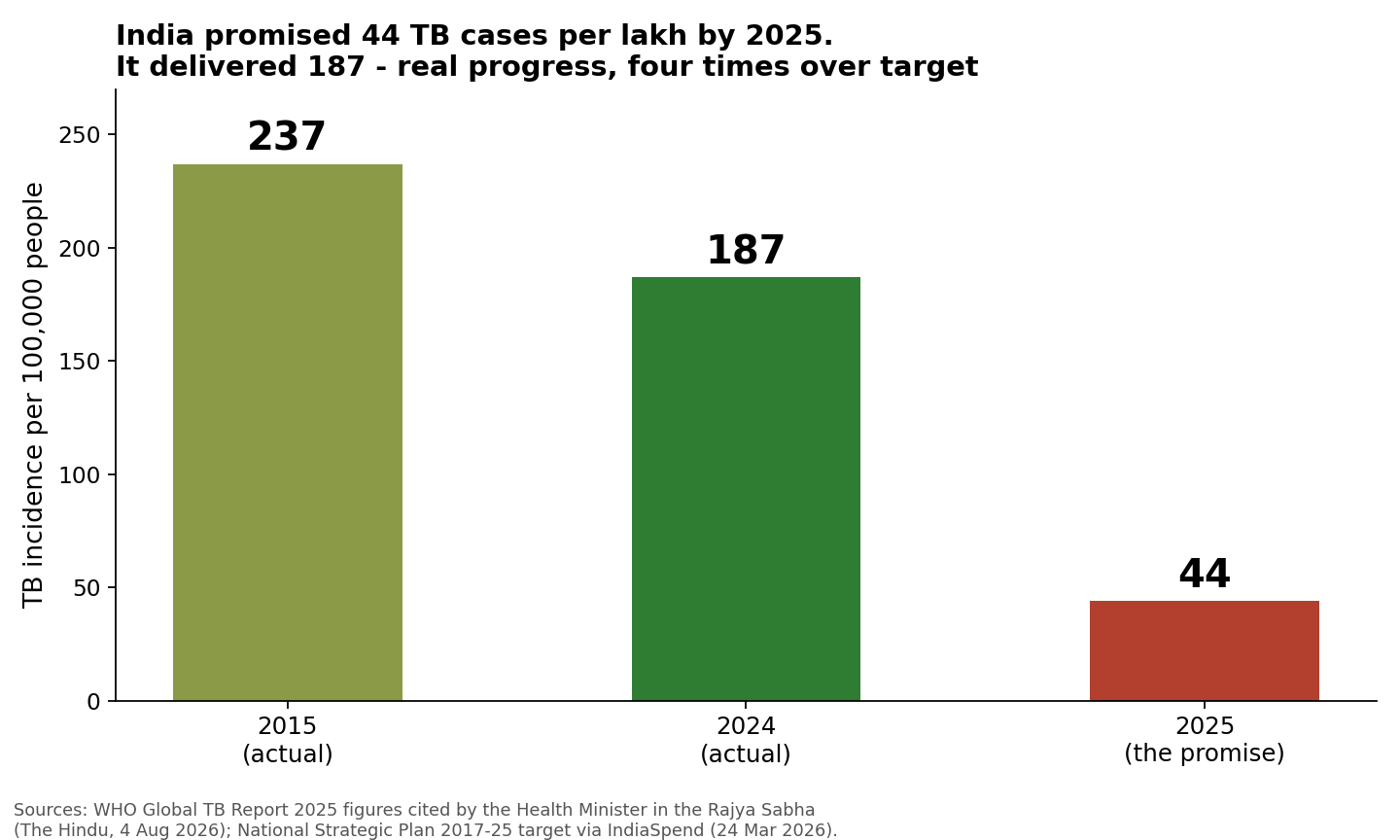
India's TB incidence per 100,000 people: 237 in 2015, 187 in 2024, against the National Strategic Plan's 2025 elimination target of 44. Sources: WHO Global TB Report 2025 cited in the Rajya Sabha (The Hindu, 4 Aug 2026); NSP target via IndiaSpend (24 Mar 2026).
Why the last mile is the slowest
So why, with all this machinery, does India still miss its own deadline by a factor of four? Because the remaining problem is precisely the one campaigns find hardest: the patients the system has never yet reached. Researchers modelling India's TB care cascade found that roughly half of all patient losses happen at the very first gap - people with active TB who never access a test at all, lost before any of the programme's impressive treatment statistics can apply to them. They are the asymptomatic, the stigmatized, the daily-wage worker who cannot afford a diagnostic visit, the migrant between two states' records. Every downstream triumph - 92% treatment coverage, six-month regimens, AI X-rays - operates only on the population that enters the door. The JOSH volunteers launched this month, tasked with active case-finding across all blocks in 55 districts of 11 states, are the programme's explicit admission of where the battle now sits: not in the clinic, but in the lane.
What the rest of the world learned
Two comparisons calibrate both the miss and the method. The tempering case is the United States, which shows how long elimination takes even where money is not the constraint. In 1989, the CDC's advisory council set a national goal to eliminate TB by 2010, defining elimination as under 0.1 case per 100,000 people. When 2010 arrived, the CDC's own assessment records the outcome plainly: the goal "was not met" - the rate stood at 3.6 per 100,000 despite decades of decline, and Washington's response was to set new, realistic target dates rather than pretend. The richest health system in history has now spent more than 35 years not eliminating a curable disease. Missed deadlines in TB are the rule, not an Indian exception; what distinguishes programmes is whether the machinery keeps improving after the deadline slips.
The instructive case is Peru, which proves the community bet works. Facing a high-burden epidemic in 1991, Peru built its response around community-based directly observed treatment - neighbours and local health workers watching every patient complete every dose. Within a decade, new pulmonary TB cases were falling across the country, at a national rate of at least 5.8% a year and between 1.9% and 9.7% across departments, and the canonical study of the programme estimates 158,000 cases and 91,000 deaths among smear-positive patients were averted between 1991 and 2000 - the first demonstration anywhere that intensive community treatment could bend the TB curve in a high-burden nation. Peru's lesson lands squarely on India's current design: the volunteers, the panchayat certifications, the Ni-kshay Mitras are the right mechanism. But Peru's other lesson is the timeline - its decline compounded over ten uninterrupted years of the same method. A hundred-day campaign starts the engine; only a decade of it arrives.
The test
The honest measure of India's TB programme is not whether it met a deadline no country has ever met on schedule. It is the distance between two numbers anyone can track in the WHO's annual report: 187 per lakh, and 44. The deadline has moved to 2030, the global date India originally set out to beat. Between here and there lies the hardest population in public health - the unreached. The programme now has the regimen, the diagnostics, the money and, as of this month, 58,000 new volunteers aimed at exactly that gap. What it needs from the rest of us is the discipline to measure it by the gap closing, not by the proximity of the applause.
Sources
DD News, 8 October 2026 - Nadda: India "very close" to eliminating TB; JOSH teams launched with 58,000+ My Bharat and NCC volunteers; pilot across all blocks in 55 districts, 11 states; 67,933 gram panchayats declared TB-free; treatment coverage 92% vs 78% global.
The Hindu, 4 August 2026 - Nadda to Rajya Sabha, citing WHO Global TB Report 2025: incidence 237/lakh (2015) to 187/lakh (2024), -21% vs -12% global; mortality 28 to 21/lakh; treatment coverage 53% to 92%; notifications 25.52 lakh (2023), 26.18 lakh (2024), 26.37 lakh (2025).
IndiaSpend, 24 March 2026 - ~2.7 million cases in 2025 (~185/lakh) vs NSP 2017 target of 44/lakh incidence and 3/lakh mortality; target reset five years to the SDG date; care cascade: half of patient losses occur before any test is accessed.
PIB, World TB Day, 24 March 2026 - TB Mukt Bharat Abhiyaan: 20 crore+ screened, 28 lakh+ diagnosed since 7 December 2024; 46,118 gram panchayats certified TB-free for 2024; BPaLM regimen; AI-driven screening tools.
WHO India, 25 March 2022 - Covid disruption: TB notification fell 25% in 2020 (1.81M vs 2.4M in 2019); 39% decline in average monthly notifications at peak; recovery to pre-Covid levels by 2021.
CDC, MMWR, 25 March 2011 - United States: elimination goal set 1989 (under 0.1 case per 100,000 by 2010); "was not met" - 2010 rate 3.6 per 100,000; new realistic target dates to be set.
Suarez et al., Journal of Infectious Diseases, 2001 - Peru 1991-2000: pulmonary TB incidence declined nationally at 5.8% or more per year (department range 1.9-9.7%); ~158,000 cases and ~91,000 deaths averted among smear-positive patients; first proof intensive short-course community treatment prevents TB at scale in a high-burden country.
Responses
No responses yet - yours could be the first.
Get the notes
Occasional emails about what I'm building, what worked, and what broke.