
The Indian Canvas #128: The Card and the Missing Middle
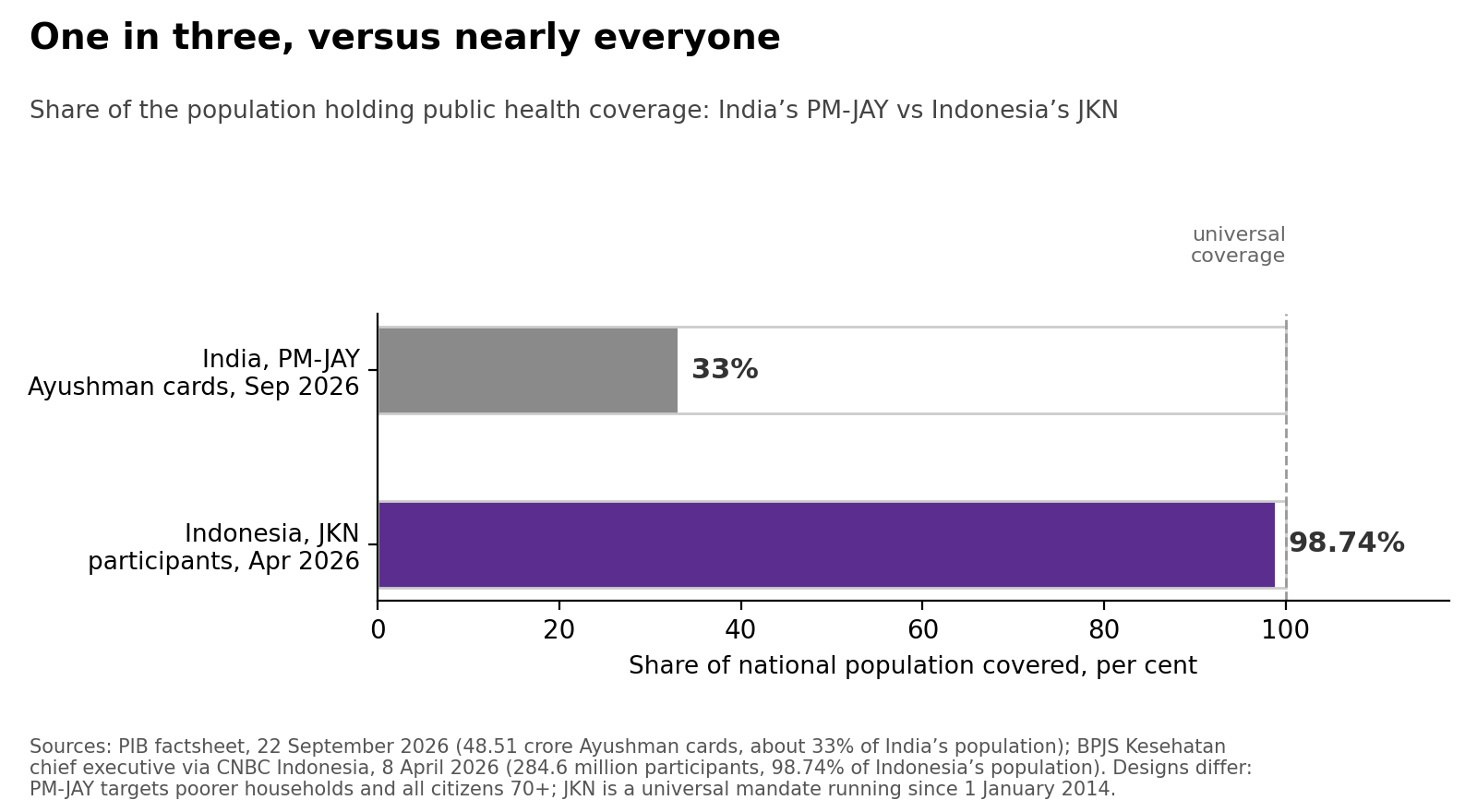
On 23 September, the Ayushman Bharat PM-JAY turned eight. The government's anniversary factsheet carries a number worth sitting with: over 48.51 crore people, about a third of India's population, now hold an Ayushman card entitling their family to Rs.5 lakh a year of cashless hospitalisation at more than 38,000 empanelled public and private hospitals. Since launch, the scheme has funded about 13.25 crore admissions, with treatment worth up to Rs.2.03 lakh crore.
I want to spend this issue on what kind of instrument that card is, because it is not the obvious one. The default way governments expand healthcare is to build: more hospitals, more posts, more budgets. PM-JAY barely builds anything. It buys.
The state as a customer
PM-JAY's mechanism is demand-side. The scheme identifies eligible households from the Socio-Economic Census 2011 - rural families meeting deprivation criteria, urban workers in eleven informal occupations - plus specific groups added since: ASHA and anganwadi workers, road accident victims, waste pickers, particularly vulnerable tribal groups. For those families, the state becomes a purchaser. Any empanelled hospital, public or private, anywhere in the country, gets paid a fixed package rate for treating them, with no cash changing hands at the bedside. The money follows the patient, and a hospital that treats shabbily loses the revenue to the one next door. That portability, across states and across the public-private line, is the part of the design that has no real precedent in Indian welfare.
The expansions tell you where this is heading. In 2024 the scheme dropped its income test for one group entirely: every Indian aged seventy or above, roughly 6 crore people, became eligible regardless of means, and 1.36 crore of them already hold Vay Vandana cards. The 2026-27 budget estimate is Rs.9,500 crore. Meanwhile the supply side runs on a separate track - the PM-ABHIM mission's Rs.64,180 crore (2021-26) for health infrastructure, and 97.61 crore digital health IDs issued under the Ayushman Bharat Digital Mission as of mid-September. The government is building and buying at once, but it is the buying arm that carries the coverage numbers.
The neighbour that went universal first
Indonesia chose the other sequencing, and its experience is the most instructive caution available. Its Jaminan Kesehatan Nasional launched on 1 January 2014 as a universal mandate: everyone enrols, formal workers and employers pay premiums, the state pays for the poor. By April this year, 284.6 million people - 98.74 per cent of the population - were registered, according to the insurer BPJS Kesehatan's chief executive. In coverage terms, it is the largest single-payer buildout in the world, completed in about twelve years.
The cost of that achievement is chronic, and honest accounting matters here. BPJS recorded an audited deficit of about Rp 10.93 trillion in 2024 and an unaudited Rp 14.49 trillion in 2025; by February 2026 its claims ratio had reached 111.8 per cent, and premiums have not been adjusted since 2020. On 29 September, Reuters reported the government will inject Rp 20 trillion, about $1.1 billion, in October and November to keep hospital claims flowing. The Jakarta Post's assessment this month was blunt: bailouts and premium hikes buy time, and only standardized care and smarter purchasing keep national health insurance solvent. Universality, Indonesia shows, is the easy half. Paying for it every year, forever, is the hard half.
The missing two-thirds
Which brings the question back to the chart. Two-thirds of India holds no Ayushman card. Some are covered by other arrangements - CGHS, ESI, state schemes, employer or private insurance. But a wide band of the country sits in the gap: not poor enough to qualify on SECC deprivation criteria, not formally employed enough to be insured any other way. Health economists call them the missing middle, and they are exactly the households a single large hospital bill hits hardest. Indonesia's answer was to close that gap by mandate and absorb the deficit; India's answer, so far, has been to hold the line at targeting and let the budget stay bounded.
My read
My opinion, plainly marked: the Vay Vandana decision is the most consequential thing that has happened to this scheme since launch, more than any admission statistic. It is the first time PM-JAY abandoned the income test for an entire demographic, and it establishes the template - universal coverage, category by category - for whatever comes next. Indonesia demonstrates both halves of that future. Its 98.74 per cent shows a middle-income country can register essentially everyone; its deficits show what happens when coverage runs ahead of premium discipline and cost control. India has so far bought the cautious version: a third of the country, a fixed budget line, package rates that cap the state's exposure per admission. Whether that caution is wisdom or delay depends on what the missing middle experiences at the hospital door. If India expands the card the way it expanded to seniors, the honest question is not whether it can afford to, but whether it has noticed that Indonesia's bill arrives every year, in the finance ministry rather than the health ministry.
Sources
Progressing Towards Universal Health: eight years of Ayushman Bharat, Press Information Bureau factsheet, 22 September 2026
BPJS Kesehatan chief: JKN participants 284.6 million, 98.74% of the population, CNBC Indonesia, 8 April 2026
Indonesia to inject $1.1 billion into health insurer BPJS Kesehatan, Reuters, 29 September 2026
What it will take to make JKN financially sustainable, The Jakarta Post, 19 October 2026
JKN running since 1 January 2014, Ministry of Health, Republic of Indonesia
Responses
No responses yet - yours could be the first.
Get the notes
Occasional emails about what I'm building, what worked, and what broke.