
The Indian Canvas #118: Growing Everywhere Except at Home
There is a number in the Reserve Bank of India's latest annual report that I have not been able to leave alone. On 31 March 2026, the total stock of retail digital rupee in circulation in India stood at Rs 771.66 crore. A year earlier, on 31 March 2025, it had stood at Rs 1,016.46 crore. India's central bank digital currency, the e-rupee, shrank by almost exactly a quarter last year.
The same annual report, sometimes in the same chapter, describes a central bank moving briskly in the opposite direction. A memorandum of understanding signed with Singapore. Cross-border pilot talks with the United Arab Emirates. Two Bank for International Settlements projects joined. A tokenisation platform built, a sandbox opened, government subsidies flowing through programmable digital money in three states and territories. The institution is expanding its digital currency in every direction except the one its balance sheet measures. That paradox is this story.
The number that went down
The figures come from the Reserve Bank's audited financial statements, Schedule 5, "Notes Issued", where the e-rupee appears as a line item among the banknotes the central bank has put into the world. CBDC-R, the retail digital rupee, is reported at Rs 1,016.46 crore for 31 March 2025 and Rs 771.66 crore for 31 March 2026. The decline of 24 per cent between those two dates is my calculation from the same table.
Cash grew in the same year, and digital payments surged. Physical notes in circulation rose from Rs 36,86,799.39 crore to Rs 41,23,983.55 crore, up 11.9 per cent, again my calculation from Schedule 5. The Unified Payments Interface crossed 200 billion transactions for the year, growing 30 per cent in volume, and now carries nearly 86 per cent of all retail payment transactions in the country. Against those numbers, the retail e-rupee is not a competitor or even a rounding error's rival: Rs 771.66 crore is about two-hundredths of one per cent of the cash in circulation.
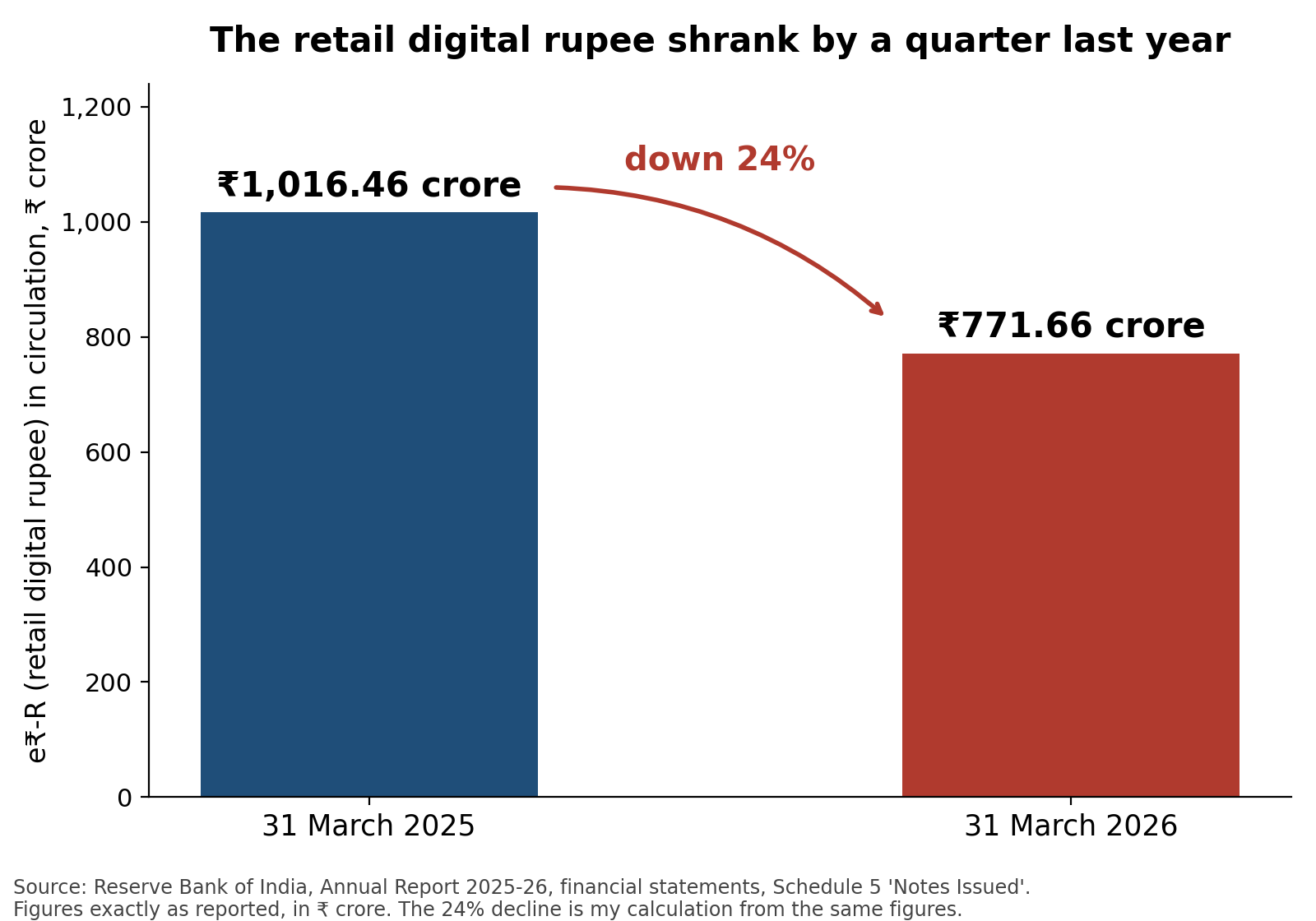
Retail digital rupee (e-R) in circulation, 31 March 2025 vs 31 March 2026. Source: RBI Annual Report 2025-26, financial statements, Schedule 5 "Notes Issued"; the 24% decline is my calculation.
The annual report does not say why the retail figure fell. I have read the relevant chapters closely, and no explanation is offered. I am not going to invent one. What the report does document, in detail, is everything that kept being built while that number shrank.
What kept advancing
Start with government money. During 2025-26, the Reserve Bank launched multiple CBDC pilots under direct benefit transfer schemes of the Centre and the states, using the programmability built into the e-rupee. In Gujarat, Puducherry and Chandigarh, public distribution system beneficiaries were credited their food subsidy in programmable CBDC, redeemable for eligible commodities at fair price shops and identified merchants. Money that knows what it is for.
Then the plumbing. The Reserve Bank developed the Unified Markets Interface, a multi-layer platform for tokenising financial assets that uses the wholesale e-rupee for settlement, and initiated a pilot issuing tokenised certificates of deposit on it. It announced a CBDC and Asset Tokenisation Sandbox at the Global Fintech Festival 2025. It enabled government departments to make DBT payments in CBDC through e-Kuber, its own core banking system, under the Treasury Single Account framework, using Aadhaar as the identifier in the same model that powers existing Aadhaar-based transfers. For individuals, it introduced user-level programmability, so one person can send programmable money to another, and BHIM, the payments app run by the National Payments Corporation of India, can now discover existing CBDC wallets. Offline e-rupee solutions, both tap-based over NFC and SMS-based for feature phones, are under test.
And then the world. The Reserve Bank signed an MoU on digital asset collaboration with the Monetary Authority of Singapore, and held bilateral discussions with Singapore and the Central Bank of the UAE on operationalising a cross-border CBDC pilot. Its annual report says it also joined two Bank for International Settlements Innovation Hub initiatives: Project Rialto, and Phase 2 of Project Mandala, both focused on improving cross-border payments through CBDCs. Next year's agenda, as the report states it, is more of all of this: new DBT and retail use cases, bilateral pilots operationalised, multilateral engagement deepened.
The global pattern
India's combination, a shrinking retail stock and an expanding wholesale and cross-border build-out, is not an Indian oddity. It is close to the global norm.
The BIS surveyed 93 central banks for its 2024 CBDC survey, published in August 2025: 91 per cent were exploring a retail CBDC, a wholesale CBDC, or both, and wholesale work was, on aggregate, at more advanced stages than retail work. The graveyard of retail CBDCs already has residents. Nigeria's eNaira, Africa's first, was reviewed by the International Monetary Fund after its first year: despite an undisrupted launch, the paper found, it "has not yet moved beyond the initial wave of limited adoption."
Cross-border wholesale CBDC, by contrast, has carried real value. Project mBridge, a multi-CBDC platform built with the BIS Innovation Hub by the Hong Kong Monetary Authority, the Bank of Thailand, the Digital Currency Institute of the People's Bank of China and the Central Bank of the UAE, with the Saudi Central Bank joining in 2024, ran a pilot with real-value transactions back in 2022 and reached minimum viable product stage in mid-2024; the BIS announced in October 2024 that it was handing the project over to its partners. The Reserve Bank of India was among the project's observing members as of that handover. I am noting the fact, not the geopolitics.
The Swiss exception that proves the rule
The clearest demonstration that a central bank digital currency can work is, formally, still a pilot. Since the end of 2023, the Swiss National Bank has been issuing a real wholesale digital franc on the SIX Digital Exchange, a regulated exchange built on distributed ledger technology, where it settles actual trades of tokenised assets. Not test tokens. Central bank money in real transactions, for nearly three years.

The Swiss National Bank's nameplate in Zurich. Since the end of 2023, the SNB has issued a wholesale digital franc on a regulated exchange. Photo: Roland zh, CC BY-SA 3.0, via Wikimedia Commons.
Under Project Helvetia, the SNB evaluated the experiment and kept extending it. A June 2025 press release committed to running the pilot until at least mid-2027; the SNB's project page now says it will run until at least June 2028, with more financial institutions to be admitted and the digital franc made available for a broader range of market transactions, alongside a second settlement approach that links tokenised platforms to Switzerland's existing real-time gross settlement system. The SNB is careful to say none of this commits it to a permanent digital franc. But notice what has been proven: where CBDC has found a genuine customer, that customer is a financial institution settling trades, not a shopper at a till.
Where the e-rupee actually fits
Everything above is drawn from documents, theirs and mine. What follows is my argument, and I want to label it as one.
India does not need the e-rupee to buy vegetables. UPI won that market so completely that a new retail payment rail has no natural opening, and the shrinking balance-sheet line may simply be the market saying so. The white space, the place where programmable central bank money does something nothing else in India can do, is the state's own money. India's direct benefit transfer machinery is vast, and the annual report's own chapters show why it suits programmable money: pilots already run under schemes of both the Centre and the states, and the government-payments rail now runs CBDC through the Reserve Bank's core systems. A subsidy that arrives as programmable CBDC can be made spendable only on foodgrain at a fair price shop, in Puducherry today and in principle anywhere tomorrow. It can travel through the Treasury Single Account with the Reserve Bank itself as sponsor bank. It can, once the offline solutions mature, reach a district with patchy connectivity over SMS. The Reserve Bank's own phrase for the DBT pilots is telling: "productive utilisation of public funds."
The second opening is plumbing for tokenised finance and cross-border settlement, where India is positioning early: tokenised certificates of deposit settled in wholesale e-rupee, an MoU with Singapore, talks with the UAE. That is a bet on where wholesale markets and remittances are heading, not on where consumers are.
Read this way, the paradox dissolves. The e-rupee was never really a product for the shopper; it is infrastructure being laid for the state's payments and for a tokenised future, while the consumer experiment finds its level. The Reserve Bank is not confused about this. It is building anyway, and it is publishing the number that fell.
A central bank can issue a currency. It cannot issue a reason to use one. Next March I will read Schedule 5 again, and I will not mind much whether the line has grown. I will be looking at what got built around it.
Sources
Reserve Bank of India, Annual Report 2025-26, Chapter I (CBDC initiatives, paragraph I.23; agenda for 2026-27, paragraph I.45; UPI volumes, paragraph I.25)
RBI Annual Report 2025-26, Chapter VI (paragraphs VI.53 to VI.55: programmability, offline CBDC, CAT Sandbox and UMI)
RBI Annual Report 2025-26, Chapter IX (payment system statistics, paragraph IX.7)
RBI Annual Report 2025-26, Chapter X (paragraph X.48: CBDC in e-Kuber for DBT under the Treasury Single Account)
RBI Annual Report 2025-26, financial statements (Schedule 5, Notes Issued: CBDC-R figures)
Swiss National Bank, Project Helvetia and SNB press release, 30 June 2025
IMF Working Paper 2023/104: Nigeria's eNaira, One Year After
Responses
No responses yet - yours could be the first.
Get the notes
Occasional emails about what I'm building, what worked, and what broke.