
The Indian Canvas #126: The Collector's Scoreboard
On 11 October, at the Indian Agricultural Research Institute in Pusa, the government marked one year of the PM Dhan-Dhaanya Krishi Yojana. A day earlier, the Press Information Bureau had quietly uploaded the more interesting document: a one-year factsheet that reads less like a celebration and more like a measurement plan reporting its first readings.
I have been going through it, and I think the scheme is worth attention not for what it has proven, which is little so far, but for how unusually legible its design is.
One hundred districts, thirty-six schemes, one plan
The scheme, approved by the Union Cabinet on 16 July 2025 and launched on 11 October 2025 with an outlay of Rs.24,000 crore, targets 100 "Aspirational Agricultural Districts". The selection rule is public and blunt: districts scoring poorly on productivity, cropping intensity, and agricultural credit disbursement, weighted by cropped area and operational holdings. Every state has at least one.
PMDDKY is not a new subsidy. It is a convergence exercise: 36 existing Central schemes across 11 ministries, plus state schemes and private participation, folded into a single District Action Plan prepared by a committee headed by the District Collector. A state committee under the Chief Secretary reviews it; two national committees, one chaired by the Agriculture Minister and one by the Agriculture Secretary, monitor. Progress is tracked through 121 indicators - 74 output, 47 outcome - and every district's output-indicator score is ranked monthly on a public NITI dashboard.
One year of readings
The factsheet is careful, and I want to be equally careful about what it shows. All 100 districts have prepared their plans and begun implementation. All 100 have submitted output-indicator data through August 2026 and outcome data for FY 2025-26. The dashboard went live in the last week of October 2025; monthly rankings began that November. The Department of Public Enterprises has folded the 100 districts into CSR adoption for central public sector enterprises for FY 2026-27 and 2027-28.
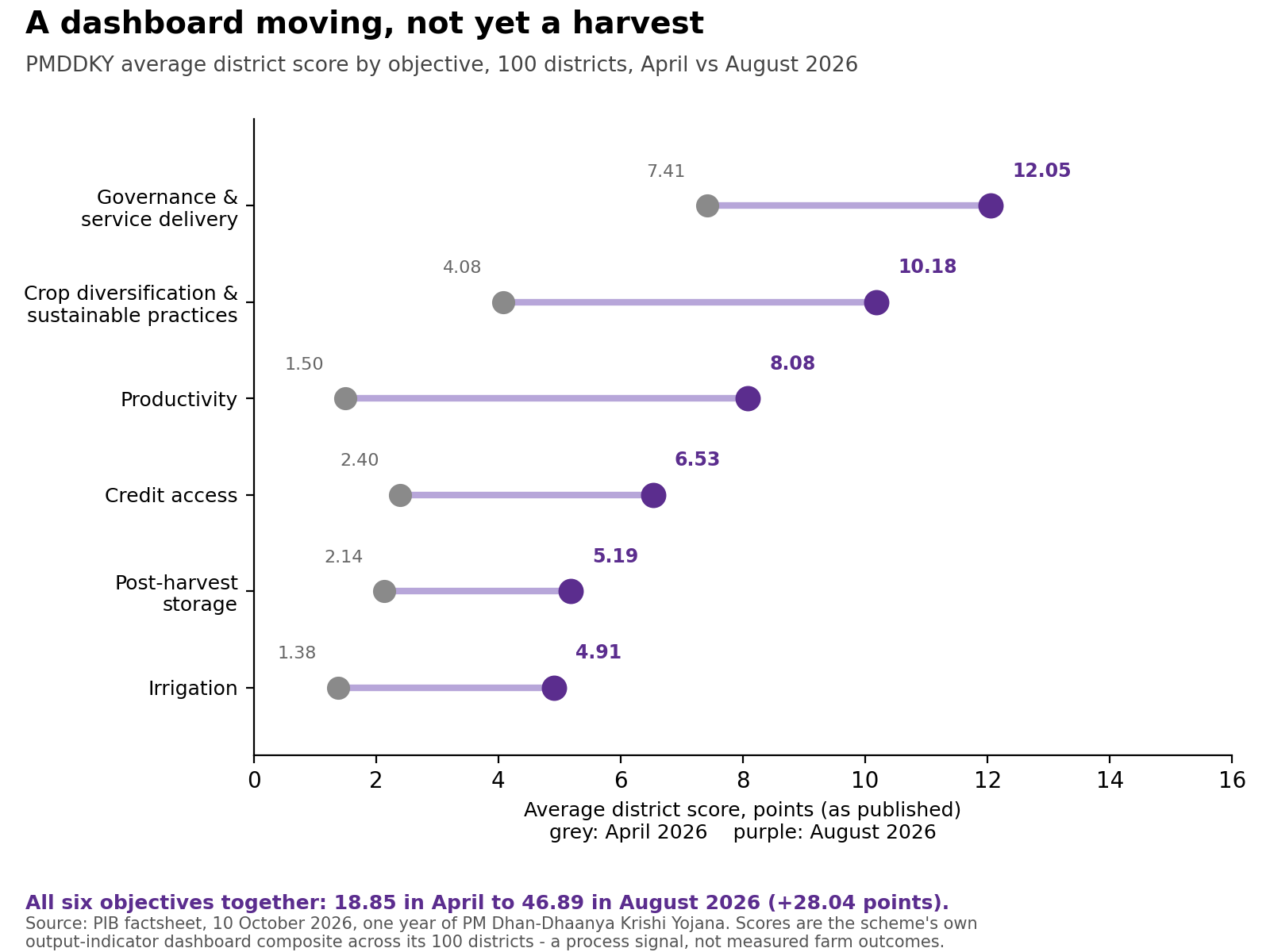
Then there is the number the government is clearly proudest of: the average score of the 100 districts across the scheme's six objectives rose from 18.85 in April 2026 to 46.89 in August 2026. Read the fine print before celebrating. These are the scheme's own output-indicator scores, self-reported by districts into its own dashboard. They tell us the machinery is moving - storage built, credit sanctioned, camps held - not that yields or incomes have risen. The 47 outcome indicators exist precisely because the designers knew the difference, and the FY 2025-26 outcome data has been collected but not yet published district-wise. This is a scheme one year in: the honest verdict is "early, and designed to be measured."
Some ground-level colour does exist. In Gadchiroli, Maharashtra, the Desaiganj Farmers Producer Company, 800 members, set up a rice processing unit and a 900-tonne warehouse and recorded a turnover of Rs.1.24 crore in FY 2025-26. In Tumakuru, Karnataka, a 750-member FPO supplying ball copra to a French multinational turned over Rs.1.60 crore and had aggregated over 138 tonnes of copra worth Rs.1.9 crore by mid-September 2026. In Jaisalmer, a 1,236-member FPO runs integrated pest management across 2,000 acres of cumin with solar-powered sprinklers on 500. These are the factsheet's own featured examples, so treat them as curated, but they show the intended direction: convergence landing as physical infrastructure and market access through FPOs.
The county that called for intensive care
The closest operating model I know ran in the United States from 2010. The U.S. Department of Agriculture's StrikeForce for Rural Growth and Opportunity began as a pilot in three states - Arkansas, Georgia and Mississippi - aimed at persistently poor rural counties. The diagnosis will sound familiar: community leaders told the Secretary they could not compete for USDA loan and grant programmes, that the application and review processes themselves were the barrier. StrikeForce's answer was not a new programme. It identified census tracts with over 20 per cent poverty using American Community Survey data, then sent USDA staff to do intensive outreach and technical assistance so that existing programmes actually reached those tracts.
The results, as the department reported in January 2016: expansion to 970 counties, parishes, boroughs and census areas across 25 states and Puerto Rico; more than 1,500 partnerships; nearly 190,000 projects; $23.5 billion invested in high-poverty rural areas since 2010. The framing fact behind it all: 85 per cent of America's persistent-poverty counties were rural.

Strip both programmes to their mechanism and they are the same idea. The money already exists in dozens of parallel schemes; what lagging geographies lack is the administrative capacity to draw it down. So you pick the worst-off districts by a public rule, put a named local officer in charge of one converged plan, and measure relentlessly. India has added two things StrikeForce never had: a monthly public ranking that pits Collector against Collector, and outcome indicators separated from outputs from day one.
My read
What follows is my opinion, not the factsheet's. The most consequential design choice here is the ranking. A published monthly scoreboard turns an abstraction, convergence, into a Collector's personal reputation, and Indian administrative history suggests that is when files move. But the same choice carries the classic risk: when a measure becomes a target, districts learn to report the measure. The gap between the 74 output indicators and the 47 outcome ones is where the honesty of this scheme will be decided. If, later this year, the government publishes district-level outcome data for FY 2025-26 with the same prominence it gave the April-to-August output jump, I will take that as the scheme trusting its own design. StrikeForce ran six years and reported inputs and projects, dollars and partnerships; it never quite closed the loop on whether persistent-poverty counties stopped being persistently poor. PMDDKY has built the instrument to answer that harder question. Watching whether it reads the answer aloud is worth the next few years of attention.
Sources
Prime Minister Dhan-Dhaanya Krishi Yojana: One Year of Focused Agricultural Development Across 100 Districts, Press Information Bureau factsheet, 10 October 2026
PM to launch PM Dhan Dhaanya Krishi Yojana with an outlay of Rs.24,000 crore, Press Information Bureau (PMO), October 2025
PMDDKY dashboard, NITI Aayog
Secretary Vilsack Launches USDA "StrikeForce" Initiative, USDA, 26 March 2013
USDA's StrikeForce Initiative Invests $23.5 Billion in Rural Communities, USDA, 15 January 2016
Responses
No responses yet - yours could be the first.
Get the notes
Occasional emails about what I'm building, what worked, and what broke.