
The Indian Canvas #131: The Running Toilet Nobody Bills
A California start-up raised $6.8 million on 20 October to put a tiny meter on every fixture in a building and find the running toilet before the bill arrives. Bengaluru already mandates internal water meters in larger buildings, yet most apartment complexes still split one common bill evenly. My hypothesis: an Indian apartment association would pay to know which flat, and which flush, is wasting the water. It is a hypothesis, not a finding.
The customers invested their own savings
DrizzleX of Santa Fe Springs, California announced a $6.8 million Series A-2 on 20 October 2026, per its funding release, led by Israel Investment Fund Group. The detail I find more interesting than the amount: a significant share of the round came from DrizzleX's own customers, property owners and operators who first cut their water costs with the platform and then invested in the company.
The product is a patented "micrometer" that installs on any fixture in minutes and feeds a software platform. Every anomaly is prioritised by potential cost, so an urgent leak alerts maintenance immediately while the rest collect into reports. Once a repair is made, the micrometer confirms it: if the flow does not return to normal, the issue was not fixed. Where regulations and leases allow, the same hardware submeters each flat, so residents pay for the water they actually use instead of an estimated share.
Company-reported numbers, which I could not check independently: properties have cut water consumption by 20 to 40 per cent, hardware and subscription pay for themselves in two to eight months, and one Los Angeles portfolio of over 2,000 units is saving about 25 per cent, adding nearly $1 million to its bottom line. Its own site puts the pitch plainly: a running toilet never sets off an alarm, and the meter on the building main sees the total, never which unit or fixture it came from.
Bengaluru mandates the meter and still splits the bill
The demand side writes itself in Bengaluru. The Hindu reported on 28 July 2026 that private water tanker businesses are coercing apartment communities into two-year contracts, and that the Bangalore Water Supply and Sewerage Board will sign MoUs with apartment communities for regular supply under its Sanchari Cauvery scheme. When a building's water arrives by tanker, every wasted litre has a cash price the association pays monthly.
Here is the part that surprised me. Amendments to the Bangalore Water Supply and Sewerage Act made internal water meters mandatory for buildings on sites of 2,400 sq ft or more, and for buildings with three or more homes on 1,200 sq ft. That mandate is years old. Yet as Citizen Matters reported, the common BWSSB meter measures the whole complex, and the monthly bill is usually split evenly among all residents. The meter is mandated; the billing fairness is not. A family that conserves subsidises the running toilet three floors up, and nobody can see it.
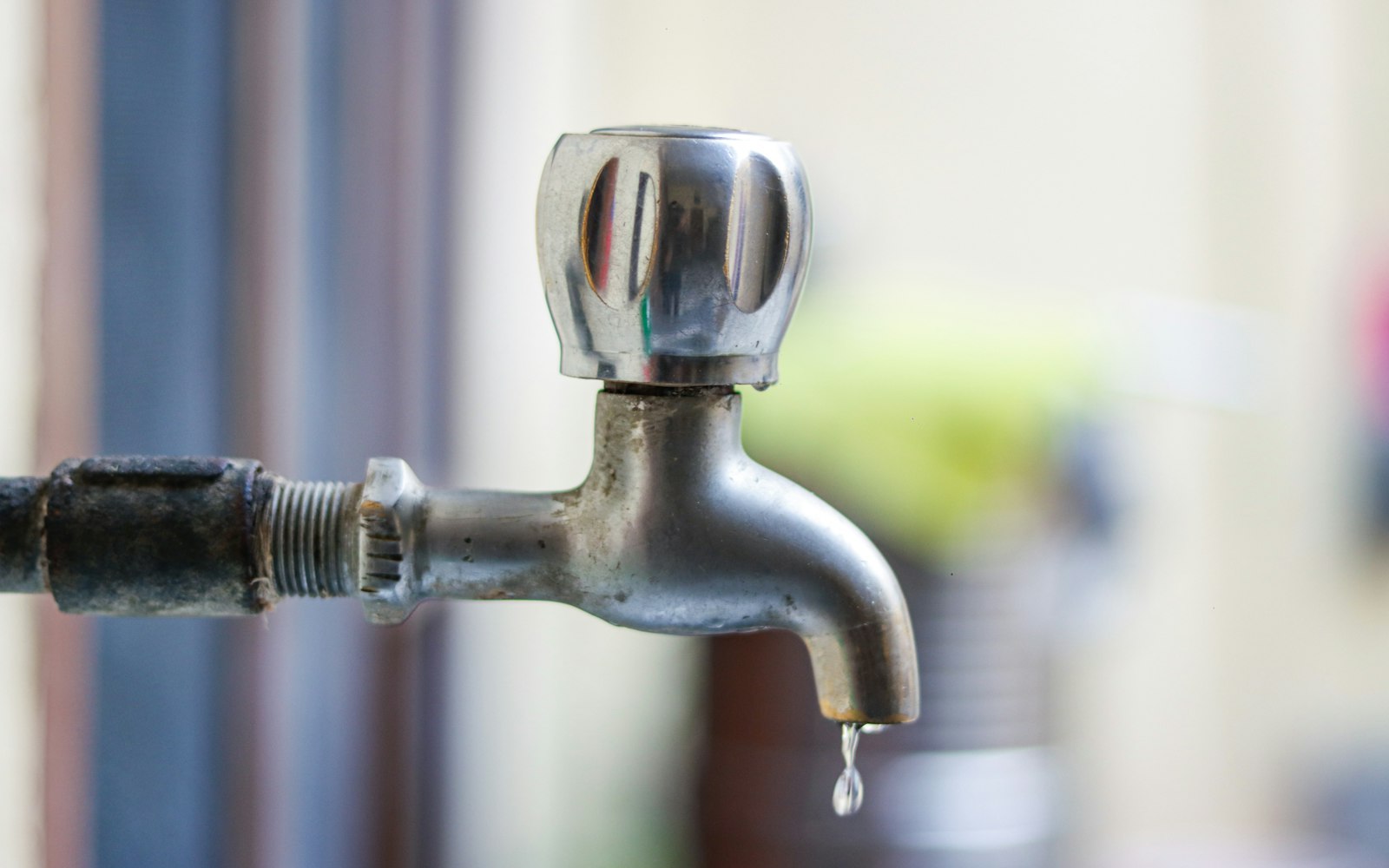
A dripping tap, the kind of slow leak a flat-level total can hide. Photo by Sanket Mishra on Unsplash.
India meters the flat, not the fixture
The market is not empty. WEGoT Utility Solutions of Chennai sells IoT water management for apartments and commercial buildings; per Business Standard in December 2021, it had deployed over 100,000 smart devices across more than 30,000 homes and 40 million square feet of commercial real estate, backed by Gruhas, a DLF family office, HDFC Capital and Prestige Group promoters. SmarterHomes of Bengaluru sells WaterOn, an ultrasonic IoT meter for flats, type-tested to IS 4064 Class C by FCRI. Both sell per-flat metering with apps and alerts.
What I did not find is an Indian company selling fixture-level detection: a sensor on every tap, toilet and washing point that answers "which flush", not just "which flat", and that confirms the plumber actually fixed it. I searched company pages and press coverage only, so a small firm could exist. WEGoT and SmarterHomes may also do more than their sites say. This is my reading, not proof.
Is the extra granularity worth its hardware?
The honest tension: per-flat metering already catches a flat that uses three times its neighbours. Fixture-level metering catches the flat whose total looks normal because a slow leak runs all night while the family is careful all day, and it closes the loop on repairs. But it means several devices per flat instead of one, several batteries to change per year per tower, and a higher price per flat. I do not know DrizzleX's per-unit hardware cost in India, and I would not guess it before talking to buyers.
The payer question is equally open. An RWA paying tanker prices has a cash reason to cut waste. A builder selling new towers has a marketing reason. A facility manager billing tenants has a fairness reason. Which of them signs the cheque decides whether this is a water business or a billing business.
What I would test
Pick one tanker-dependent Bengaluru complex of 200+ flats. Read twelve months of BWSSB bills and tanker invoices. If the spread between the most and least careful blocks is small, the problem is thinner than the pitch.
Meter one tower at flat level for 90 days and show each family its number. Then put fixture sensors in ten volunteer flats and count what the flat meter missed: running flushes, dripping geysers, a garden tap left open.
Track every alert to a repair and re-measure. The product is the confirmation, not the alert.
Ask the association what it would pay per flat per month out of verified savings, and ask WEGoT and SmarterHomes why they stopped at the flat boundary. If the answer is hardware cost or maintenance load, that is the real barrier, and it is fixable.
Open question: who maintains five hundred battery devices in a tower, and what happens to readings when they start failing? The idea dies cheaply if the answer is "the already-tired facility manager".
Sources and photo credits
DrizzleX funding release, DrizzleX, The Hindu on Sanchari Cauvery, The Hindu on the BWSSB meter mandate, Citizen Matters on internal metering, Business Standard on WEGoT, WEGoT, SmarterHomes. Cover photo: apartment tower in Bengaluru by @dumbledore1996 on Unsplash (Prestige Hermitage, per the photo page). Body photo: a dripping tap by Sanket Mishra (@sanketgraphy) on Unsplash, illustrative. Both free to use under the Unsplash License.
Responses
No responses yet - yours could be the first.
Get the notes
Occasional emails about what I'm building, what worked, and what broke.