
The Indian Canvas #42: AMRUT's new taps are spread across small places. Who meters them?
I recounted the Ministry of Housing and Urban Affairs table of household tap connections provided under AMRUT 2.0. Of 990 urban local bodies (ULBs) in it, 933 have fewer than 25,000 connections under the mission, and together they hold 53 per cent of the 70.6 lakh total. That says the mission's taps are spread thin across small places. In North Carolina, Subeca raised about USD 3 million to sell metering to small US utilities. India is not empty on retrofit metering, so the question I would test is narrower: who bundles it for a state's small towns.
What the table says
The Ministry's table lists household tap connections provided under AMRUT 2.0 for each ULB, as updated by states and UTs on the portal on 9 July 2026. The same date appears in a Lok Sabha reply of 6 August 2026. I read the tap table from the PDF and counted 990 rows, totalling 70,61,845 connections. This counts taps provided under the mission, not meters, and not all urban taps in India. A "small" ULB here means few mission connections, not a small population.
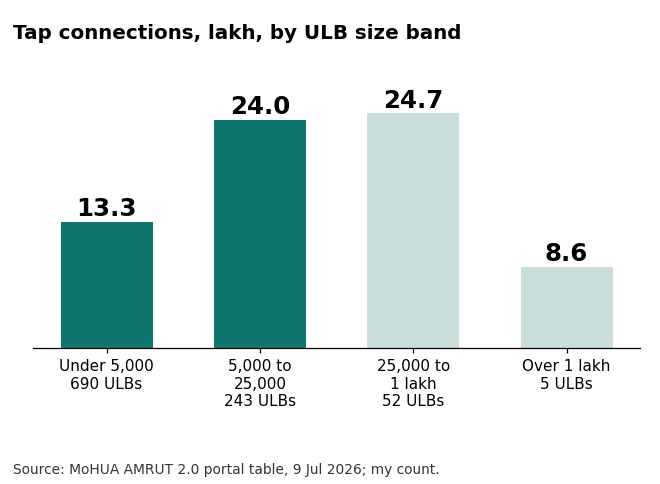
Chart by me from the table. The axis starts at zero. Teal bars are the ULBs under 25,000 connections.
By count: 690 ULBs have under 5,000 connections (13.3 lakh in total), 243 have 5,000 to 25,000 (24.0 lakh), 52 have 25,000 to one lakh (24.7 lakh) and five pass one lakh (8.6 lakh). The median ULB has about 2,840 connections. The biggest is Bhopal with 3,09,499. A previous version of this piece said 988 rows and 931 small ones because two rows did not parse. I corrected that.
What AMRUT tenders look like in a small town
AMRUT 2.0 encourages smart components in water schemes, including consumer metering, SCADA and IoT monitoring. A Lok Sabha reply of 30 July 2026 describes one small project in Katni, Madhya Pradesh: 3,000 household tap connections and 2,158 smart water meters, along with pipe network, tanks and SCADA. I do not know the price or whether the meters were new or retrofits. The point is that smart meters are bundled inside a larger works contract, and I did not review tender rules to see whether a retrofit device would qualify.
Stock photo of plumbing pipes. Not a Subeca product or an Indian utility.
Subeca's model
Subeca's release of 12 October says it raised approximately USD 3 million in a Series A-2 led by Burnt Island Ventures, with Cycle H2O and SUEZ. Burnt Island has written about investing in Subeca. The earlier USD 6 million Series A in 2024 was led by SUEZ, with Burnt Island and Amazon's Climate Pledge Fund. The company says it is live in 23 communities and targets the more than 51,000 US utilities and businesses it says are locked out of advanced metering by cost and complexity. That is company-reported.
Its product page says a retrofit device connects to "encoded or pulsed output meters" with a 20-year battery life. That matters: it works on meters that already have a signal output, not on any plain mechanical meter. Its communications module uses Amazon's Sidewalk network, which the release says covers more than 90 per cent of the US population. I did not find the same network in India, so an Indian version would need another link.
India is not empty on retrofits
I checked Indian companies on their own sites. All claims are company-reported, and I did not test any product.
Enthu Technology sells a LoRaWAN retrofit module for water meters with RS485 Modbus or pulse output. Metrium offers to convert existing AMR-compatible meters into AMI-enabled ones. KarIoT says its gateway and node devices digitise multijet, ultrasonic and electromagnetic meters without replacing them. Laqua says its platform works with existing ultrasonic meters over LoRaWAN or LTE-M, and I did not check where it sells. Kritsnam sells a managed water-accounting service to enterprises, says it is deployed across 18 states since 2015, and does not sell to municipalities, as far as I could see.
Who pays, and where it could fail
My hypothesis: the gap is not the module but a bundle for a state water board or a group of small ULBs: retrofit, connectivity, billing data and a service contract, sold per connection. This is not surveyed. I do not know how many mission taps have a working meter with a pulse or encoded output to retrofit, and many small-town meters may be plain mechanical ones. Tenders may specify new meters. Small ULBs may lack staff to use the data. Any monthly fee I would try is a test assumption.
What I would do first
Pick one state with many small ULBs. Read its water-meter tender conditions for retrofit eligibility, and ask its water board how many connections have meters with signal output. If most do not, the product is a meter swap, not a retrofit, and the idea changes.
Sources and photo credits
MoHUA AMRUT 2.0 tap table, Lok Sabha reply, 6 Aug 2026, Lok Sabha reply, 30 Jul 2026, Subeca release, Subeca metering page, Burnt Island post, company sites linked above. Photos on Unsplash with no stated location: cover by Kouji Tsuru (@pafuxu), a bathroom sink with a faucet next to a window (Unsplash's title; the photo shows an outdoor tap on a wall); body by Ryan Vargas (@rvargasphoto), a close up of pipes and fittings on a wall. Free to use under the Unsplash License. My count and reasoning are a research view, not investment advice.
Responses
No responses yet - yours could be the first.
Get the notes
Occasional emails about what I'm building, what worked, and what broke.