
The Indian Canvas #142: The Water That Never Gets Billed
On a summer morning in Delhi, the tanker queue forms before the water does. Drums, buckets, a rota negotiated lane by lane. What the queue cannot see is the water that never reaches the lane at all - treated, pumped, and gone somewhere between the plant and the tap.
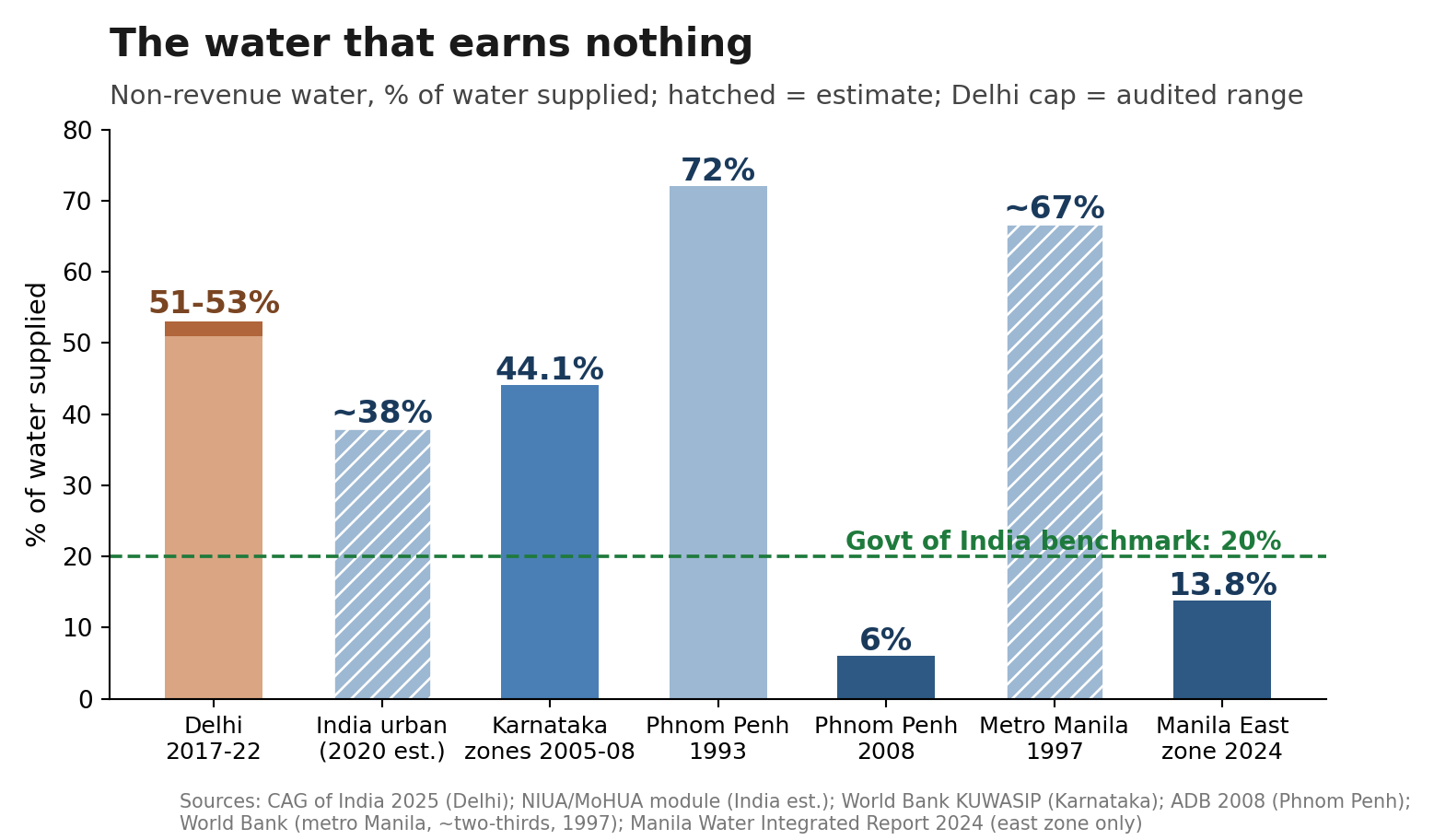
In 2025, the Comptroller and Auditor General put a number on the loss - all of it, not only what vanishes underground. A performance audit of the Delhi Jal Board, covering 2017 to 2022, found non-revenue water - water supplied that earns nothing - running at 51 to 53 per cent of the average quantity supplied each day, a loss the audit values at Rs 4,988 crore. In 2021-22 specifically, the Board billed only 371 million gallons a day, 40 per cent of the potable water it produced, and only two-thirds of even that billing was based on meter readings. The audit carries its own caveat: with flow meters missing at treatment plants, reservoirs and borewells, these quantities are estimates. Meanwhile the Board's loans and interest stood at Rs 66,595 crore in March 2022.
The industry term is non-revenue water, and it is more than leaks. It is the physical losses from cracked pipes, the "apparent" losses from theft and dead meters, and the authorised use nobody bills - firefighting, public standposts. India's urban average is estimated at around 38 per cent, a 2020 figure cited in a National Institute of Urban Affairs training module. The government's service-level benchmark for utilities is 20 per cent; the handbook's stated rationale is that below that point, the cost of further reduction outweighs the benefits. Delhi's audited range is two and a half times that ceiling.
The loss feeds on itself, twice over. The NIUA module calls it the vicious cycle: a utility that bills less than half of what it produces is short of maintenance money, and the leaks grow. Intermittent supply makes it worse: the World Bank notes that when an empty pipe repressurises, the first ten minutes of flow can carry high bacterial contamination - and households respond with tanks, pumps and filters, coping costs that never appear in any tariff. Delhi's transmission loss alone rose from 16 to 21 per cent over the audit period.
Three places have already run the other direction, each with a different owner of the fix.
Phnom Penh chose public autonomy. In 1993 the Phnom Penh Water Supply Authority was, in its own general director's words, "the perfect bad example": 72 per cent non-revenue water, a fifth of the city connected, ten hours of supply a day, revenues covering half of operating costs. A 1996 decree gave the utility financial and administrative autonomy, and Ek Sonn Chan's team replaced corrupt managers, metered every connection, split the network into 41 zones with pressure and flow telemetry, computerised billing, and paid staff on performance. By 2008, per an Asian Development Bank case study, non-revenue water was 6 per cent, coverage 90 per cent with round-the-clock supply, and collection 99.9 per cent. In 2012 the utility became the first company to list on Cambodia's new stock exchange - and it trades there still.
Manila chose a private concession. After the 1995 Water Crisis Act, the metro's failing utility was split in two and auctioned in January 1997 as twin 25-year concessions, with an independent regulator and binding targets. Before the split, according to the World Bank, almost two-thirds of the water produced across metropolitan Manila was being lost to leaks, poor metering and illegal connections, and the poor bought from vendors at up to seven times the tariff. In the east zone - the Manila Water Company's concession area, not the whole metro - non-revenue water was 13.8 per cent at the end of 2024, per the company's integrated report, alongside a 72 per cent EBITDA margin. One company's zone is not a national statistic, but it is a quarter-century of evidence that institutions and contracts can shrink the loss, working alongside pipe repair rather than instead of it.
Karnataka chose a performance contract, one zone at a time. Between 2005 and 2008, five demonstration zones - about a tenth of the population each - in Hubli-Dharwad, Belgaum and Gulbarga were handed to an operating contractor carrying performance risk and bonus, under a World Bank-supported project. The baseline read like any Indian city: 44.1 per cent non-revenue water, half the connections metered, roughly ten hours of supply a week. The contractor replaced the distribution network outright. The result, in the project's own field note: continuous 24x7 supply, every household connected, 10 per cent less water consumed, revenue billed up five-fold and collected up seven-fold, with 99 per cent collection efficiency in two of the three cities. No post-project non-revenue-water percentage was published; the money, however, moved.
The honest question is why twenty years later that experiment is still an experiment. Karnataka's model never spread statewide. Nagpur's city-scale 24x7 concession is contested - in 2023 the municipal corporation declared the scheme a failure and rejected the operator's claims, which the operator disputes. Researchers argue in Economic and Political Weekly that zone-level success does not automatically survive replication at city scale. And the numbers here - different cities, different decades, different denominators - are illustrations, not a league table.
Here is my hypothesis, and it is a hypothesis: India's missing market is water performance contracting. The NIUA module works the arithmetic for a representative city pumping 320 million litres a day at 25 per cent non-revenue water: about Rs 7 crore a year goes into pumping water that is never sold, and cutting losses would unlock roughly Rs 31.5 crore a year in electricity savings and avoided water purchases on the ministry's own training arithmetic; the module does not price the fix itself. The Karnataka contractor was paid partly on performance; what has never been tried at city scale in India is paying an operator directly out of recovered billing, the way energy-service companies are paid out of saved power. Whether that cash flow is really bankable is an open question the CAG's Rs 4,988 crore revenue-impact estimate does not answer - it says nothing about tariffs, collection rates, capital cost, or whether a utility that cannot meter its water can be a reliable counterparty. But the Delhi audit and the Phnom Penh ledger point the same way: half the water earns nothing, and somebody could be paid to change that.
Sources: CAG of India, Report No. 3 of 2025 - Performance Audit on Functioning of Delhi Jal Board; National Institute of Urban Affairs, Non-Revenue Water training module (ClimateSmart Cities); Asian Development Bank, "Phnom Penh Water Supply Authority: Internal Reforms Fuel Performance Upgrade" (2008); Cambodia Securities Exchange listing data; World Bank/IFC, "PPP Stories: Philippines - Manila Water"; Manila Water Integrated Report 2024; World Bank, "The Karnataka Urban Water Sector Improvement Project: 24x7 Water Supply is Achievable" (field note); Times of India (2023, 2024) on Nagpur's 24x7 scheme; Economic and Political Weekly (2018). Cross-city figures are drawn from different years and methodologies and are illustrative, not a performance ranking.
Responses
No responses yet - yours could be the first.
Get the notes
Occasional emails about what I'm building, what worked, and what broke.