
The Indian Canvas #143: Who Pays When the Bus Runs Empty?
The new bus does not announce itself. No diesel clatter at the light, no heat off the bonnet as it pulls away - and, if you look closely, a green number plate where the white one used to be. The bigger surprise is not the motor. It is who owns the bus. Under the contract India now prefers, the city does not.
India's state road transport undertakings, which run most public buses, are under severe financing pressure: a Ministry of Road Transport and Highways review puts the combined net loss of 58 of them at Rs 30,192 crore in 2021-22, and CESL, the state-owned demand aggregator, notes that 90 per cent operate at a loss. City fleets, counted separately, are thin: the housing and urban affairs ministry counted about 45,450 buses in organised city service across 92 transport agencies in million-plus cities, and a Shakti Sustainable Energy Foundation study put availability at roughly 24 buses per lakh people against a norm of 40 to 60. Into this walked the electric bus, at a price the International Energy Agency calls too high to bear for local transport systems with little access to financing and an uneven record of on-time payments.
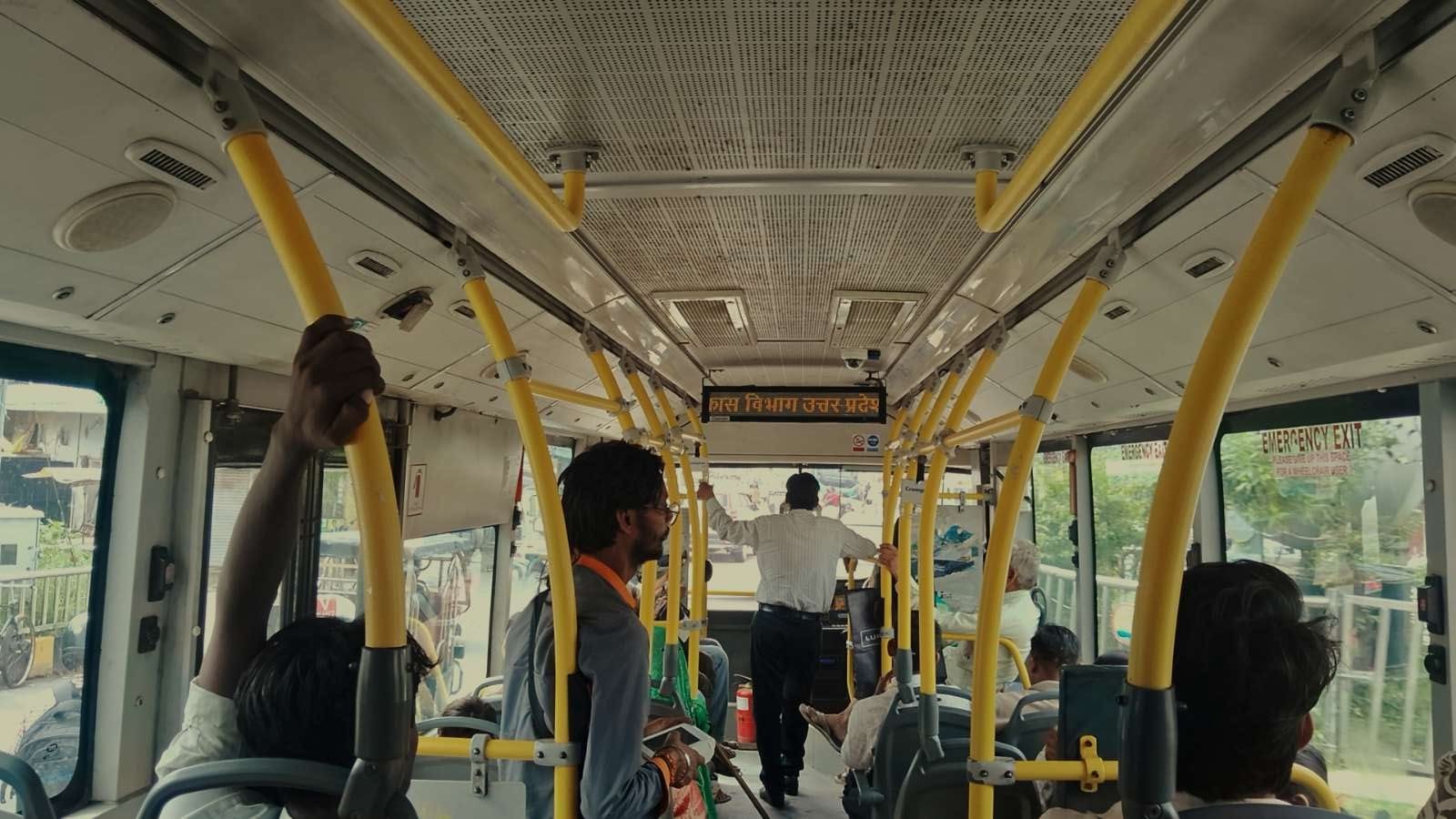
The financing answer settled on was to stop buying buses. Under FAME-I (2015-19), the centre subsidised 390 buses purchased the usual way. FAME-II, announced in 2019 with a $1.3 billion outlay of which about 35 per cent was earmarked for buses, allowed only gross cost contracts under a model concession agreement: a private operator finances, owns and runs the bus - driver, maintenance, charging, often in a depot the city provides - and the city pays a discovered price per kilometre, keeps the fares, and guarantees a floor, about 70,000 assured kilometres a year under CESL's contracts, over ten years extendable to twelve. The IEA describes the bulk-procurement design as a deliberate replay of the playbook CESL's parent, Energy Efficiency Services Limited, ran for LED lighting.
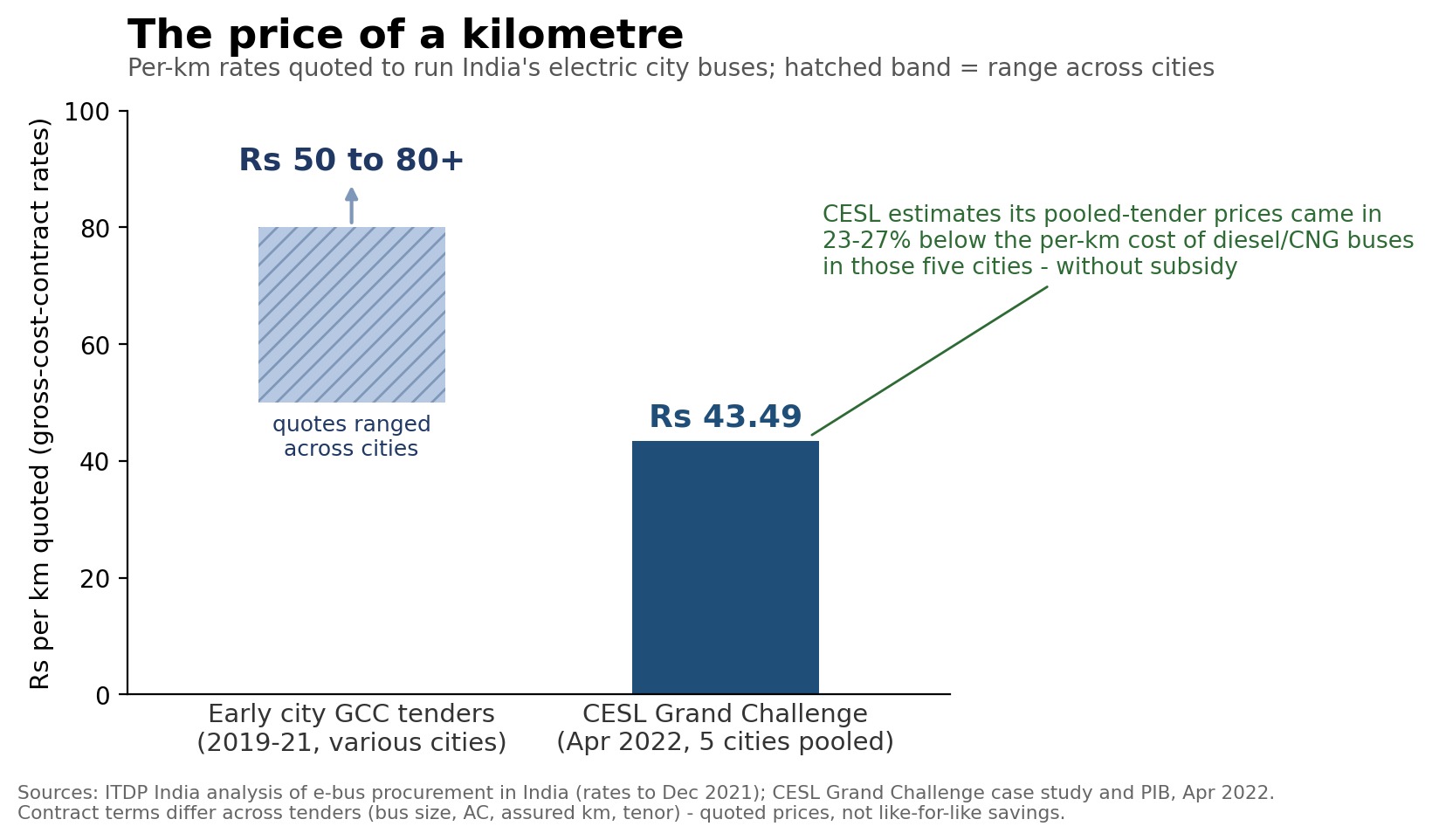
When cities tendered alone, quoted rates scattered. An ITDP analysis of contracts awarded to December 2021 - 2,965 buses across 18 cities - found per-kilometre rates below Rs 50 in some cities and above Rs 80 in others, with bus sizes, air-conditioning and contract terms varying between tenders. In September 2021, CESL pooled demand from the FAME-II phase-II cities into one Grand Challenge; when prices were announced in April 2022 for 5,450 buses across five of them - Kolkata, Delhi, Bengaluru, Hyderabad and Surat - the lowest twelve-metre rate was Rs 43.49 per kilometre. CESL's own case study estimates its discovered prices, before any subsidy, came in 23-27 per cent below the per-kilometre cost of diesel and CNG buses in those cities.
The contract has since been scaled twice. PM-eBus Sewa, approved in August 2023, commits Rs 57,613 crore - Rs 20,000 crore of it central support - to deploy 10,000 electric buses on PPP terms in 169 cities, prioritising cities with no organised bus service, with ten years of operating support; the scheme's live dashboard shows letters of award issued for 5,958 buses across 86 cities, and the first services running in Guwahati, Bhavnagar, Nagpur and Chandigarh since February 2026. PM E-DRIVE, notified in September 2024, adds Rs 4,391 crore for 14,028 buses in the nine cities above 40 lakh population. An official count reported in August 2025 put 14,329 electric buses on Indian roads, 3,564 of them in Delhi; the capital's transport minister said that month the fleet had grown from 400 in February 2025 to 3,400, with 6,000 targeted by the end of that year.
None of this works unless the operator believes the cheque will arrive, and that is the problem the newest layer addresses - not a vehicle or a subsidy but a payment machine. Per a UITP explainer, it is built from the same instruments that made renewable power projects bankable in India: letters of credit, escrow accounts, a payment security fund, tripartite agreements and state guarantees. Under PM E-DRIVE's payment security mechanism, notified through Gazette S.O. 4259(E), the city parks money in an escrow account; if the escrow runs short, the operator can ask CESL to activate the mechanism; and if the bill is still unpaid 90 days later, the Ministry of Heavy Industries can ask the Reserve Bank of India to invoke a direct debit mandate and recover the money from the state's account. Karnataka, Gujarat and Rajasthan already hold the RBI's acknowledgement of their mandates, per the scheme dashboard.
Two fleets abroad mark the road India is on. Shenzhen electrified its entire bus fleet - 16,359 buses - by December 2017, a World Bank case study records. Santiago's first electric buses cost more than twice a diesel Euro VI bus and fell to about $300,000 by 2020, per the World Bank; its fleet grew from 411 buses in 2020, six per cent of the city's total, and ITDP expects it to pass 4,400 by the end of 2026 - a forecast, not yet a count.
Here is my hypothesis, and it is a hypothesis: the lasting export of this programme is not the bus but the paperwork. A gross cost contract turns a capital purchase a loss-making undertaking would struggle to finance into an operating bill it can schedule; aggregation discovers the price; escrow and a central bank's debit mandate make the bill collectible. The risks have not vanished - they have been reassigned. Operators still carry uptime, grid and utilisation risk; WRI India notes the Grand Challenge rate escalates just two per cent a year against input costs, and that payment still flows from cash-strapped transit agencies. And the city, which keeps the fares, now carries ridership risk under these contracts: the assured-kilometre bill arrives whether or not anyone boards. ITDP's proposed GCC+, which would split the per-kilometre fee into separate availability and operating payments, is one answer on the table. Nobody yet pays for the passenger.
Sources: Ministry of Road Transport and Highways, Review of the Performance of State Road Transport Undertakings (2019-20 to 2021-22); Ministry of Housing and Urban Affairs city-bus fleet data (October 2025) and the PM-eBus Sewa dashboard (accessed October 2026); Convergence Energy Services Limited, Grand Challenge case study; Press Information Bureau (April 2022, August 2023, October 2024); ITDP India, An Analysis of E-bus Procurement in India; UITP India, Payment Security Mechanism (August 2025); International Energy Agency, Accelerating the Deployment of E-Buses in India; WRI India, Key Lessons from India's Bus Electrification Drive; World Bank case studies on Shenzhen and Santiago; Hindustan Times and Business Standard (August 2025) for Delhi and national fleet figures. Photos: Delhi Transport Corporation JBM Eco-Life e12 electric bus by Kool Nerd 123 (CC BY 4.0) and an electric city bus interior in Prayagraj by ADARSH23456789 (CC BY-SA 4.0), both via Wikimedia Commons.
Responses
No responses yet - yours could be the first.
Get the notes
Occasional emails about what I'm building, what worked, and what broke.