
The Indian Canvas #138: Who Pays the Family Caregiver?
On 15 October, a San Francisco startup called Abby Care raised $82 million to do something that sounds odd until you think about it: put family members on the payroll to care for their own parents, spouses and children. The Series C was led by Transformation Capital, with CVS Health Ventures, Frist Cressey Ventures and Pivotal Ventures joining, and Khosla Ventures, Thrive Capital and Sequoia Capital returning. The company's thesis, in founder Havi Nguyen's words: the person who already knows a family member best, and is consistently there for them, can deliver more proactive and preventative care than traditional models - if you train, certify, clinically supervise and pay them.
That last verb is the whole story. Pay them.
America has built an entire invisible workforce it is only now learning to count. Caregiving in the U.S. 2025, from AARP and the National Alliance for Caregiving, finds 63 million Americans - nearly one in four adults - provided ongoing care to an adult or child with a complex condition or disability in the past year, up 20 million in a decade. They spend roughly $7,200 a year out of pocket, and one in four puts in 40-plus hours a week. Buried in the same report is the number that explains Abby Care's round: more than 11 million of these family caregivers are already paid, through programmes such as Medicaid's home and community-based self-direction waivers. Abby Care simply industrialised the arrangement. It operates as a Medicaid provider in eight states - Colorado, Florida, Georgia, Indiana, Massachusetts, New Jersey, Pennsylvania and Tennessee - trains the family member into a certified aide, pairs them with a registered-nurse care manager, and uses software to document the care for the health plan footing the bill. The payer is the state; the worker is the daughter.
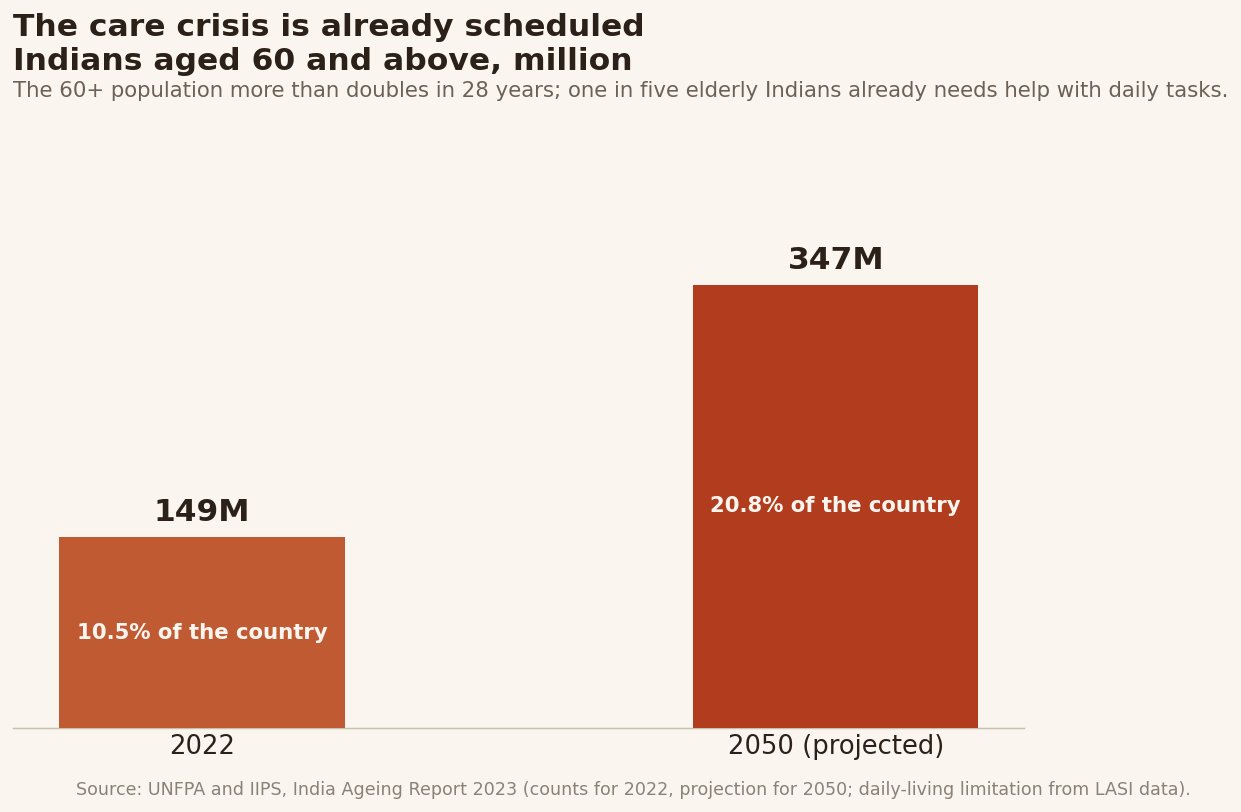
India's 60-plus population, 2022 versus 2050 projection. Source: UNFPA-IIPS India Ageing Report 2023.
Every ageing country has to answer the same design question: is family care love, labour, or infrastructure? Germany answered it in 1995 with long-term care insurance that pays cash. Its Pflegegeld - care allowance - sends between 347 and 990 euros a month, depending on care grade, to the person needing care, who typically passes it to the relative doing the caring; Destatis counts more than two million people in Germany cared for by relatives alone under this roof. Japan answered the same question in 2000 the opposite way: its long-term care insurance pays for services, and - by explicit design - no cash benefits to family caregivers, to push families toward professional care. Germany prices family care. Japan replaces it. America now payrolls it.
Now look at India. The India Ageing Report 2023, from UNFPA and the International Institute for Population Sciences, counted 149 million Indians aged 60-plus in 2022 - about 10.5 percent of the country - and projects 347 million, or 20.8 percent, by 2050. One in five elderly Indians already lives with at least one limitation in the basic activities of daily living: bathing, dressing, getting out of bed, using the toilet. That care is being given today, in crores of homes, by family members.
What does the Indian state offer them? In September 2024 the Union Cabinet extended Ayushman Bharat PM-JAY to every citizen aged 70 and above, regardless of income - a Rs.5 lakh cover reaching about 6 crore senior citizens. It is a genuine expansion, and it is hospitalisation insurance: it pays for the surgery, not for the months of feeding, lifting and cleaning after it. The German payslip, the American payroll, the Indian silence - that is the comparison this issue is about.
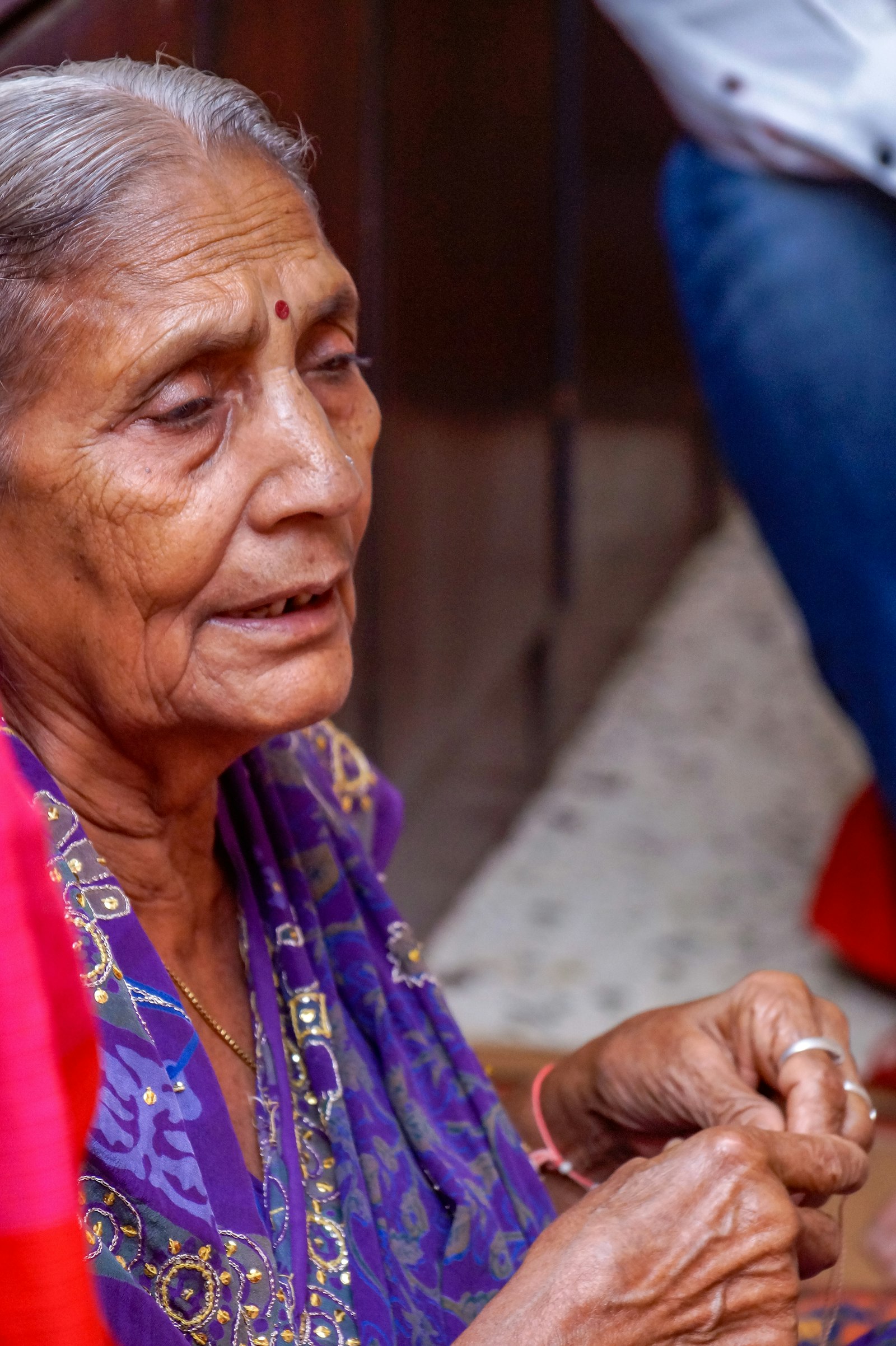
An elderly woman at her knitting. Photo: Rosario Fernandes / Unsplash
Here is my hypothesis, and it is a hypothesis. India's entry point is not a new insurance product - the country barely buys the ones it has - but a waiver-style pilot bolted onto what just shipped. The 70-plus PM-JAY cover creates the register of exactly the population that needs long-term care. A structured family caregiving benefit on top of it - assess the senior for ADL dependence, train and certify one family member, pay a monthly stipend against nurse-verified care logs, the Abby Care shape minus the startup - would turn India's biggest new entitlement into its first long-term care instrument. Start with one state, one district, five thousand seniors, and measure hospital readmissions against the stipend cost. The market, as always in this series, is not empty: Age Care Labs, which runs the Emoha elder-care platform, raised Rs.85 crore this July, and home healthcare firm Portea posted Rs.160 crore in FY25 revenue. The demand side is being built. Nobody is building the family side of the payroll.
America's lesson is not that India should copy Medicaid. It is that the cheapest, most trusted, most motivated caregiver in the system is already in the house - and that a country can choose, deliberately, whether that person's work counts as work. Germany chose in 1995, Japan in 2000, America is choosing now, one waiver at a time. India has 347 million reasons due by 2050, and the register to find the first six crore of them already exists. The only question left is whether the payslip ever arrives.
Sources: Abby Care Series C announcement; Home Health Care News (15 Oct 2026); AARP / National Alliance for Caregiving, Caregiving in the U.S. 2025; Bundesgesundheitsministerium (Pflegegeld); Destatis long-term care statistics; The Long-Term Care Insurance System in Japan (PMC); UNFPA-IIPS India Ageing Report 2023; PIB (11 Sep 2024); YourStory (Jul 2026); Entrackr (Portea FY25). Figures marked as projections or estimates are the sources' own; the pilot design is my hypothesis, not any government's plan.
Responses
No responses yet - yours could be the first.
Get the notes
Occasional emails about what I'm building, what worked, and what broke.