
The Indian Canvas #135: Who Guides the Patient?
On 20 October, a New York company called Baba raised $40 million to sell something Indian healthcare barely has a name for. Not a drug, not a device, not a hospital bed. A guide. Baba's product is a person - backed by a lot of software - who walks a patient through the American medical system, and the remarkable part is who pays: not the patient. The health plan does.
The problem Baba is solving will sound familiar to anyone who has taken a parent to a hospital. Its own announcement lays out the American version: nearly 70 million people on Medicare, each juggling doctors, hospitals, pharmacies and benefits, with the average patient now seeing more than 40% more specialists a year than two decades ago. Holding it all together is usually a family member - more than 63 million Americans are family caregivers, up 20 million in ten years. The system did not design this role. It simply depends on it.
Baba's answer is to make the guide a covered benefit. Every Baba patient gets a dedicated care team - care coordinators and licensed therapists - that keeps the whole journey connected: specialist visits, hospital discharges, behavioural health, in-home support, and needs like housing and transport that sit outside any prescription. The company says it has supported more than 10,000 patients and families, with more than 100,000 families on the waiting list. The money comes from health plans and value-based arrangements, and the model has official blessing: in June, the Centers for Medicare & Medicaid Services selected Baba for its ACCESS Model, a ten-year test of technology-supported chronic care, across all four clinical tracks. This round was led by FirstMark Capital, with CVS Health Ventures and Valtruis joining and General Catalyst, Genius Ventures and Ground Up Ventures returning.
One line in the announcement stayed with me. Connor Sweeney, Baba's founder, called causal, dollar-denominated care navigation "a holy grail in healthcare for a long time, and it's finally possible because of AI." The company has even published a benchmark, BabaBench, that tests whether AI agents can complete long patient-advocacy tasks - paperwork, insurer calls, billing follow-ups that stretch over weeks - without dropping the ball. The claim underneath all of it: coordination was always valuable, just too expensive to staff. AI cuts the cost of the guide enough that an insurer can pay for one.
India runs on unpaid guides
Now bring this home. India has the same confusion at a scale America would not recognise. The freshest official accounting of who pays for Indian healthcare came in May, when the Health Ministry released the National Health Accounts estimates for 2022-23. The headline trend is real progress: government's share of health spending has risen from 28.6% to 43.7% over a decade, and the out-of-pocket share has fallen from 64.2% to 43.4%. But read that second number again. Even now, 43 rupees of every 100 spent on healthcare in India comes straight out of a household's pocket. The Indian patient is not just a patient. The Indian family is still the insurance department, the transport desk, the pharmacy runner and the case manager, all at once.
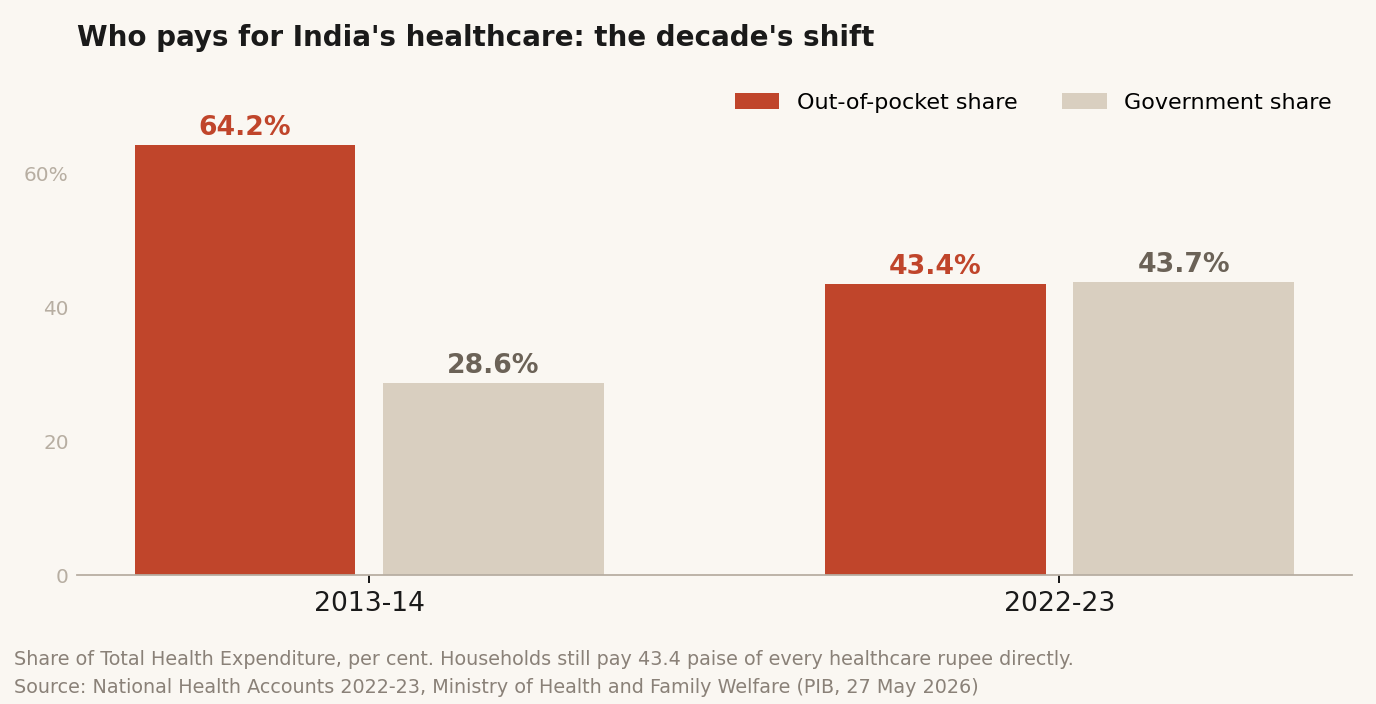
Out-of-pocket spending fell from 64.2% to 43.4% of total health spending between 2013-14 and 2022-23, while the government share rose from 28.6% to 43.7%. Data: National Health Accounts, India.
What guidance exists is real but narrow. PM-JAY, the world's largest health assurance scheme - issue #128 of this series looked at how it works - puts a trained Arogya Mitra at the desk of every empanelled hospital. But that is a hospital-desk role for scheme beneficiaries once they have arrived at the door. It is not an advocate who walks with you before, during and after, and it answers to the scheme, not to you. On the private side, employer benefits cover the salaried slice: Loop Health sells group health with care navigation to companies, and MediBuddy and others run corporate health platforms. If you are formally employed, someone may already be paid to guide you. If you are not - and most of India is not - the guide is your daughter, taking the day off.
Who pays for the guide?
So here is my hypothesis, and it is a hypothesis. The gap in India is not awareness, and it is not doctors. It is the absence of anyone whose job is the journey. Baba's bet is that the payer should be the one who profits when the journey goes right: the insurer, whose claims shrink when patients take medicines, keep follow-ups and avoid readmissions. Indian insurers lose fortunes to exactly these failures, but today none of them buys navigation as a benefit the way Baba's health-plan partners do. The test I would run is small and concrete: take one insurer's portfolio of senior-citizen policies, offer navigation as a paid benefit for a year, and measure claim severity and renewal rates against the rest of the book. If Baba's American arithmetic holds - that guiding the patient is cheaper than losing the patient - an Indian insurer should be able to make money on the same equation.
Wrinkled hands with a gold ring resting on a cane handle. Photo by Alexas_Fotos on Unsplash.
The obstacles are honest ones. Indian premiums are thin, margins thinner, and the regulator watches both. A navigation benefit adds cost before it saves any. And the American payer structure - Medicare Advantage plans competing for members - has no clean Indian twin. But the direction of travel is visible in the government's own data: as the out-of-pocket share falls, more of the country's health spending flows through payers, and payers are the ones who can buy a guide at scale. Someone will sell Indian families a Baba. The only question is whether it arrives as an insurance benefit or as another thing the daughter takes the day off to do herself.
And the market, as always in this series, is not empty. It is just missing the one role everyone assumes someone else is playing.
Sources: Baba Series A announcement (GlobeNewswire, 20 Oct 2026); Baba; PIB / Ministry of Health and Family Welfare - National Health Accounts 2022-23 (27 May 2026); PM-JAY; Loop Health; The Indian Canvas #128 - The Card and the Missing Middle.
Responses
No responses yet - yours could be the first.
Get the notes
Occasional emails about what I'm building, what worked, and what broke.