
The Indian Canvas #96: Bengal's fishers asked for insurance that pays when the storm hits. Who carries it to the jetty?
In the second week of October, at a fisheries consultation in West Bengal, more than fifty delegates - fishers, women fish-workers, fish vendors, fisher organisations and researchers - asked for a specific kind of insurance: cover that pays out when the weather crosses a measurable line, without an assessor having to verify each family's loss. The reports of the meeting describe demands for tailored parametric insurance, better medical cover and formal recognition for women in the fish economy, and place the consultation among inputs towards the national fisheries plan.
That ask is specific enough to build a business question on. Products like this are already being designed for India. The piece I could not find clearly claimed in what I read is the last stretch: who carries such a policy to a fisher who has never read one, and who stands next to them when the payout comes - or does not.
Pay when the gauge crosses the line
Conventional insurance pays after your loss is assessed. Parametric insurance drops the assessment: the policy names a measurable trigger - wind speed at a location, rainfall at a named weather station, wave height from a buoy - and pays a pre-agreed amount when the data says the trigger fired. The pitch is speed and certainty. The catch has a name: basis risk. The index can stay quiet while the storm wrecks your nets anyway, or pay out on a day your own losses were small. The policy pays what the index says, not what your jetty saw. Any honest last-mile role starts by explaining that, not hiding it.
India's crop schemes have run index-based covers for years, and three moves in late 2025 pointed the same idea at informal workers. In November 2025, SEEDS, Howden India and New India Assurance launched what they described as a first community parametric pilot for cyclone-exposed coastal communities on the east coast, aimed at recurring income losses among fisherfolk. In October 2025, Reuters reported the government had begun early discussions with insurers about a nationwide climate-linked insurance programme built on pre-determined payouts - a plan, as reported then, not an announced scheme. The same month, the Agriculture Insurance Company of India, the country's largest farm insurer, told Business Standard it planned to scale weather-linked covers to livestock and to income protection for agricultural workers.
The pipe reaches the co-op, not the jetty
Who sells these products today? InRisk Labs, an Ahmedabad-based parametric platform. In August 2026 it raised 27 million dollars in a Series A co-led by Bessemer Venture Partners and Northpoint Capital, and a subsidiary received a final reinsurance licence from IFSCA in GIFT City the same week, the Economic Times reported. The platform designs the products for governments, development agencies, insurers and intermediaries. Its published case studies all run through aggregators: a farmer producer organisation in Telangana buying rainfall-index cover for paddy farmers, a milk union in Gujarat covering dairy farmers against heat stress, a seed distributor in Assam bundling a fertiliser-cost guarantee, a soybean cooperative in Madhya Pradesh buying price-index cover. Case studies are not proof of exclusive distribution, but the pattern is consistent: the insurer writes one policy, the aggregator is the customer, the member is the beneficiary.
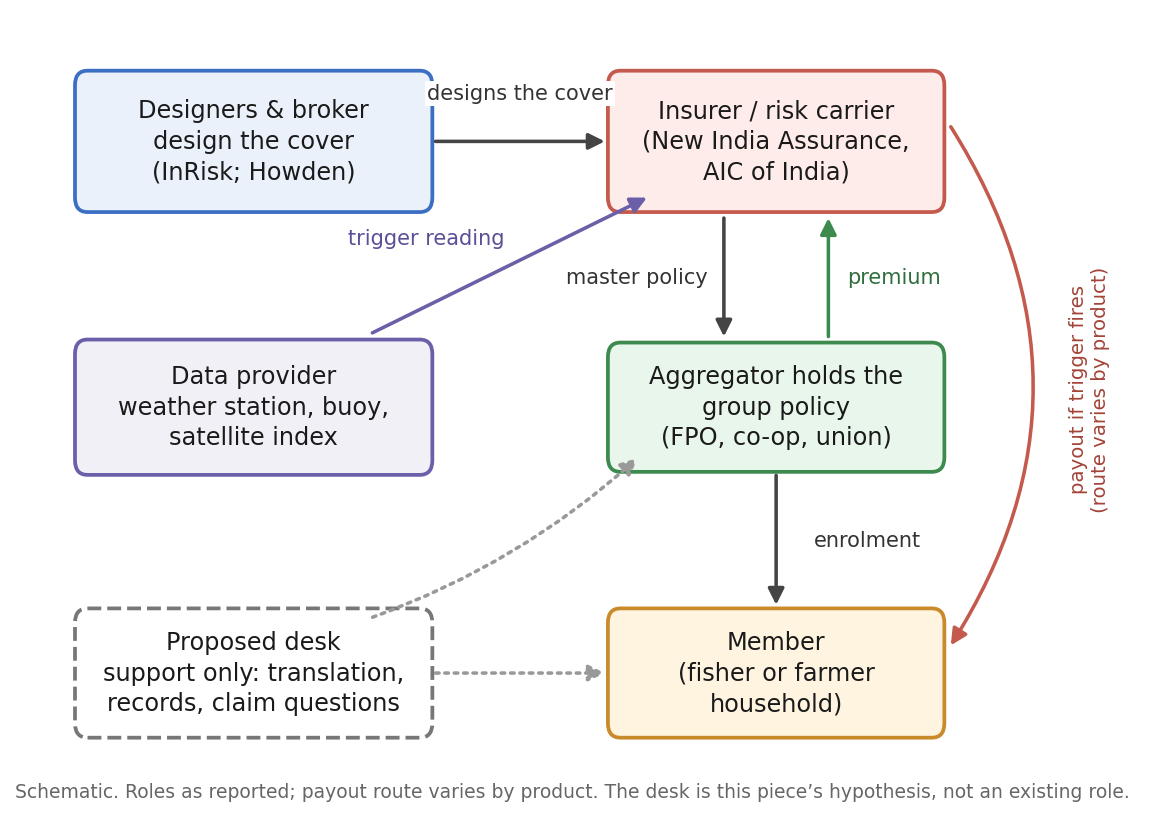
The chain from policy to payout, roles as reported. The desk this piece proposes works between the aggregator and the member.
That structure makes sense, and it concentrates the hard work at the aggregator. Someone must explain what a rainfall-index trigger pays and what it does not, handle enrolment documentation, keep the member-to-policy mapping straight, and stand in the middle when the index and the jetty disagree. Inside the current pilots, this work exists - the designers, the insurer's partners and the NGO teams do the village meetings and the hand-holding. The Philippine experience shows what it looks like at scale - and who pays. In November 2025 the national government, through the Bureau of Fisheries and Aquatic Resources and the state crop insurer PCIC, launched the country's first parametric cover for small-scale fishers with Rare and Willis, a WTW business - developed, per Rare's launch release, with support from the Ocean Risk and Resilience Action Alliance and funding from the Government of Canada and the UK Government's Blue Planet Fund. The premiums are paid by the fisheries bureau, so the cover is free to the fishers; by March 2026, PCIC reported between 11,000 and 12,000 policyholders against a target of about 14,000, across five provinces, with expansion to more coastal communities planned. Enrollment is uptake, not proof that claims have paid out well or that the economics stand on their own. The fact that matters here is the payer: a state bureau, not the co-op or the member. In India's pilots too, the last mile runs on a funded project. What I could not find in what I read is evidence of it surviving as a paid, local, ongoing service once the project team leaves.
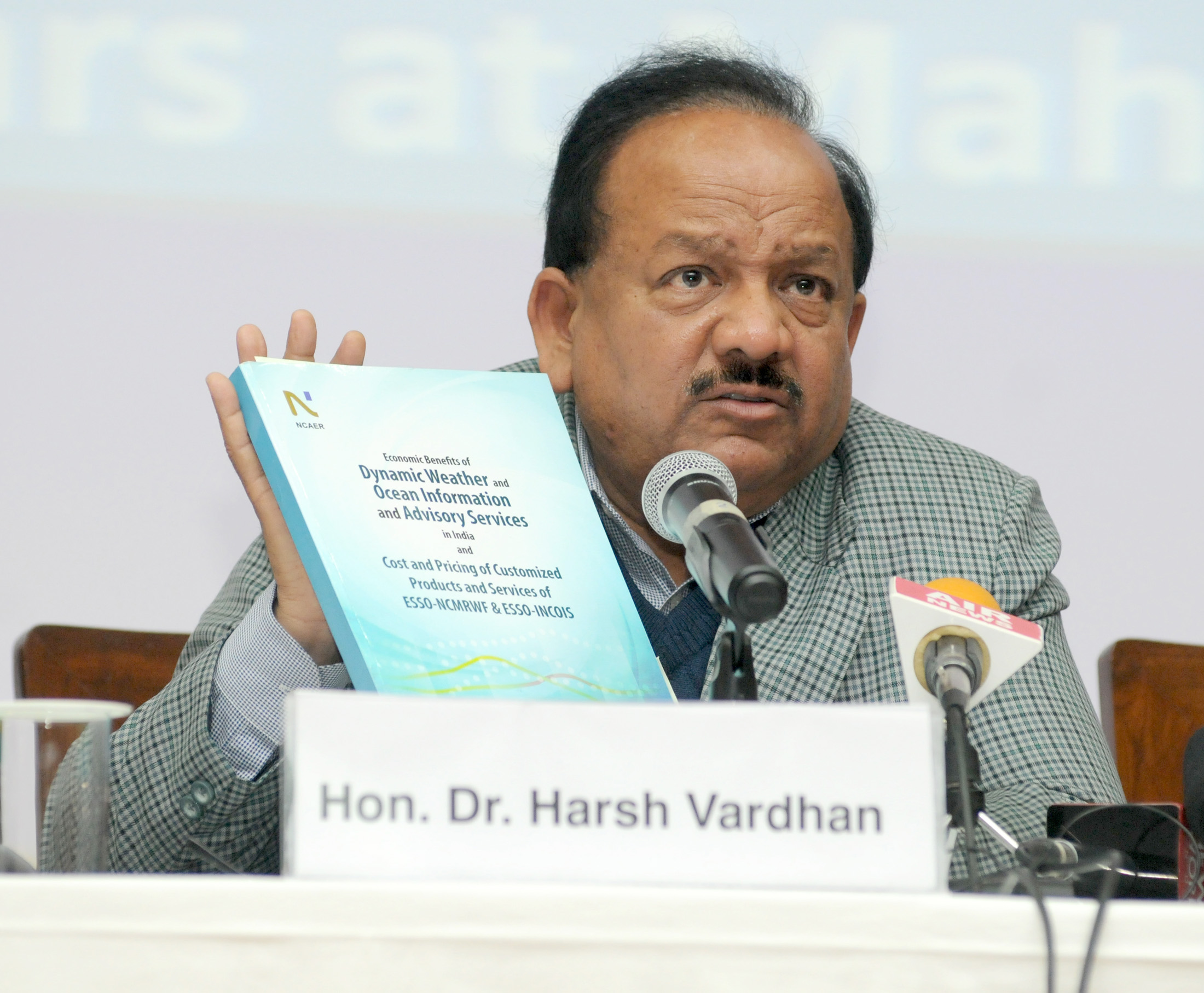
A 2016 press conference releasing a report on the economics of weather and ocean advisories for farmers and fishermen - the forecast pipe. Photo: Press Information Bureau (GODL-India), via Wikimedia Commons.
The desk between the policy and the people - and its limits
The shape I would test - a hypothesis, not a finding: a parametric support desk that works for aggregators and their members, on the customer side of the policy. The desk's proposed scope: translate the actual policy wording into the local language, run documentation, maintain the member records with their written consent, and when a trigger fires or stays silent, check the index reading against the named station and the wording, and help members question the outcome through the insurer's grievance channels when the three do not agree.
The regulated perimeter sits right through the middle of this. Scope, solicitation, enrolment, remuneration and premium handling all need current legal and insurer review before launch; the pilot I would test involves no selling, no enrolment for commission and no premium collection until authorised arrangements are verified. Where exactly the support work itself falls is a legal question I cannot settle from a statute text, and a licensed partner for any regulated step is necessary but not by itself a blanket cure. Member records carry data duties of their own, which written consent alone may not settle. And whether a co-op would pay for the support on its own is genuinely untested - in the Philippine programme and in India's current pilots, the payer has been the state or the project.
A starting configuration I would test, not an established model: one coastal district, one fisher cooperative, one live parametric product, one enrolment season. Staff it with one person who can read policy schedules and one local organiser the community already trusts; partner with a licensed broker for every regulated step; handle member documents only with consent and under the data duties that apply; quote the co-op a price for the support work in advance, with travel, documentation and training as cost categories rather than invented figures. Measure three things: what share of enrolled members can correctly state what the trigger pays, how long any claim or query takes to resolve, and whether the co-op renews the arrangement at its own cost. Two stop gates: walk if the insurer will not put the trigger data source in writing, and walk if no co-op will pay anything for the support after one season.
The state has built advisory pipes for these communities before - weather and ocean forecasts aimed at farmers and fishermen. A forecast tells you the storm is coming. A parametric policy promises a fixed payout if the contractual trigger fires - basis risk included. Somewhere between that promise and a fish shed in the Sundarbans there is work that today gets done inside projects, and the interesting question is whether it can ever get done as a business.
Sources
Reuters - India considers introducing nationwide climate-linked insurance scheme, 6 October 2025
Press Information Bureau - Cabinet approves continuation of Weather Based Crop Insurance Scheme
Cover photo: the Prime Minister meeting fishermen who were victims of Cyclone Ockhi, Kanyakumari, December 2017 - Press Information Bureau (GODL-India), via Wikimedia Commons.
Verified statements in this piece trace to the linked sources; the desk, its configuration, metrics and pricing are my hypotheses, labelled as such.
Responses
No responses yet - yours could be the first.
Get the notes
Occasional emails about what I'm building, what worked, and what broke.