
The Indian Canvas #148: Who Pays When the Crop Fails?
Crop insurance is a promise about a bad year. India's version of that promise is the Pradhan Mantri Fasal Bima Yojana (PMFBY), launched in 2016; the American version is the federal crop insurance programme run through the Department of Agriculture's Risk Management Agency. Both put a private insurance company between the farmer and the loss. The interesting question is who actually pays - and who waits.
The Indian farmer's premium is capped on foodgrain and oilseed crops at 2% of the sum insured for kharif and 1.5% for rabi - or the actuarial rate, whichever is less - and at 5% for commercial and horticultural crops, per the scheme's revamped operational guidelines. The insurer charges an actuarial, bidded or tendered rate, and the difference between that rate and the farmer's share is the premium subsidy, shared 50:50 between the Centre and the states; for north-eastern and Himalayan states and UTs the split is 90:10, per the ministry's scheme note. The equal split has a ceiling: the Centre's full share applies only up to an actuarial premium rate of 25% in irrigated and 30% in rainfed districts, and beyond that the state bears the excess, the guidelines say. Some states and UTs - the PRS analysis names Maharashtra, Odisha, Meghalaya, Puducherry and Jharkhand - were paying even the farmer's share as of its February 2026 publication; where a state subsidizes the full farmer share, the guidelines require a token farmer premium of at least one rupee for enrolment tracking.
Who funds that pool is on the parliamentary record. Over the five years 2021-22 to 2025-26, insurance companies collected ₹18,351.69 crore of premium from farmers, ₹66,177.87 crore from state governments and ₹55,738.64 crore from the Centre, the ministry told the Lok Sabha on 4 August 2026; on my arithmetic from that answer, farmers supplied about 13% of the ₹1,40,268 crore premium pool. The pool has been paying out at scale: between kharif 2016 and rabi 2025-26, more than 92.46 crore farmer applications were insured and over 26.33 crore applications were paid claims exceeding ₹2.06 lakh crore, the ministry's August 2026 scheme note records, with enrolment at an all-time high in 2024-25 - over 15.23 crore applications, over 4 crore farmers, over 623 lakh hectares. Twenty-five states and Union Territories are implementing the scheme in kharif 2026. For 2026-27 the Union Budget allocated ₹12,200 crore to the crop insurance schemes, roughly level with the revised estimate for 2025-26, per the PRS analysis; the cabinet had approved ₹69,515.71 crore in January 2025 to continue PMFBY and its weather-based sibling RWBCIS through 2025-26, the Press Information Bureau reported.
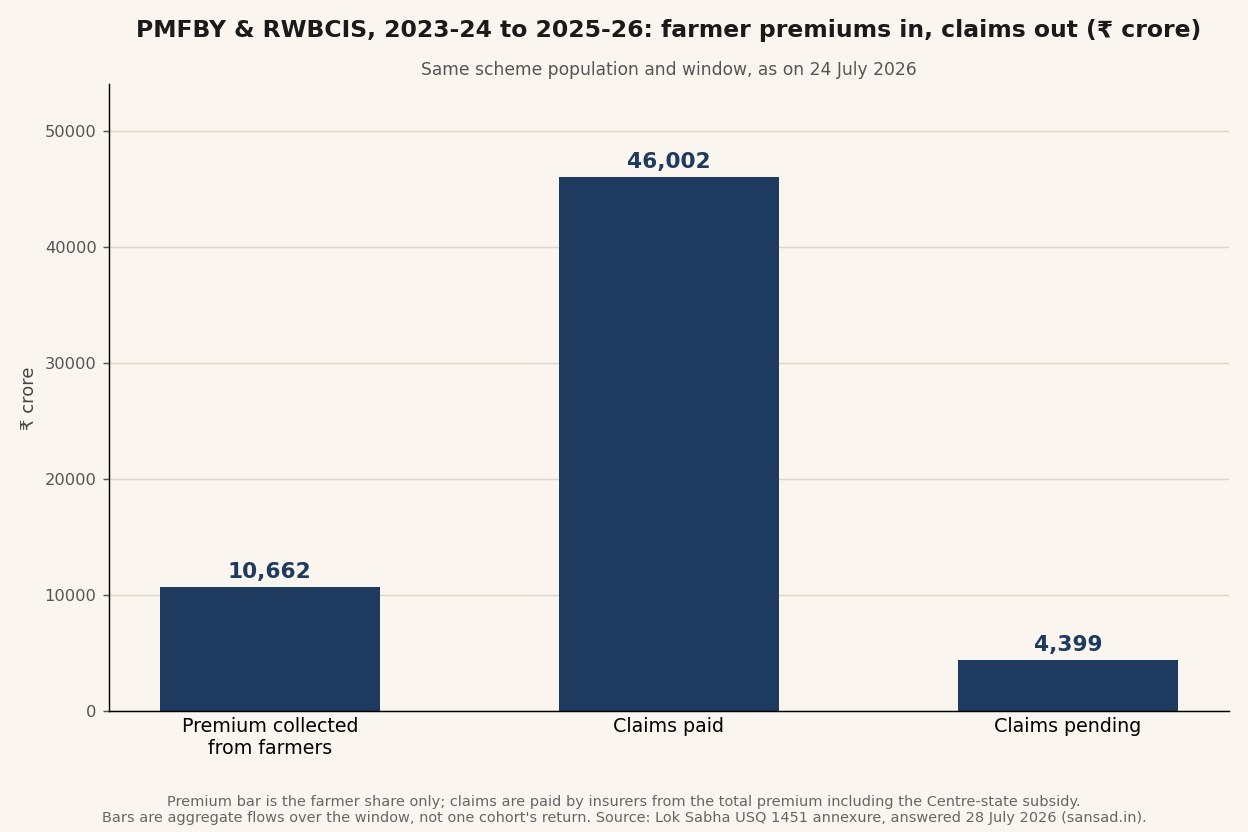
What came back to farmers is on the record too. Over 2023-24 to 2025-26, as of 24 July 2026, premium collected from farmers under PMFBY and RWBCIS was ₹10,662.32 crore, while claims of ₹46,002.08 crore were paid and ₹4,399.06 crore were pending, the annexure to a 28 July 2026 Lok Sabha answer shows. On my arithmetic over that annexure, ₹4.31 was paid in claims for every ₹1 farmers paid in across the window. That is not any single farmer's return - the bars below are aggregate flows across three reporting years, not one cohort - and the gap between them is filled by the Centre-state subsidy and the insurers' underwriting risk.
The scheme's rules give insurers 21 days to settle a claim once it is calculated on the National Crop Insurance Portal and the premium subsidy is received, the ministry's answer states. When settlement slips, the ministry's listed reasons are delay in providing the state government's share of subsidy, incorrect or delayed insurance proposals from banks, and disputes between states and insurance companies over yield data. The pending pile is concentrated: of the ₹4,399.06 crore pending as of 24 July 2026, ₹2,752.94 crore was Andhra Pradesh's - about 63%, on my arithmetic from the same annexure. Andhra's settlement record is the lowest in the ministry's state-wise table: 67.29% of its reported claims since 2016 had been settled as of 30 June 2026, against 97.16% nationally, a separate 21 July 2026 answer records. The annexures also mark Bihar, Gujarat, Telangana and West Bengal as "Not Implemented" in the later years of the claims table, and Punjab has never opted in.
The guidelines already price delay on both sides: insurers owe penal interest of 12% per annum on admissible pending claims beyond 30 days of the yield data being uploaded, subject to the state releasing the applicable subsidy, and a state that runs more than three months past its subsidy cut-off owes a penalty at 12% per annum, payable into a central technology fund. The July 2026 answer says that from kharif 2024 this "penalty of 12% is auto-calculated and levied" through the portal on insurers, and from kharif 2025 on states that delay their share; it does not break out how much has been collected. From kharif 2025 states must also open escrow accounts to deposit their premium share in advance, and the Centre's share of premium subsidy has been delinked from the states' share so that, in the ministry's words, "farmers can get proportionate claims relating to the Central Government share" without waiting on the state. These are newer versions of an old prescription: a parliamentary committee had recommended back in 2018 that a farmer's premium be returned with interest when the delay is caused by a state's non-payment of subsidy, and in 2024 the Standing Committee on Agriculture suggested exploring compulsory universal crop insurance for smallholders up to two hectares, the PRS analysis records.
The American design answers the same question through a different money path. Premiums there are set so that they equal the expected payments for crop losses, the Congressional Budget Office explains. The federal government pays about 60% of total premiums on average and farmers about 40%; private companies sell and service the policies; the federal government reimburses their administrative costs, expected at $2.4-2.5 billion a year over 2025-2034, and reinsures the companies through a Standard Reinsurance Agreement. There is no state share in that path: the subsidy and the reinsurance are both federal. CBO estimates the companies' rate of return at 14.5% for crop year 2023, within a 14.4%-34% band across crop years 2013-2023. And payouts scale with the year: indemnities for crop year 2024 summed to about $25.5 billion in the RMA's county-level file as of 10 March 2025, on my aggregation of its 2,972 county rows.
India has also been moving part of the tail risk back onto government budgets. Since kharif 2023, three "alternate risk transfer models" - cup-and-cap variants and a profit-and-loss sharing model - have been implemented in which, where a state adopts them, part of the government's premium subsidy returns to it when claims run below the model's threshold, and governments pay the additional claims when claims breach it, per the August 2026 answer; ₹15,552.29 crore has been refunded to the Centre and states under these models out of the five-year premium it reports.
Strip both systems down and they share a chassis: an actuarial premium, a subsidized farmer share, private insurers carrying the paper, and government money behind the pool. They differ in what the farmer pays: India caps it as a share of the sum insured - 1.5%, 2% or 5% depending on the crop - while the American farmer pays about 40% of the total premium on average. They also differ in how many treasuries the money passes through. Government has carried most of the premium in both systems - about 87% in India over the five years to 2025-26, on my arithmetic from the August answer, and about 60% on average in America, per CBO. In America it travels from one treasury; in India, where a state's subsidy release is pending, that part of the claim still waits on the state budget.
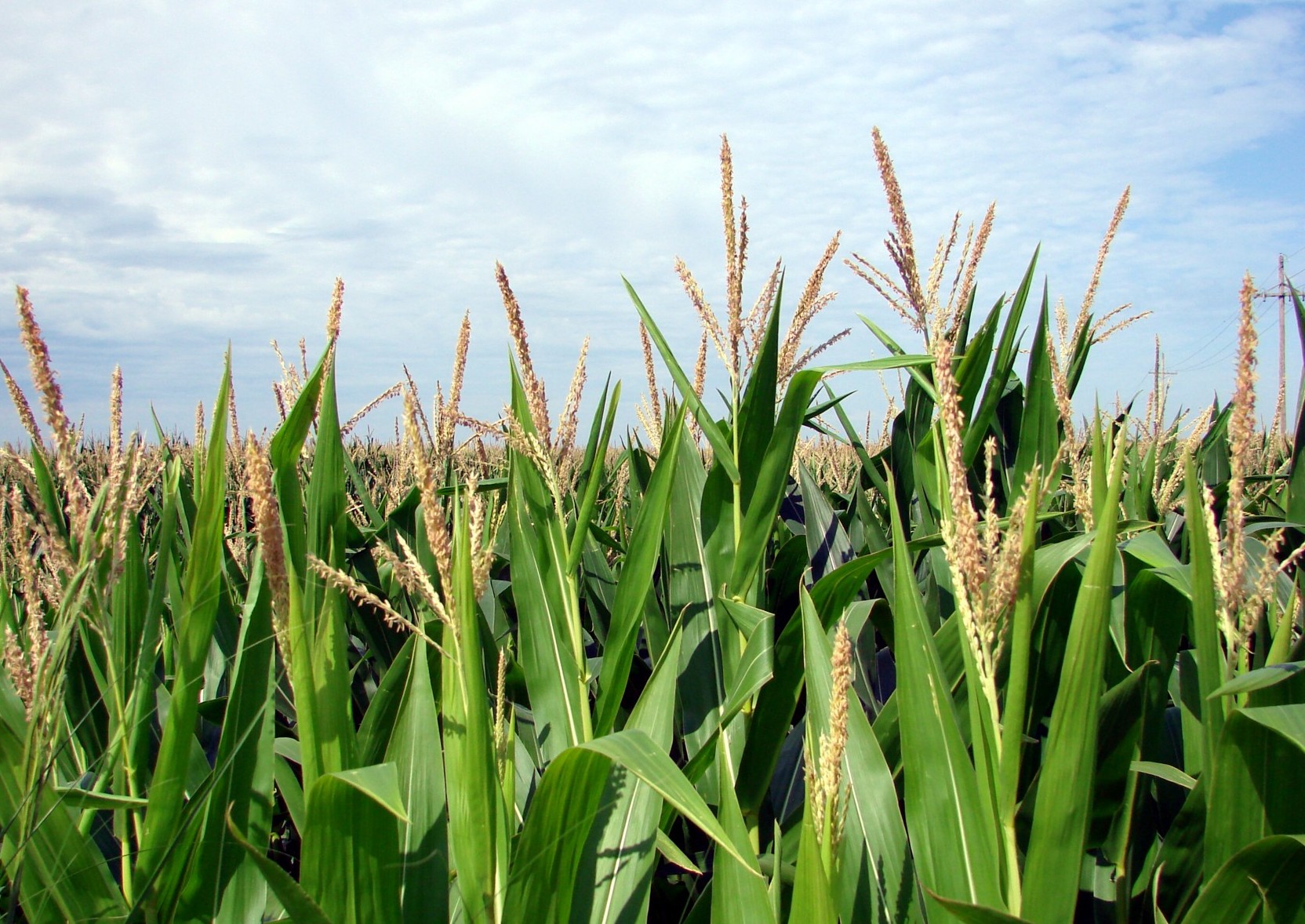
Sources: Lok Sabha USQ 444, claim settlement under PMFBY (21 July 2026); Lok Sabha USQ 1451, PMFBY implementation review (28 July 2026); Lok Sabha USQ 2644, PMFBY premium shares and risk-transfer models (4 August 2026); PMFBY revamped operational guidelines (17 August 2020); PRS, Demand for Grants 2026-27: Agriculture (24 February 2026); PIB, PMFBY scheme note (29 August 2026); PIB, cabinet continuation of PMFBY/RWBCIS (1 January 2025); US Congressional Budget Office, crop insurance budget option; USDA RMA, 2024 crop indemnity data (10 March 2025). Photos: cover - drought-affected farmland, Karnataka, 2012 (Pushkarv, CC BY-SA 3.0, via Wikimedia Commons); in-text - tasseled corn crop, NW Iowa, 2013 (inkknife_2000, CC BY-SA 2.0, via Wikimedia Commons).
Responses
No responses yet - yours could be the first.
Get the notes
Occasional emails about what I'm building, what worked, and what broke.