
The Indian Canvas #144: Who Pays When Food Becomes Fuel?
The pump meter at a city fuel station counts rupees and litres, and nothing on its face says where the litre came from. Between November 2025 and June 2026, about one-fifth of the petrol India sold, by volume, was ethanol - made mostly from sugarcane and maize, with smaller streams from surplus rice and damaged foodgrains.
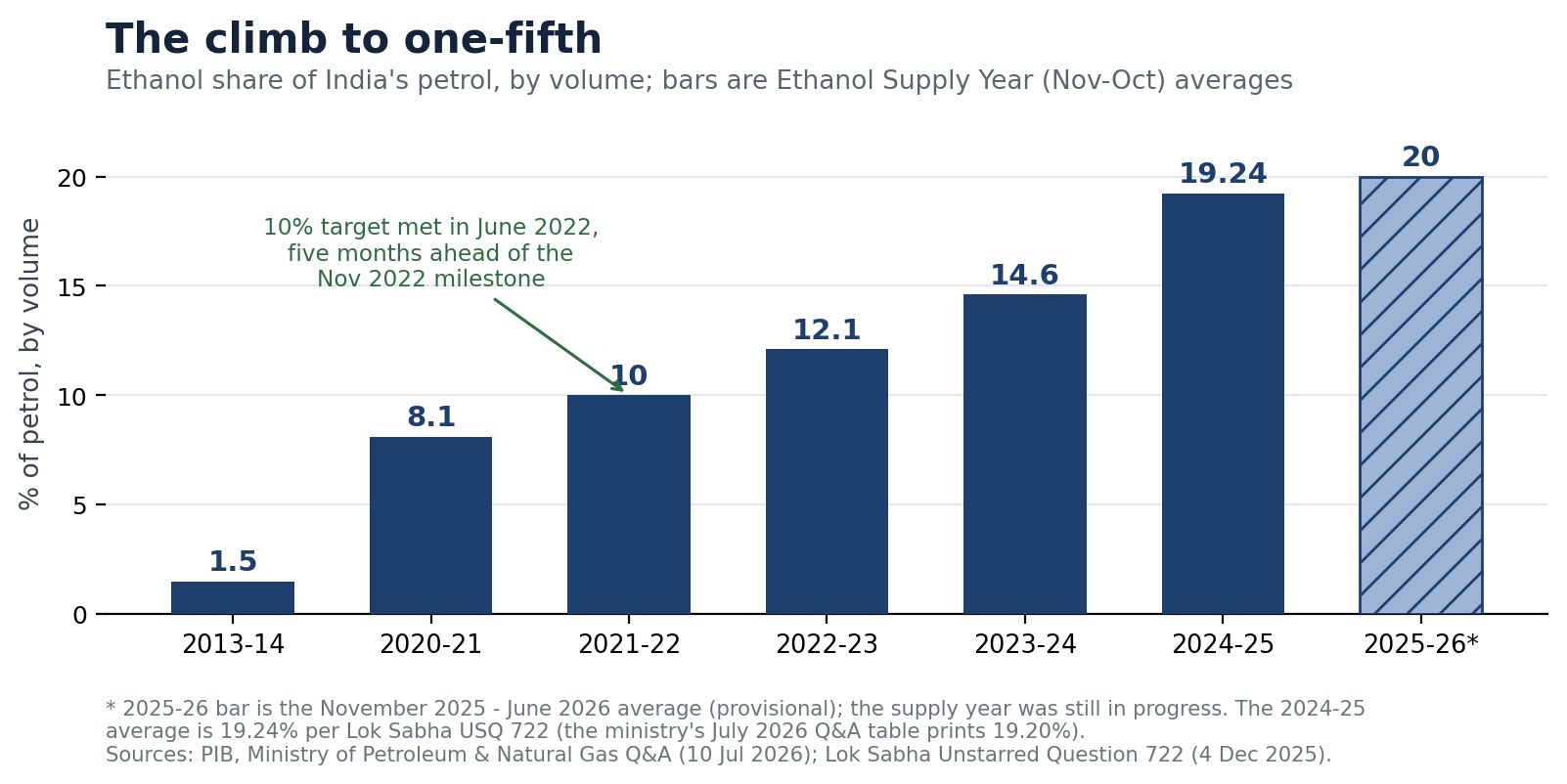
The climb was deliberate and fast. In Ethanol Supply Year 2013-14 (supply years run November to October), oil marketing companies blended 38 crore litres of ethanol into petrol, about 1.5 per cent by volume, the petroleum ministry records in a July 2026 question-and-answer release. The blend reached 10 per cent in ESY 2021-22 - achieved in June 2022, five months ahead of target - and averaged 19.24 per cent in ESY 2024-25, on more than 1,000 crore litres, the ministry told the Lok Sabha in December 2025. The ministry reports about 20 per cent for November 2025 to June 2026, a provisional part-year average.
The product India built to get here is not a fuel. It is a purchase order. The Cabinet Committee on Economic Affairs sets administered prices for molasses-derived ethanol: its 29 January 2025 decision fixed the C-heavy molasses rate for ESY 2024-25 at Rs 57.97 a litre. For the rest, the ministry's July 2026 release reports provisional procurement rates for ESY 2025-26 of Rs 71.86 a litre for maize, Rs 65.61 for sugarcane juice and Rs 60.73 for B-heavy molasses, before taxes, transport and handling. Assured offtake did the rest: 233 long-term offtake agreements between the oil companies and dedicated ethanol plants, interest subvention schemes between 2018 and 2022, and a 5 per cent GST rate for ethanol meant for blending, per the ministry's Lok Sabha answer. Distillation capacity rose from roughly 400 crore litres a decade ago to more than 1,950 crore litres.
Who bears the cost of a fixed price has several candidates, and the motorist is one of them. The ministry itself concedes that "in some vehicles there may be a 3-5 per cent reduction in fuel economy" on E20; the NITI Aayog roadmap that designed the transition had earlier called the loss marginal for four-wheelers designed for E10 and calibrated for E20. There is no lower-blend choice at the retail outlet: the ministry argues that running parallel nationwide supply chains for pure petrol, E10 and E20 across more than one lakh outlets is not workable. On cost, the ministry's own arithmetic is candid: with ethanol procured at around Rs 71 a litre, it says, E20 is costlier to produce than pure petrol when crude trades around $70 a barrel, and the economics reverse if crude rises toward $120-130. Its answer to the cost question is insulation: with a fifth of the petrol pool bought at a rupee price that does not move with Brent each morning, it argues, the pump is less exposed to oil's swings.
The second name on the bill is the feed chain. Maize has become the programme's biggest feedstock, the food ministry told the Lok Sabha on 17 December 2025: 125.75 lakh tonnes of maize went to ethanol in ESY 2024-25, against maize production of about 434 lakh tonnes. By my arithmetic on the ministry's numbers, maize-based ethanol accounted for 477.8 crore litres of the more than 1,000 crore litres supplied in ESY 2024-25 - close to half. The poultry industry, which competes for the same grain, is adapting rations with rice bran, broken rice, bajra and wheat offal, the minister's answer notes. Rice from the Food Corporation of India reaches distilleries only from surplus Central Pool stock after buffer and public distribution needs are met - 52 lakh tonnes allocated in each of the last two supply years, of which distilleries actually lifted 31.83 lakh tonnes in 2024-25.
There is also a ledger running the other way, and it is large. The ministry counts, cumulatively since ESY 2014-15 and as of July 2026: over Rs 1.97 lakh crore of foreign exchange saved, nearly 316 lakh tonnes of crude substituted, about 952 lakh tonnes of carbon dioxide avoided, and more than Rs 1.66 lakh crore it says has been transferred directly into the hands of farmers. The release does not provide a breakdown or method that lets me independently check the farmer-transfer figure, and it presents no accounting of the programme's fiscal cost against the foreign-exchange saving. NITI Aayog's lifecycle study put greenhouse-gas emissions from sugarcane ethanol at 65 per cent below petrol, and maize ethanol at 50 per cent below. On vehicle safety, the ministry cites Maruti Suzuki's report of 2.84 crore vehicles serviced in FY 2025-26, including 1.5 crore older vehicles not certified for E20, with no E20-linked corrosion, abnormal wear or component-life damage reported; the release does not say whether these are unique vehicles or service visits, and they are the company's numbers relayed by the ministry, not an independent test.
The reference model for all of this is Brazil, and it is still moving. Brazil's ethanol policy roots go back to 1931, with mandatory blending from 1938 and the Proalcool programme from 1975. The mandate stood at 27 per cent from 2015. The Brazilian government's August 2026 notice says the blend rose from 30 to 32 per cent on 1 August 2026 for 180 days, extendable by another 180, with 35 per cent the law's ceiling, pending further fleet tests. Flex-fuel vehicles that run anything from E27 to pure hydrous ethanol made up over 80 per cent of new vehicles sold there in 2019, per NITI Aayog's roadmap; the US Department of Agriculture records the mandate's arc from 1931 to E27 in 2015. India is only starting down the flex-fuel road: the cabinet's January 2025 ethanol decision lists the launch of flexi-fuel vehicles among its recent enablers.
Here is my hypothesis, and it is a hypothesis: the ethanol programme is as much farm and industrial policy as fuel policy - a guaranteed buyer at a reported price, built so that crops can compete with crude. Who ultimately bears the cost difference the ministry's own crude-parity arithmetic implies - motorists, taxpayers or the companies - I cannot quantify from these sources, and I will not pretend to. Two stresses will test it before the blend number does. One is water: NITI Aayog's own task force under Ramesh Chand estimated that sugarcane and paddy together already use 70 per cent of India's irrigation water, which is why the roadmap argues for the shift to maize and second-generation feedstock. What a maize-heavy ethanol economy does to aquifers in its new growing belts is a question the sources do not yet answer, and I will not pretend otherwise. The other is the feed chain, which now shares its grain with the fuel tank. For rice, the ministry's answer is the surplus-stock rule - but that rule covers FCI rice alone; for maize, now the biggest feedstock, the answer is that production, at about 434 lakh tonnes, is sufficient for ethanol, poultry and other uses. Both answers hold until the year they don't. The next time sugar runs short or maize prices spike, those answers - not the 20 per cent - are what get audited.
Sources: Press Information Bureau, Ministry of Petroleum & Natural Gas, Ethanol Blended Petrol Programme Q&A (10 July 2026); Cabinet Committee on Economic Affairs, administered ethanol price decision for ESY 2024-25 (29 January 2025); Lok Sabha Unstarred Question 722, Ministry of Petroleum & Natural Gas (4 December 2025); Lok Sabha Unstarred Question 2961, Department of Food and Public Distribution (17 December 2025); NITI Aayog, Roadmap for Ethanol Blending in India 2020-25 (June 2021); US Department of Agriculture, Biofuels Annual - Brazil (2024); Government of Brazil, Secom notice on the E32 blend (August 2026). Photos: sugarcane harvest at Doddagowdana Koppalu, Karnataka, by Timothy A. Gonsalves (CC BY-SA 4.0) and a Bharat Petroleum station near Nagpur by Ganesh Dhamodkar (CC BY-SA 4.0), both via Wikimedia Commons.
Responses
No responses yet - yours could be the first.
Get the notes
Occasional emails about what I'm building, what worked, and what broke.