
The Indian Canvas #97: Punjab has the machines, the mandate and the buyers. Why is the straw still burning?
Between 15 September and 17 October this year, the satellite count stood at 220 crop-residue fires in Punjab - a shade ahead of the 208 counted in the same window last year, a rise of about 6 per cent, and a fraction of the 1,289 counted in that window in 2024. Madhya Pradesh, at 354, led the six-state table that the Indian Agricultural Research Institute maintains for the season, the Hindustan Times reported. Four of every five Punjab fires came from just two districts, Amritsar and Tarn Taran, whose administrations were served notices by the air quality commission in mid-October. The arc is not simple: far below two years ago, ticking up against last year, and concentrated enough that two district offices got a legal letter.
Yet the same straw has buyers it is not reaching. A Ministry of Power policy of 7 November 2025 sets annual co-firing blends for coal-based thermal plants from FY 2025-26. Plants in the NCR must run a 5 per cent blend of biomass pellets by weight, plus a further 2 per cent that may be pellets or torrefied charcoal made from municipal waste; plants in other regions must run 5 per cent, met with pellets or such charcoal. An exemption committee, a review clause and cost pass-through are written into the text. One clause matters more than the rest for this story: for plants in the NCR and adjoining areas, it is mandatory that at least half the raw material in their pellets be rice-paddy stubble or straw, sourced exclusively from the NCR and adjoining areas. At the India Bioenergy and Tech Expo in August, the Central Electricity Authority's Member (Thermal), T Venkateswarlu, put installed pellet capacity outside the NCR at around 38,000 tonnes a day, with effective capacity of about 30,000, against a requirement of around 130,000 tonnes a day - the quote, as reported, does not break out the geography of that requirement, so it cannot be set against the outside-NCR capacity figure. Co-firing volumes, on the CEA's figures, rose from about 1.6 million tonnes in 2024-25 to about 3 million tonnes in 2025-26.
On paper, there is no shortage of straw. Punjab alone generates an estimated 20 million tonnes of paddy residue a year, an estimate reported in September 2025 - an aggregate figure, not proof of supply a buyer can actually reach. The government's biomass mission, SAMARTH, counts about 206 million tonnes of surplus agricultural residue nationally, citing a 2025 study. At the same expo, SAMARTH's mission director named the missing piece in plain terms: the first gap is aggregation, and agricultural aggregation "needs to be recognised and developed as a formal industry". This piece asks a narrower question: the straw is cut in a few weeks and needed all year - who carries it across the months between?
The buyers, and what they actually buy
The obligated buyers are the coal plants, and what they must procure is processed fuel - biomass pellets, or in the permitted cases torrefied charcoal - not raw bales. Between the field and the boiler sits the pelletiser, and it is the pelletiser that must find the straw: the customer a carry pilot would sell to. The oil and gas regulator's August 2026 tally counts 207 functional compressed biogas plants in the country - against the thousands envisioned when the SATAT scheme launched in 2018 - and biogas plants can take paddy straw among their feedstocks. The Punjab Pollution Control Board counts 74 paddy-straw pellet units operating across 20 districts, with 72 more entrepreneurs registered - registrations are plans, not operating capacity, but the new fleet could process about 2.2 million tonnes a year on top of the existing 1.9 million if built. Biomass power plants buy bales directly; one of them anchors the university study this piece leans on. And at Panipat, Indian Oil's 2G ethanol refinery - 100 kilolitres a day of design capacity, an approved capital cost of Rs 984 crore as the government told the Lok Sabha - was designed to consume about 2.1 lakh tonnes of dry rice straw a year.
Harvest gives these buyers a few weeks of supply. Their need runs twelve months. Whoever bridges that gap - farmer, trader, plant or someone new - is the business this piece is about.
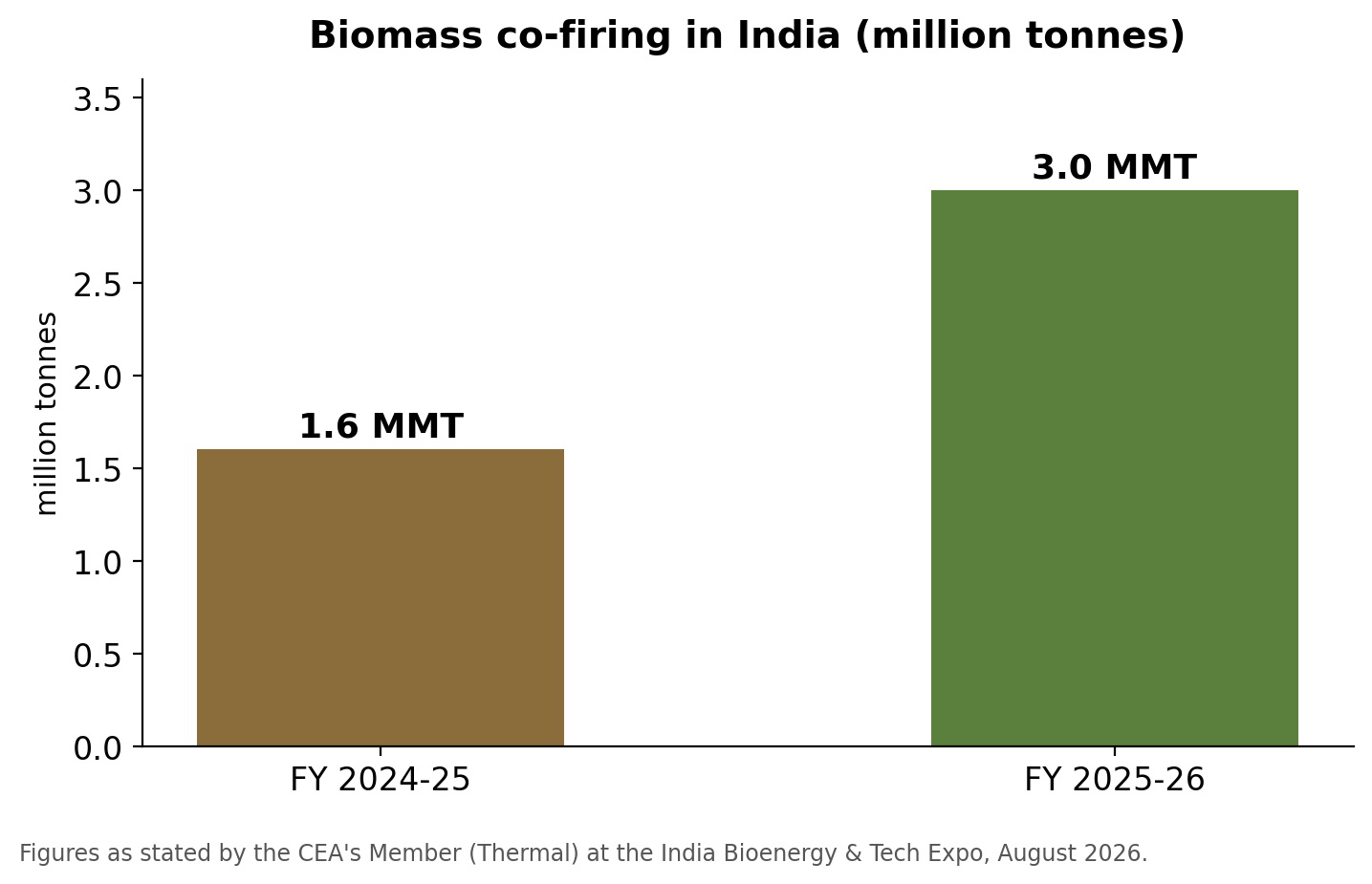
Biomass co-firing volumes in India, as stated by the CEA's Member (Thermal) at the India Bioenergy & Tech Expo, August 2026.
The machines do not stay alive
Now the supply side. The Centre's crop residue management scheme, running since 2018, pays half the cost of residue machinery for individual farmers and 80 per cent for custom hiring centres; Punjab's allocation this year is Rs 576 crore, its ninth consecutive year of support, with the state now contributing 40 per cent under the revised funding pattern. The Hindustan Times reported in April that about 1.6 lakh machines have been supplied since 2018, of which roughly 40,000 - about a quarter - have become redundant from wear, against a typical machine life of five to six years; the state's target is 23,000 more machines this year. Two cautions belong with those numbers. They span the whole subsidised fleet - in-situ machines like the Happy Seeder that work residue into the field, and ex-situ machines like balers that carry it away - not just the balers this piece follows. And machines on a register do not by themselves explain fires, which have their own economics: the same paper notes farmers burn to clear fields inside the short sowing window.
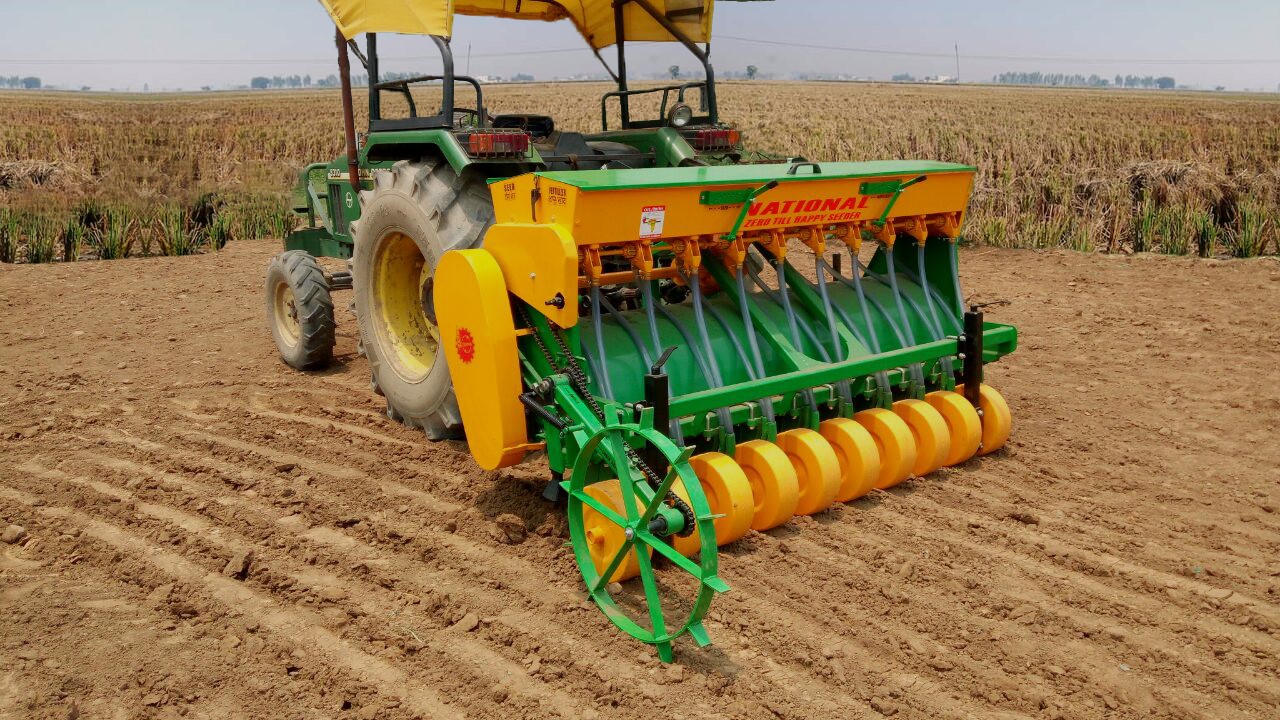
A Happy Seeder - an in-situ machine that sows the next crop through the residue. It is one of the machine types the subsidy buys. Photo: FatherofGod, CC BY-SA 4.0, via Wikimedia Commons.
What one study found
The most useful Indian numbers I found come from a single Punjab Agricultural University study of the straw supply chain around one working biomass power plant at Sri Muktsar Sahib, using 2023-24 data. It is one plant's catchment, not a map of the state - but it is detailed in a way nothing else I read was. Among the operators the study tracked, baling a quintal of straw that year cost Rs 147.37 all-in - machinery depreciation and interest, fuel, labour, twine, transport - and sold for about Rs 175, leaving about Rs 27.63. Transport was the largest variable cost, at about 27 per cent of the variable total, and the study cites the rule of thumb that hauling bales beyond about 15 kilometres turns uneconomical - the same 15-kilometre ring it drew its sample from. The studied machines baled on about 42 days in the year on average, and their owners ranked machinery cost as their biggest constraint, followed by the difficulty of collection and transport. Read those as one study's findings, not laws of the business. What they leave out matters as much: no storage, no grading, no working capital beyond the machine, no allowance for a buyer who pays late or a shed that catches fire. Baling is not the business. Carrying is.
Two countries that solved the carrying
The carrying problem is not new, and two places have run it at scale for years. Denmark has burned straw for heat since 1980. A 2020 review prepared under the EU's Horizon 2020 programme counts about 55 straw-fired district heating plants in operation. The organisation is the interesting part. Plants keep only about a week's buffer; the year's straw sits in decentral stores - barns and wrapped stacks - held by farmers and agricultural contractors, who have invested in balers and storage since the 1980s to serve the energy sector. Payment follows weight and moisture: 14 to 15 per cent water is optimal, at 18 to 20 per cent some plants cut the price, and at 25 per cent or higher most plants reject the straw outright. The contract shape has evolved too: early plants signed long-term indexed contracts with farmers, some badly, and as supply matured the market moved to open bidding. Contracts built the Danish straw market; competition now runs it.
England offers the second ownership model. The 40-megawatt Sleaford plant in Lincolnshire has burned straw since 2014 - its operator signed a fresh twelve-year maintenance agreement in 2022, and its environmental permit was varied in 2024 - and a 2020 notice describes it drawing daily from a small number of what it calls strategic storage sites: bale stores on farms and disused airfields. There, the plant side organises the carry. The lesson is not that one structure wins. It is that the carry - storage, grading, and an owner for the bales between harvest and boiler - is treated as a job in itself.
Who already moves straw here
The Indian chain exists in pieces, and this piece shares its shape with an earlier one in this series - the used-cooking-oil collection piece - so the difference is worth stating: that was a year-round waste stream sold spot; this is a seasonal crop that must be carried across time. Collection here is real: Haryana announced a common determined rate of Rs 2,500 a tonne in 2023 and channelled district collection toward Panipat; farmers with subsidised balers sell bales to biomass plants, the arrangement the PAU study measured; NTPC was contracting pellets years before the national mandate - by January 2022 the government counted 59,000 tonnes co-fired, contracts for 11 lakh tonnes and tenders for 55 lakh. BiofuelCircle is the direct competition for anything new: it sells year-round feedstock supply as a service to biogas and biofuel plants, alongside a marketplace with transport and settlement. Marketplaces like Buyofuel and Kissaan Sampatti list residue lots. A 2020 report had one Ambala firm pledging 1.5 lakh tonnes of collection for Haryana's plants - a pledge I could not verify the delivery of.
What remains unresolved, honestly stated: the public materials I reviewed do not show who, in India, owns the straw in the months between harvest and burning - who carries the inventory, the financing and the fire risk on their own balance sheet. That is not proof that nobody does. It is also not only my reading: a 2025 study by the Council on Energy, Environment and Water - distributed by the Climate and Clean Air Coalition - interviewed eight straw-using companies in Punjab and found effective biomass storage missing from the policy conversation, even as schemes fund baling, collection and utilisation.
The business the gap describes
The shape I would test - a hypothesis, for an underserved catchment, not a claim about empty national space: a straw carry operation for one district, anchored to one plant. The Danish and English evidence says the function can sit with a contractor or with the plant itself, so the first offer is not competition with the plant but a service to it: depots run close to the fields - the study's 15 kilometres is one catchment's rule of thumb, not a universal boundary - with covered storage sized between harvest and delivery, and bales graded on moisture before they move, the way Danish plants grade at the gate. The costs are quoted in components, not invented: baling, measured against the PAU study's 2023-24 figure of Rs 147 a quintal for baling alone; storage, its own line, with Denmark's cost-versus-quality tradeoff as the caution that cheap storage throws bales away; financing for inventory that sits for months; and a risk line for fire, rain and late payment. Who pays the financing, and who bears storage damage or a defaulting buyer, are contract terms a pilot would negotiate - not assumptions a plan can make. Land, storage and fire permissions for the depots are part of the setup cost, not an afterthought.
A starting configuration, labelled as such: one district, one anchor plant, one season. Quote the plant a carry contract first - buy in the window, store, deliver graded bales against a schedule - before any depot is leased. Measure three things: tonnes delivered on specification against the contract, cost per component against its own benchmark (baling against the PAU figure, storage and financing against their quotes), and whether the plant renews. Two stop gates: walk if no plant will sign a carry contract at a price that covers the full chain, and walk if delivered cost lands above what the plant's own economics can absorb. Denmark's history carries the final caution: long contracts built that market, then bidding replaced them. A carry contract is a bridge, not a moat - which is why the pilot would measure renewal, not just a first season.
This week the fires are being counted again, concentrated in two districts, below 2024 and above last year. The machines are subsidised, the mandate is written, the pelletisers are registered. Somewhere between the field and the boiler, October's straw needs an owner in May. Abroad, farmers, contractors and plants take that job. Whether an operator here takes it - district by district, under one plant's contract - is what a season could test.
Sources
Hindustan Times - Madhya Pradesh leads farm fires with 354 incidents, Punjab at 220, 19 October 2026
PNGRB - CBG market overview FY 2025-26 (207 functional plants), August 2026
Sleaford Renewable Energy Plant - Offsite storage of straw (strategic storage sites), November 2020
BWSC - 12-year operation and maintenance extension for Sleaford, January 2022
Environment Agency - Sleaford Renewable Energy Plant permit variation notice, February 2024
Verified statements in this piece trace to the linked sources; figures from the CEA and SAMARTH are as reported by the outlet that covered the expo. The carry operation, its configuration, metrics and gates are my hypotheses, labelled as such.
Cover photo: farmers raking stubble in a smoke-hazed field. Photo: Neil Palmer (CIAT), CC BY-SA 2.0, via Wikimedia Commons.
Responses
No responses yet - yours could be the first.
Get the notes
Occasional emails about what I'm building, what worked, and what broke.