
The Indian Canvas #132: The Boiler You Never Buy
On 13 October, a two-year-old Paris company called Epyr announced an oversubscribed €15 million Series A to do something most factories never thought to ask for. Not a cheaper boiler. Not a greener fuel. Epyr sells steam, the way a utility sells power: it builds, owns and operates a heat battery on your site, and bills you for the heat you use. You never buy the boiler.
The physics is almost disappointingly simple. When electricity is cheap, smart controls push power through resistors that heat air, and the air heats firebricks that hold the energy at high temperature. When the plant needs steam, the bricks give it back. The whole trick is timing: charge when the grid is drowning in solar and wind, discharge when the process calls. SlateVC, which led the round, notes that France in 2026 has already logged more hours of near-zero or negative power prices than in all of 2025. The fuel Epyr stores is, increasingly, electricity nobody else wants.
And this is not a rendering. Epyr’s first unit has been running since May at WEPA Group’s paper mill in Troyes, France’s first industrial thermal energy storage installation, built and commissioned in under six months and now covering up to a quarter of the site’s steam. WEPA liked it enough that its own venture arm joined the Series A. Next is a 35 MWh unit at Papeco’s mill in Normandy, announced as France’s largest thermal storage project, designed to replace the site’s entire natural gas consumption. It has been announced, not yet commissioned; that distinction matters.
The product is the financing
SlateVC’s own investment note says the quiet part aloud: their research on industrial heat showed that the business model matters as much as the technology. Epyr calls its offer Heat-as-a-Service. The customer signs a heat contract, not a purchase order. No capital expenditure, no boiler-room staffing problem, no technology risk on the plant manager’s desk. For those who want ownership, a build-and-operate variant exists. But the default is: you buy steam, Epyr owns everything behind the steam.
The company claims the stakes are enormous: industrial heat, it says, accounts for roughly 25% of global energy consumption, most of it still made by burning gas, oil or coal. The figure is Epyr’s, and it is plausible territory, but treat it as the company’s framing. What is independently checkable is the behaviour of the people writing cheques: the customer’s own investment arm doubled down, and the lead investor is explicitly betting on the model, not the brick.
India has the boilers. Who owns them is the question.
This is where it gets interesting for us, because India has just counted its boilers for the first time. The national boiler inventory published by iFOREST in 2025 estimates 45,226 process boilers across the country, with 428 kilo-tonnes per hour of installed steam capacity generating an estimated 1.26 billion tonnes of steam a year. The shape of that stock is the story. Eighty-five percent of the boilers are small, up to 10 tonnes per hour, and together they hold only 37% of installed capacity. The average boiler is 18 years old. Forty-eight percent of capacity burns biomass, 40% fossil fuels, and the food industry alone accounts for 41% of installed capacity, followed by chemicals and refineries. Eight states, led by Gujarat, Maharashtra and Tamil Nadu, hold two-thirds of the stock.
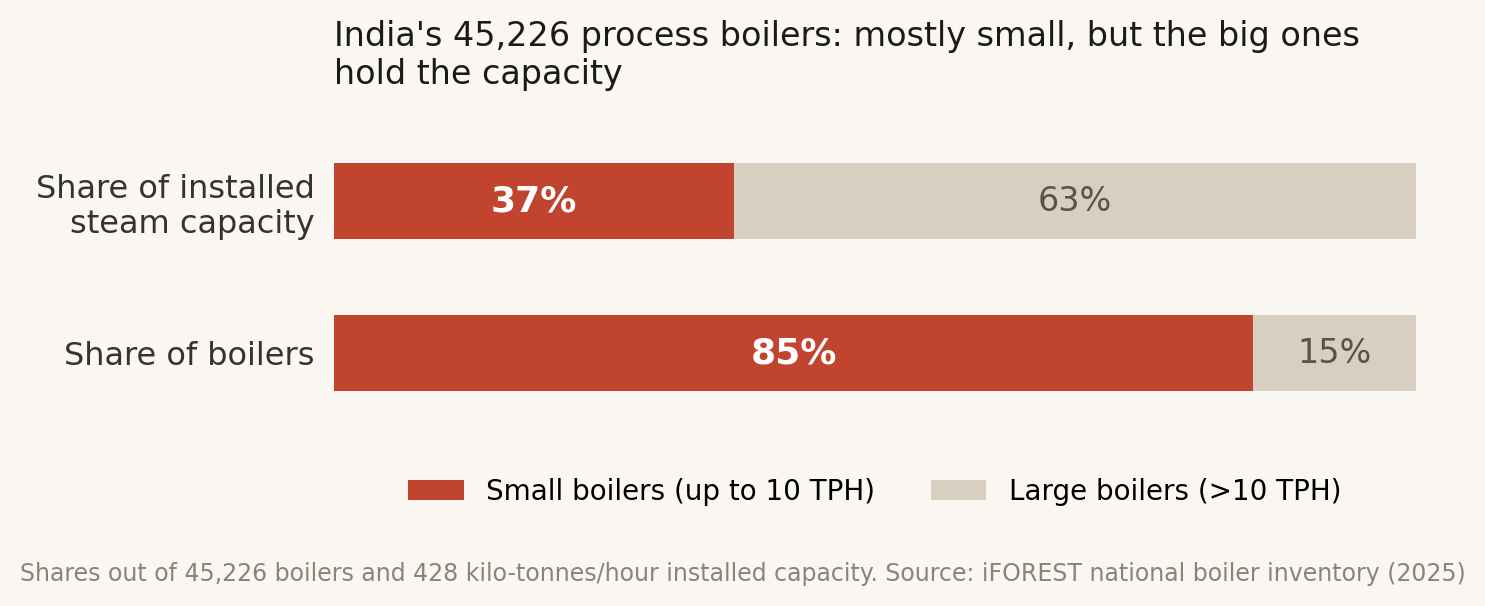
Of India’s 45,226 process boilers, 85% are small (up to 10 TPH), yet they hold only 37% of installed steam capacity. Source: iFOREST national boiler inventory (2025).
And here is the detail that made me sit up: the iFOREST report itself, after noting that small boilers are too scattered to regulate or retrofit one by one, names the escape hatch. “Steam-as-a-Service (SaaS) model,” it says, “can potentially be used to decarbonise steam in MSME sector.” India’s own boiler census points at the Epyr shape.
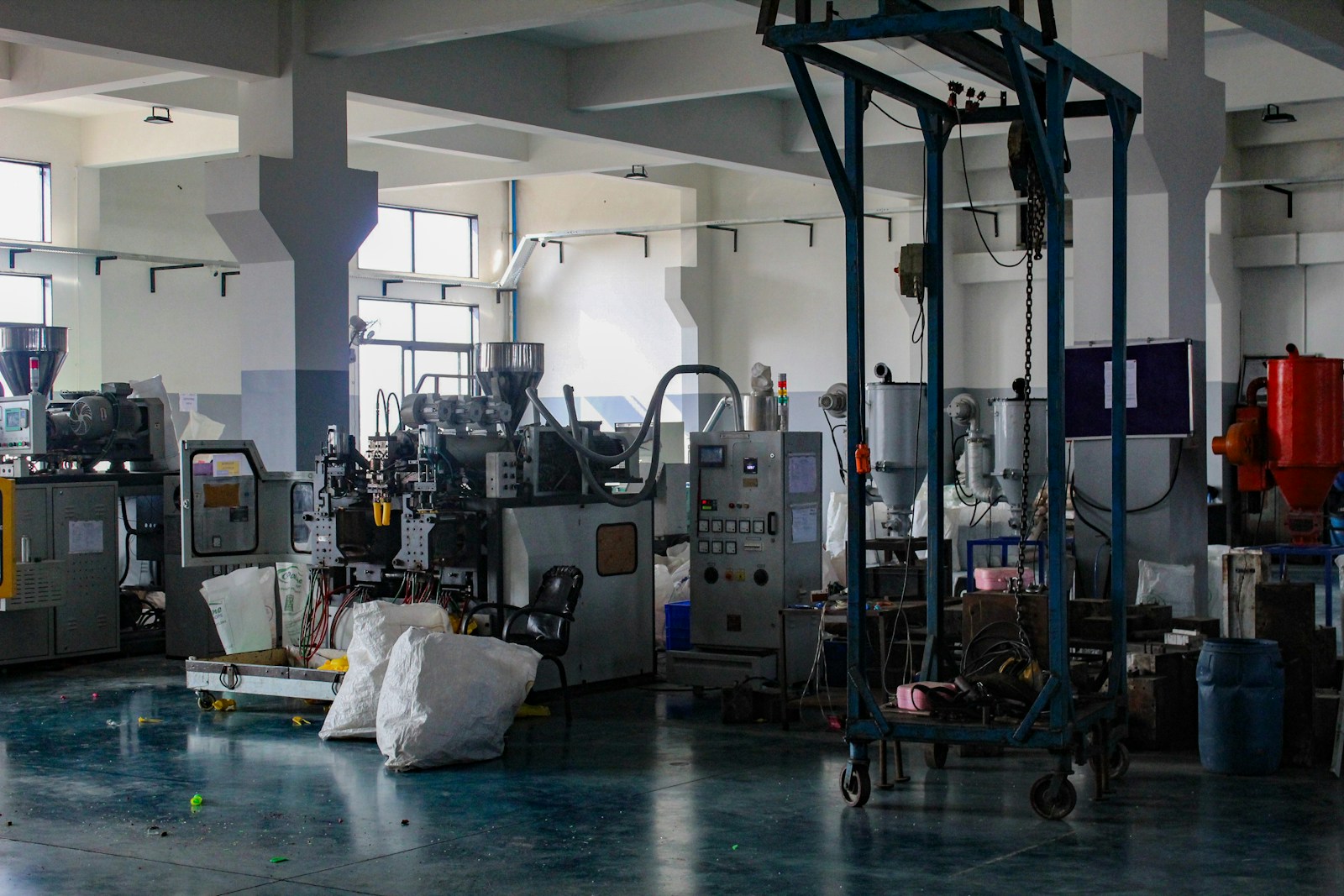
A small Indian factory floor, the MSME scale that owns most of India’s boilers. Photo by Aditi Toys on Unsplash.
The market, as always in this series, is not empty. Steamhouse India pioneered the community boiler here in 2014: one large, clean steam plant in an industrial estate, selling metered steam by pipeline to surrounding factories, so dozens of units retire their own small coal boilers. It runs facilities across Vapi, Ankleshwar, Sarigam, Nandesari and Panoli, and this September it went public, raising Rs 414 crore in an IPO that opened for bidding on 9 September. PRESPL sells steam-as-a-service from biomass: it designs, finances, builds, owns and operates the plant on the customer’s site. Voltanova, a Bengaluru deep-tech startup incubated at IISc, is building the thermal battery itself, with Rs 50 crore in orders reported in March 2025 and grant backing from Zerodha. Clear Energy will design, build, own and operate clean thermal assets on your premises, including electric boilers.
Nobody yet sells the sun by the kilogram of steam
Look at the gap. India’s steam-as-a-service players sell biomass. Its thermal-battery builders sell hardware. Epyr’s actual trick, storing electricity when the grid is giving it away and selling it back as process heat, has no named Indian operator I can find. Meanwhile the tariff tailwind is arriving: Gujarat this March extended its daytime solar discount window for industry by two hours, and Maharashtra’s regulator has made peak power costlier and solar hours cheaper. The midday electron is getting cheap exactly where the boilers are: Gujarat and Maharashtra are two of the top three boiler states.
Here is my hypothesis, and it is a hypothesis: the first Indian player to offer Epyr’s full shape, owned thermal storage plus a steam contract plus time-of-day arbitrage, will find its beachhead not in a greenfield plant but in a Gujarat industrial estate already used to buying steam by the kilogram from Steamhouse. The test is brutally simple and therefore worth running: price stored midday solar, delivered as steam at the factory header, against the going biomass rate, Rs per kg, in one cluster. If it wins in Vapi or Ankleshwar, 45,226 boilers stop being a census and start being a market.
Sources: Epyr Series A announcement; tech.eu; SlateVC investment note; iFOREST, Greening Industrial Steam (2025); Steamhouse India; Steamhouse IPO details; Voltanova; Industrial Automation India on Voltanova orders; Clear Energy; Times of India on Gujarat solar discounts; CareEdge on MERC ToD changes.
Responses
No responses yet - yours could be the first.
Get the notes
Occasional emails about what I'm building, what worked, and what broke.