
The Indian Canvas #149: Who Pays When the Power Company Can't?
Somewhere between the power grid and the meter on the wall sits a grey box on a pair of poles: the distribution transformer, part of the machinery that turns electricity into a bill. Behind that box stands a distribution company, and for the past two decades, India's distribution companies, taken together, have lost money year after year. In 2022-23, the all-India gap between what a unit of power cost to supply and what the utilities recovered, counting subsidy actually received and excluding regulatory income and takeover grants, was 50 paise.
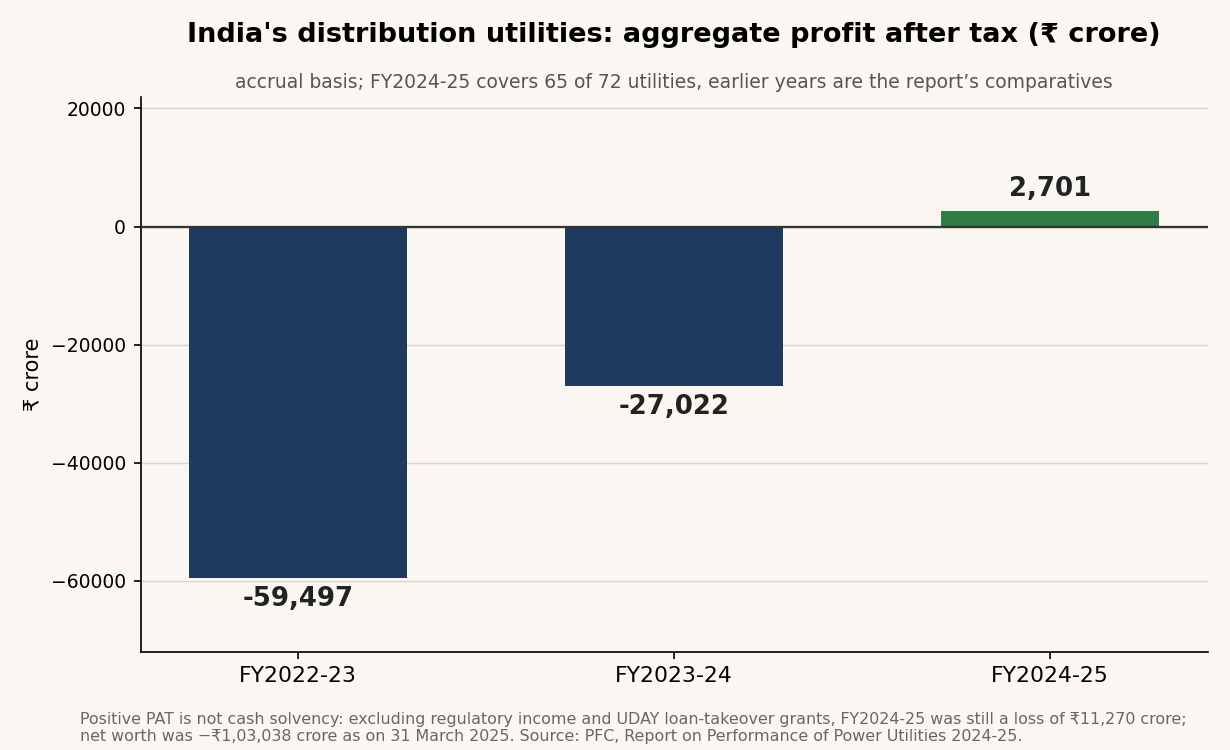
In 2024-25, that story bent. Power Finance Corporation's annual report on utility performance records an aggregate profit after tax of ₹2,701 crore across the distribution utilities it covers, against a loss of ₹27,022 crore the year before and ₹59,497 crore in 2022-23. The Ministry of Power told the Lok Sabha on 30 July 2026 that this was the first aggregate profit since the Electricity Act came into force in 2003.
Two caveats ride on that headline, and both come from the same PFC table. The profit is on an accrual basis, not cash solvency: the sector's net worth stood at negative ₹1,03,038 crore as on 31 March 2025, and its payables for power purchases stood at 113 days' worth. And excluding regulatory income and the revenue grants states booked under the UDAY debt takeover, 2024-25 was still a loss, of ₹11,270 crore. The turnaround is real; it is also thinner than the headline.
The hole underneath, as on 31 March 2025: ₹7,26,378 crore of outstanding debt, down from ₹7,58,996 crore a year earlier, and ₹6,47,210 crore of accumulated losses. These are aggregates across the 65 of 72 utilities the PFC report covers for 2024-25: 42 state discoms, 12 private discoms and 11 power departments. A hole that size does not close on its own. Someone has been paying to keep it from widening. The interesting question is who.
The first payer is the state budget, in the 2015 rescue. In November 2015 the Centre launched the Ujwal Discom Assurance Yojana. Participating states would take over 75% of their discoms' eligible debt as on 30 September 2015 by issuing state development loan bonds, and absorb future losses in a graded manner. It was voluntary: 27 states and five Union Territories signed up, Odisha and West Bengal among those that stayed out. Sixteen states actually issued the bonds, ₹2,34,862 crore worth, with Rajasthan alone accounting for ₹74,790 crore; states also ended up taking over ₹36,378 crore of discom losses, the ministry told Parliament on 30 July 2026. No UDAY bonds have been issued in the last three years.
The first payer, again, is the state budget, as standing subsidy. In 2024-25, utilities billed state governments ₹2,40,992 crore of tariff subsidy. By the PFC report's own measure, that billed subsidy equals 21.32% of utilities' total revenue, up from 19.97% the year before. The report records subsidy received from state governments at 98.90% of subsidy billed for the year; back in 2022-23 the same ratio was 108.57%, which shows it can include arrears from earlier years rather than only that year's invoices. Either way, billed tariff subsidy equal to roughly a fifth of reported total revenue is now a standing line in state budgets.
The second payer is the Centre, with strings. In July 2021 the Centre launched the Revamped Distribution Sector Scheme with an outlay of ₹3,03,758 crore and a committed central grant of ₹97,631 crore, aiming to pull aggregate technical and commercial losses to a pan-India band of 12-15%. Projects worth ₹1.53 lakh crore for loss reduction and ₹1.31 lakh crore for smart metering have been sanctioned, and, the part that matters, fund release is tied to each utility's operational and financial performance. The 2026-27 budget allocates ₹18,000 crore to RDSS, 60% of the power ministry's allocation, up 15% over the revised estimate. On smart metering, the pace is slower than the paper: 22 crore consumer meters sanctioned, 5 crore installed as of December 2025, or 23%. And PRS Legislative Research notes that the central grant of ₹900 per meter sits far below the discovered cost of ₹7,000 to ₹16,000 per meter, a gap financially weak discoms may be unable to bridge.
The third payer is the power producer, which carried the financing gap when discoms did not pay. Under the Electricity (Late Payment Surcharge and Related Matters) Rules notified on 3 June 2022, all dues to generators, traders and transmission companies up to that date, ₹1,39,947 crore, a figure that included the surcharge accumulated up to that date, were classified as legacy arrears and allowed to be liquidated in up to 48 monthly instalments; no further surcharge accrues on those old dues as long as instalments are paid on time. For fresh delays, the surcharge was cut from 18% to a rate linked to the bank lending rate, and continued default can bring graduated curtailment of a discom's access to power markets, per the Ministry of Power's own description of the rules. The framework is a repayment schedule, not a blanket principal write-off: the reported legacy balance fell to ₹3,330 crore as on 27 March 2026, tracked on the PRAAPTI portal. Asked why discoms delay payments at all, the ministry listed three reasons: regulators disallowing expenses the discoms incurred, the persisting cost-recovery gap, and delayed receipt of subsidy and government-department dues from state governments.
And the consumer's own bill sits inside every one of these settlements, which is where the accounting needs care. The average cost of supply in 2024-25 was ₹7.10 a unit. Counting tariff subsidy actually received from state governments and excluding regulatory income and UDAY grants, average revenue came to ₹7.04 against the ₹7.10 average cost, a gap of 6 paise, down from 20 paise in 2023-24 and 50 paise in 2022-23. That narrow gap counts the subsidy states pay, so it cannot show how much of the cost consumers' own payments cover. What it shows is the system as a whole, subsidy included, nearly breaking even per unit, the narrowest gap in the report's three-year window.
The composite loss measure improved too, more modestly. Aggregate technical and commercial loss, a composite measure of technical loss, billing inefficiency and uncollected bills that PRS defines as the share of power for which the distribution company receives no payment, stood at 15.04% in 2024-25, improved from 15.97% the year before and marginally above the 12-15% band RDSS is paying to reach.
Britain answers the same question differently, because it unbundled the wires from the retail seller decades ago. An Indian discom owns both jobs; in Britain they are two different businesses, and who pays depends on which one fails.
The wires are private regulated monopolies. Six distribution network operators running fourteen local networks work under Ofgem's RIIO-ED2 price control for 2023-28: the regulator fixes the revenue each network is allowed to collect five years ahead, recovered through a network charge on bills then averaging about £100 a year per bill-payer. The November 2022 settlement projected the charge would stay flat across 2023-28 while lowering investor returns. Consumers fund the wires through that regulated charge.
In the 2021-22 crisis, the failures happened on the retail side. When wholesale gas prices surged, twenty-eight suppliers failed between June 2021 and the NAO's June 2022 estimate. The National Audit Office estimated in June 2022 that those failures would cost customers £2.7 billion, recovered through the Supplier of Last Resort process, where Ofgem moves a failed supplier's customers to a surviving supplier, and through the failed suppliers' missed payments into government renewables schemes. That estimate is separate from Bulb's costs. About 2.4 million customers were transferred, and the NAO reported that Ofgem moved them without interruption to their supply; Citizens Advice estimated the move cost the average transferred customer £30 more a month for the duration of their original contract. The failure cost was mutualised across everyone's bills.
Then there was Bulb, with 1.5 million customers, too big for the last-resort process. On 24 November 2021 it entered a special administration, the state running a failed retailer as a going concern. The NAO's March 2023 investigation records gross taxpayer funding of £3.02 billion as of 31 January 2023, with Octopus Energy paying £113 million for Bulb's customer book. The repayment plan, as the Public Accounts Committee recorded in 2023, was for Octopus to repay £2.96 billion by September 2024, with the remaining shortfall, then estimated at £246 million including accrued interest, to be recovered from energy consumers. Those are 2023 projections, not a final accounting; the point here is the design. Britain did reach for the taxpayer, but wrote the rescue so the bill comes back to bill-payers.
Set the two systems' rescue mechanisms side by side and the contrast is in who is designed to absorb the shortfall. India's rescues have run through state budgets: ₹2,34,862 crore of takeover bonds, ₹36,378 crore of absorbed losses, and billed tariff subsidy the PFC measures at 21.32% of utility total revenue. Britain's 2021-22 rescues were designed to land mostly on the market and the customer: retail failure costs pooled across bills, and the taxpayer's Bulb funding expected to be repaid by the buyer, with only the residual shortfall, then estimated at £246 million, to come from bill-payers. Neither British business maps neatly onto an integrated Indian discom; the mechanisms differ because the structures differ.
So the honest reading of India's first profit since 2003 is a conditional one. It is ₹2,701 crore across the 65 utilities the report covers, on an accrual basis, with grants included. The debt remains ₹7.26 lakh crore. Alongside the headline, the plumbing has changed: legacy dues rescheduled instead of silently rolled over, central grants tied to performance, billed subsidy largely received, and the per-unit recovery gap, subsidy included, down to 6 paise. Whether the hole stays shallow depends on things no profit announcement settles: whether billed subsidy keeps being received at recent rates, and whether the 15.04% composite loss can be pulled into the 12-15% band. The grey box on the poles stays where it is. Whose budget stands behind it is still being decided, one instalment at a time.
Sources
Power Finance Corporation, Report on Performance of Power Utilities 2024-25 (debt, accumulated losses, PAT, subsidy, ACS-ARR gap, AT&C, as on 31 March 2025)
Lok Sabha Unstarred Question No. 2025, answered 30 July 2026 (UDAY bonds and losses taken over)
Lok Sabha Unstarred Question No. 2032, answered 30 July 2026 (RDSS outlay, grant, sanctions)
Lok Sabha Unstarred Question No. 2063, answered 30 July 2026 (AT&C trend; first profit since the Electricity Act, 2003)
Lok Sabha Unstarred Question No. 6283, answered 2 April 2026 (LPS Rules, legacy dues, delay reasons)
Press Information Bureau, Ministry of Power year-end review, 27 December 2022 (LPS Rules mechanism: 48 instalments, surcharge waiver on legacy dues, bank-linked rate, supply regulation)
PRS Legislative Research, Demand for Grants 2026-27 Analysis: Power (RDSS budget, smart-meter status and grant-cost gap)
UK National Audit Office, The energy supplier market, 22 June 2022 (28 failures, £2.7 billion, 2.4 million customers)
UK National Audit Office, Investigation into Bulb Energy, March 2023 (special administration, £3.02 billion gross)
House of Commons Public Accounts Committee, Bulb Energy, 2023 (£2.96 billion repayment expectation, £246 million shortfall to be recovered from consumers)
Ofgem, RIIO-ED2 price control for 2023-2028, 30 November 2022 (network charge, investor returns)
Cover photo: TNEB distribution transformer, Nilgiris, by Timothy A. Gonsalves, CC BY-SA 4.0, via Wikimedia Commons. Body photo: National Grid pylons at sunset, by Geoff Trim, CC BY-SA 2.0, via geograph.org.uk and Wikimedia Commons.
Responses
No responses yet - yours could be the first.
Get the notes
Occasional emails about what I'm building, what worked, and what broke.