
The Indian Canvas #39: Indian insurers disallowed Rs 15,100 crore of health claims. Who checks the bill first?
In FY2023-24, Indian insurers disallowed Rs 15,100 crore of health claims under policy terms and repudiated another Rs 10,937 crore, according to a Lok Sabha reply built on IRDAI data. Nobody in that reply says how much of it started as a billing or coding error at the hospital. In Munich, calliora raised USD 6 million to catch such gaps before the invoice goes out. India is not empty here, and the hypothesis I would test is the small hospital, not the big chain.
Deductions outweigh rejections
Annexure-I to a Lok Sabha reply of 3 February 2025, citing the IRDAI annual report for FY2023-24, lists health claims "disallowed as per policy terms" at Rs 15,10,041.80 lakh, which is Rs 15,100 crore. Claims repudiated outright come to Rs 10,93,717.75 lakh, or Rs 10,937 crore. Health premium in the same table is Rs 1,07,681 crore.
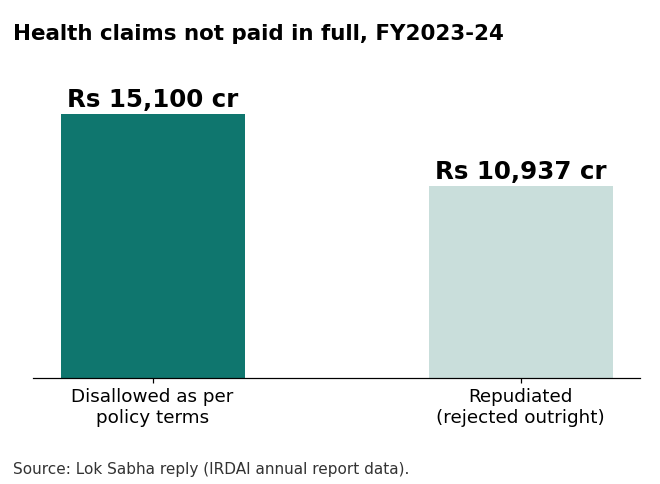
Chart by me from the reply. The axis starts at zero. I do not know how much of either figure a hospital could have avoided, so I do not claim any.
The partial deductions are the larger number. The reply does not say why claims were disallowed, so the cause of a deduction is unknown from this table.
The regulator does not see the reason
A Lok Sabha reply of 24 July 2026 says IRDAI captures overall repudiation data but not a split by specific grounds such as non-medical necessity or exclusion. It also says there is no proposal to give the treating doctor an overriding say. So the country's own figures cannot tell a hospital what to fix. That is a gap in public data, and I am not claiming that no private data exists.

Stock photo of a desk with a calculator and papers. Not a hospital billing office.
What calliora does in Germany
Germany gives hospitals a hard reason to care. The Federal Health Ministry's press release of 10 July 2026 on the law passed by the Bundestag raises audit quotas: a hospital with 50 to 65 per cent of invoices unobjected faces audits on 40 per cent of cases, and below 50 per cent the number is unlimited. I checked the thresholds against that release because older write-ups of this law gave different ones.
calliora, founded in Munich, announced its pre-seed round of USD 6 million on 6 October 2026, co-led by Bertelsmann Healthcare Investments and redalpine. redalpine confirms the lead in its own post and on its portfolio page. Per that post, the product follows each case from admission to closure and flags gaps such as uncoded diagnoses and missing evidence before the invoice. The company says its platform is live in a number of hospitals, that effort per case is down by more than half, and that over 90 per cent of gaps are closed before invoicing. All of that is company-reported.
India is not empty
I checked four Indian players on their own sites. Every number below is company-reported.
AuditorX is the closest match: it claims 99 per cent acceptance, more than Rs 500 crore of claims audited, over 60 hospitals and more than 10 panels and schemes. ClaimBook reconciles claims against NHCX, RGHS and CGHS from a billing export, and says it keeps no claim data beyond the session. IHX offers one login to over 30 insurers, TPAs and schemes, and says a team of three or four now needs one person. YIRA MedSense reads medical documents for insurers, TPAs and hospitals, and claims more than one lakh documents parsed and over 5,000 fraud cases flagged.
Some of these appear to work on the claim after it is built, or on the insurer side. I did not test any of them.
Who pays, and where it could fail
My hypothesis: the buyer is a mid-sized or small hospital that files claims across many schemes and insurers and has no revenue-cycle team. The missing piece would be a pre-invoice check tied to each case from admission, as in the German product, priced to a hospital with thin margins. This is not surveyed. A hospital of that size may not buy software at all, and the four players above may already cover it.
The German pull is a law with audit penalties. I did not find an equivalent Indian penalty on hospitals for billing errors, so the demand here would come only from lost money on deductions. Any price I would try is a test assumption, not a market price.
What I would do first
Ask ten small hospitals what share of their last quarter's claims came back with a deduction, and what reason the insurer wrote. If most cannot answer, that is the product. If AuditorX already sells to them, the idea is a niche, not a gap.
Sources and photo credits
Lok Sabha reply, 3 Feb 2025, Lok Sabha reply, 24 Jul 2026, Federal Health Ministry release, redalpine post, redalpine portfolio, company sites linked above. Photos on Unsplash with no stated location: cover by Szabolcs Antal (@szabolcsantal), empty hospital hallway with rows of chairs; body by Cht Gsml (@karepesinde), desk with calculator, charts and binders. Free to use under the Unsplash License. This is a research view, not a proven business.
Responses
No responses yet - yours could be the first.
Get the notes
Occasional emails about what I'm building, what worked, and what broke.