
The Indian Canvas #91: A Chennai cemetery numbered 20,000 graves by hand. Who keeps the record?
The Constitution lets states entrust your municipality with both the burial ground and the death record. A court is now asking a city to show the ground. Someone has to build the register.
In Chennai's Kilpauk, one of the city's oldest and biggest cemeteries was reported in late 2025 to be finishing an unusual exercise: numbering its graves by hand. The 15-acre cemetery has been divided into 34 zones of about 600 graves each - roughly 20,000 plots - so that families can find their dead without depending on a staff member's memory. Alongside the paint, the Madras Cemeteries Board Trust was documenting and digitising the records of every family that holds a grave. It is 2026, and one of India's largest cities is just now learning who is buried where.
Kilpauk is not behind. Kilpauk is ahead.
The last address has no register
Item 14 of the Constitution's Twelfth Schedule lists "burials and burial grounds; cremations, cremation grounds; and electric crematoriums" among the subjects a state may entrust to municipalities under Article 243W. Item 16 lists vital statistics, including registration of deaths. The same schedule, in other words, lets a state hand your city both the ground and the record. The ground gets run; the record, too often, gets lost.
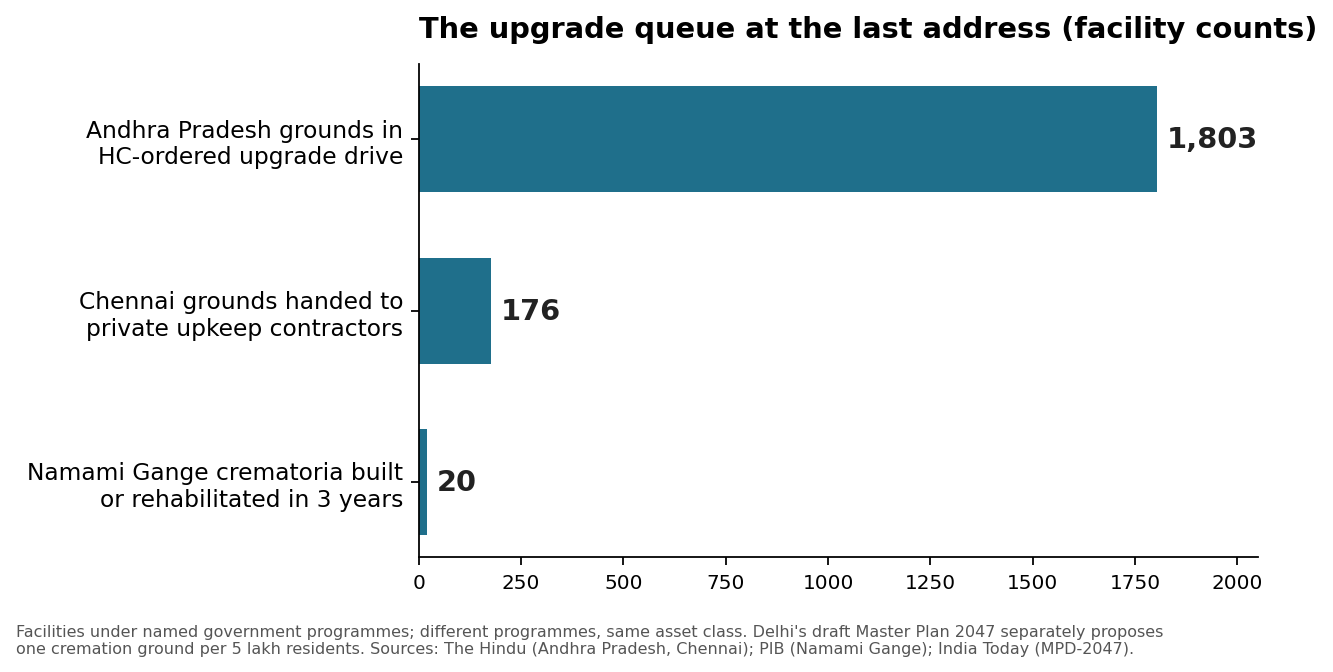
The consequences are now reaching courtrooms. In September 2026, the Delhi High Court told the Municipal Corporation of Delhi that arranging space for last rites is one of its primary statutory functions, hearing a plea that says Delhi's Christian cemeteries - Burari, Patel Chest, Paharganj, Mangolpuri, Prithviraj Road - are full, and that families are transporting bodies to neighbouring states for burial. The court asked the MCD to list its Christian cemeteries and the space left in them. In Andhra Pradesh, a High Court PIL pushed the state into a drive to upgrade 1,803 burial and cremation grounds across its urban local bodies, with the government conceding that maintenance is a statutory responsibility under municipal law and the Twelfth Schedule.
Delhi's own planning answer is in its draft Master Plan 2047, cleared by the DDA board in 2026: one cremation ground for every five lakh residents, one burial ground for every ten lakh, time-bound upgrades of existing grounds, and a push toward gas-fired and electric crematoriums. Under Namami Gange, a 2022 PIB release counted 20 crematoria built or rehabilitated over the preceding three years along the river towns.
So the queue is real: constitutional backing, court orders, master-plan norms, and upgrade money, all pointing at the same under-instrumented asset.
Chennai pays Rs 40 crore a year. The tender is a roadwork template.
Look at how the money flows. After ward committees complained about hygiene, the Greater Chennai Corporation folded the upkeep of 176 burial grounds across the city into its privatised solid-waste contracts. Under the new contracts, Chennai Enviro Solutions maintains 87 grounds across four northern zones for Rs 1.22 crore a month, and Urbaser Sumeet maintains 89 more across seven southern and central zones for about Rs 2.1 crore a month. Call it Rs 40 crore a year, for one city, for contractors whose core competence is garbage.
And the procurement paper trails behind the money. In October 2026, the New Indian Express found that Chennai's 110-page operation-and-maintenance tender for an LPG crematorium in Ambattur zone is a generic template - it covers bridges, stormwater drains and road relaying, and says nothing about the crematorium. A second tender was floated without even the title of the work.
This is the pattern: cities are paying serious money to private operators for a service that has no records layer, no asset register, no compliance format. The contractor inherits a ground with no reliable list of who is buried in it, no plot map, no furnace log, and a monthly invoice that depends on proving work nobody can verify.
The global model is a records business, not a funeral business
The company that saw this early is not a funeral company. PlotBox, from Ballymena in Northern Ireland, sells cloud software that runs cemeteries, crematoria and funeral homes: digital maps of every plot, the burial register, the contracts, the scheduling, the finance. It has about 120 people, teams in the US and Australia, and partnerships with America's largest funeral consolidators. In April 2025, growth investor Serent Capital took a stake to scale it. The insight PlotBox monetised: a cemetery is a real-estate ledger with emotions attached, and most of the world's ledgers are paper.
India's queue is forming. Who is in it?
The consumer side of Indian deathcare is already served: Last Journey, Anthyesti and Mokshshil will arrange your funeral, and cities like Bengaluru and Indore let you book a cremation slot online. Equipment makers will sell the municipality an electric furnace. But the operator's desk - the register, the plot map, the compliance file - is nearly empty.
Two early movers are worth naming. GraveLedger, a young Indian venture, wants to fit every grave with a durable QR-tagged identification pole and build the digital burial register on top, selling traceability to cemetery trusts and a centralised burial database to municipal corporations. Its site cites its own estimates - a third of burial records missing or incomplete, graves reused for a decade or two without tracking - and names no customers or funding yet. Opsintech, an Indian software firm, sells a cemetery register product to parishes and cemetery offices. Neither company shows a municipal-scale deployment on its site. That is the gap.
The blueprint: sell the register before the ground runs out
If I were building this, I would not start with families or funerals. I would start with the contractor.
Step one: the O&M evidence layer. The Chennais of India are signing monthly-fee upkeep contracts with waste firms that have no deathcare systems. Sell the contractor a simple operations app: geotagged plots, work logs, photo proof, grievance tickets, and a monthly compliance report the corporation can actually audit. The contractor pays because the report is what gets their invoice cleared.
Step two: the municipal register. Digitise the burial register and plot map as a paid project, then charge an annual licence. The pitch writes itself from the news: when the High Court asks your city to list its cemeteries and the space left in them, you want to press a button, not form a committee. Master-plan norms - one cremation ground per five lakh people - become a gap report the software generates.
Step three: plot reuse and space recovery. India's burial-space crisis is partly a records crisis: graves are reused informally because nobody tracks tenure. A trusted register makes lawful, dignified reuse administrable - which is how a land-locked city finds "new" space without finding new land. This is the hardest, most sensitive part of the product, and the part with the biggest payoff.
Step four: the furnace as an asset. Electric and LPG crematoria are machines that break down at the worst possible moment. Once the register is in, add asset management: furnace uptime, service schedules, emission checks. The roadwork-template tender shows nobody is speccing this today.
The moat is the register itself: once a city's dead are indexed in your system, nobody rips it out. The honest risks are procurement - municipal tenders are slow, badly written, and priced for garbage contractors - and religion: many grounds are run by churches, trusts and waqfs, not the corporation, so the buyer fragments. I would price the contractor app at a per-ground monthly fee and the register as a digitisation project plus licence; those numbers are a hypothesis to test with one zone of one corporation, not a forecast.
The first call I would make is to the Madras Cemeteries Board Trust. They are already numbering 20,000 graves by hand. Offer to do it in weeks, keep every number, and hand them the register the Constitution says was always their job.
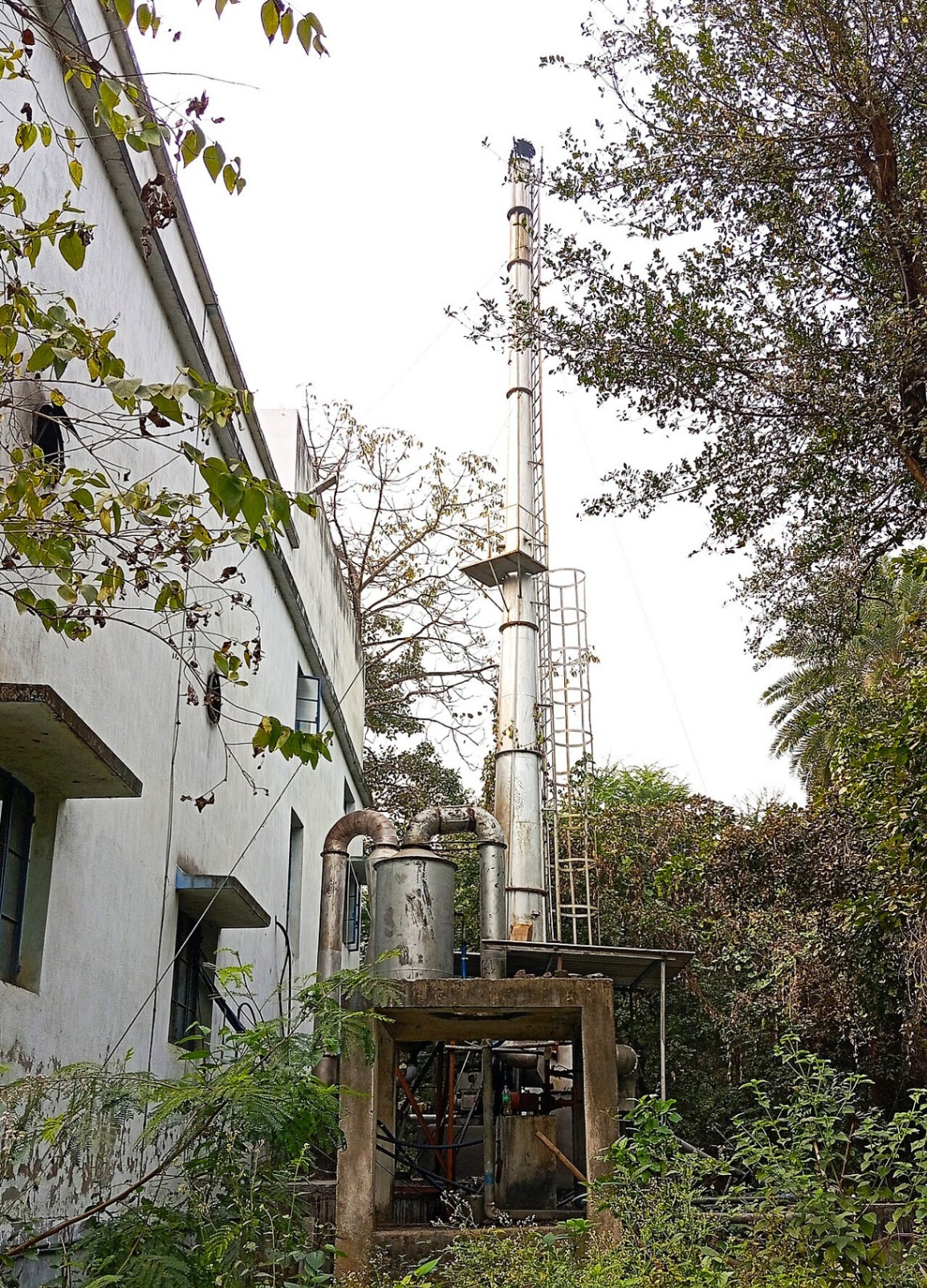
Sources: The Hindu on Kilpauk Cemetery's grave-numbering exercise; the Twelfth Schedule of the Constitution; New Indian Express on the Delhi High Court's direction to the MCD; The Hindu on Andhra Pradesh's 1,803-ground upgrade drive; India Today on the Master Plan Delhi 2047's crematorium norms; The Hindu on Chennai's privatised burial-ground upkeep; New Indian Express on the crematorium tender template; PIB on Namami Gange crematoria; Serent Capital on investing in PlotBox; GraveLedger and Opsintech's cemetery product. Cover photo: the Shahar Bangla Muslim Burial Ground in Kolkata, by Indrajit Das, CC BY-SA 4.0, via Wikimedia Commons. In-article photo: the air-pollution-control system of an electric crematorium at Domohani Burning Ghat, by Salil Kumar Mukherjee, CC BY-SA 4.0, via Wikimedia Commons. Both are illustrative; neither shows a family or a funeral.
The business described above is a hypothesis. The regulations, the court cases, the contracts and the spending are real and linked above.
Responses
No responses yet - yours could be the first.
Get the notes
Occasional emails about what I'm building, what worked, and what broke.